

Key Insights:
|
|
|
Setting the Stage: Circularity and the Low Carbon Transition
At COP31 in Antalya, Türkiye, we expect circularity to emerge as an important decarbonization lever to watch. According to the Ellen MacArthur foundation: “A circular economy tackles the 45% of global greenhouse gas emissions that renewable energy and energy efficiency alone cannot fix—specifically from making materials like steel, cement, and plastics, and managing food systems. By replacing ‘take-make-waste' with reuse, repair, and recycling, it slashes primary resource extraction and keeps embodied carbon locked in circulation.”1
In this article, we analyze sectors with high risk exposure to products and materials that are subject to existing and upcoming circularity regulations. The ability to manage operational carbon emissions alone does not address transition risks. For many industrial and manufacturing industries, we see circularity emerging as a new transition gap.
It is then not surprising that the concepts of zero waste and circularity remain prominent in discussions on how to transition to a lower carbon economy. Antalya’s COP31 presidency has laid out targets to “bring zero waste to the center of climate action, advance green industrialization and support the circular economy by increasing the global circular material use rate to at least 15 percent.”2
At the same time, national and international regulatory regimes on eco-design and circularity continue to evolve and gain traction, pushing for approaches to product, service, or building development that integrate environmental considerations into every phase of their life cycles. In June 2026, China released its 15th Five-Year Plan for Circular Economy Development, promoting targets for 2030 aimed at promoting green product design and advancing cleaner production and consumption.3 In Europe, the European Commission is expected to adopt the EU Circular Economy Act with rules aimed at boosting the adoption of circular solutions, such as high-quality recycled materials and refurbished products.4
Against this backdrop, we use Morningstar Sustainalytics’ ESG Risk Rating research to cross-examine how selected industries are prepared to manage operational emissions and circularity initiatives on their journey to achieve net zero. Additionally, we provide an industry comparison, where containers and packaging emerges as a leader.
Cross-Issue Comparison
We use Morningstar Sustainalytics’ Environment and Social (E&S) Impact of Products and Services material ESG issue (MEI) as a starting point to examine how corporate management capabilities compare across different aspects of the circularity transition. This MEI captures how a company manages the environmental and social impacts stemming from its products and services, from design choices to disposal. We also look into the Raw Materials Use MEI, which focuses more narrowly on input materials’ recycling, reuse and innovation, especially the critical ones. We focus on industries where both E&S Impact of Products and Services (specifically the circularity aspect) and the issue of Carbon – Own Operations are considered material, allowing us to compare companies’ management of the more established operational carbon challenge with their management of product- and material-related impacts.
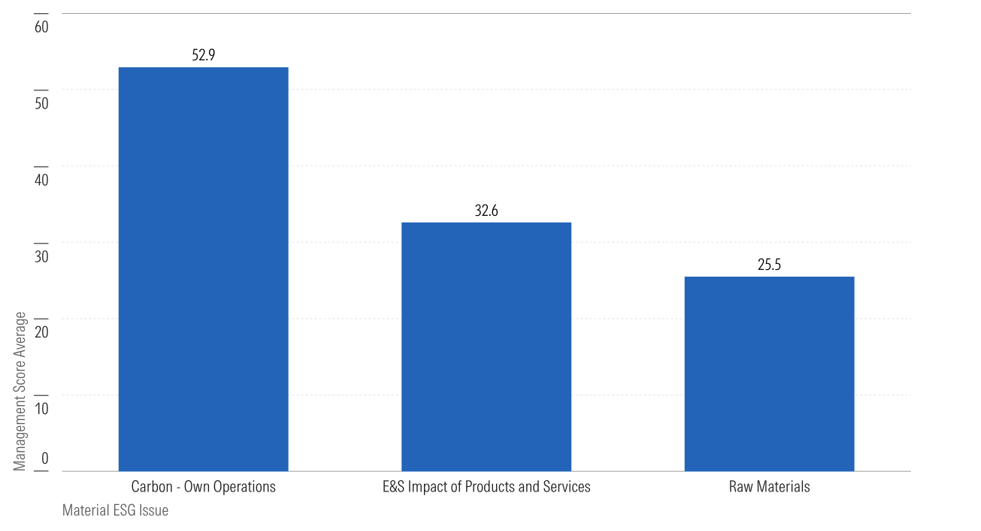
Figure 1. Average Management Score Across Circularity-Related Material ESG Issues
Source: Morningstar Sustainalytics.
We research these two MEIs through indicators that show climate mitigation potential. In the case of Carbon – Own Operations, we use indicators such as greenhouse gas reduction programs, carbon intensity, or renewable energy use, which provide an accurate estimation of how selected industries manage their exposure to operational emissions. For E&S Impact of Products, we use indicators such as end-of-life product stewardship programs, recycled material use, recycled materials programs, sustainable products and services, eco-design, and supplier environmental policy. All these indicators reflect a company’s actions to minimize resource inputs, extend product lifespan, promote recycling, and retain materials, which are activities that severely cut emissions before, during, and after product use.
The initial comparison shown in Figure 1 points to a sizable disconnect between the management of greenhouse gas emissions from operations and the management of circularity-related initiatives. Across these industries, companies’ management of Carbon – Own Operations is strong. Specifically, this measures companies’ disclosure and preparedness to deal with transition risks as it relates to their scope 1 and 2 emissions, as well as their carbon intensity and general environmental management programs. This compares to only average management for E&S Impact of Products and Services, which covers eco-design programs, the share of sustainable revenue, supplier environmental programs and share of recycled material use, among others. The comparison also shows weaker management of raw materials, which measures preparedness in terms of recycled material commitments and programs, or recycled material innovation programs, especially critical materials. In other words, companies appear substantially better equipped to manage carbon emissions arising from their own operations than the product and material challenges associated with a more circular economy.
Strong operational carbon management therefore does not necessarily translate into equally developed capabilities further along in the circularity challenge. Where the carbon transition requires changes to product design, increased use of recycled material inputs, and end-of-life product stewardship programs, there remains a significant opportunity for companies to implement initiatives and demonstrate leadership in the transition to a low carbon economy.
Industry Differentiation: Containers and Packaging Emerging as a Leader
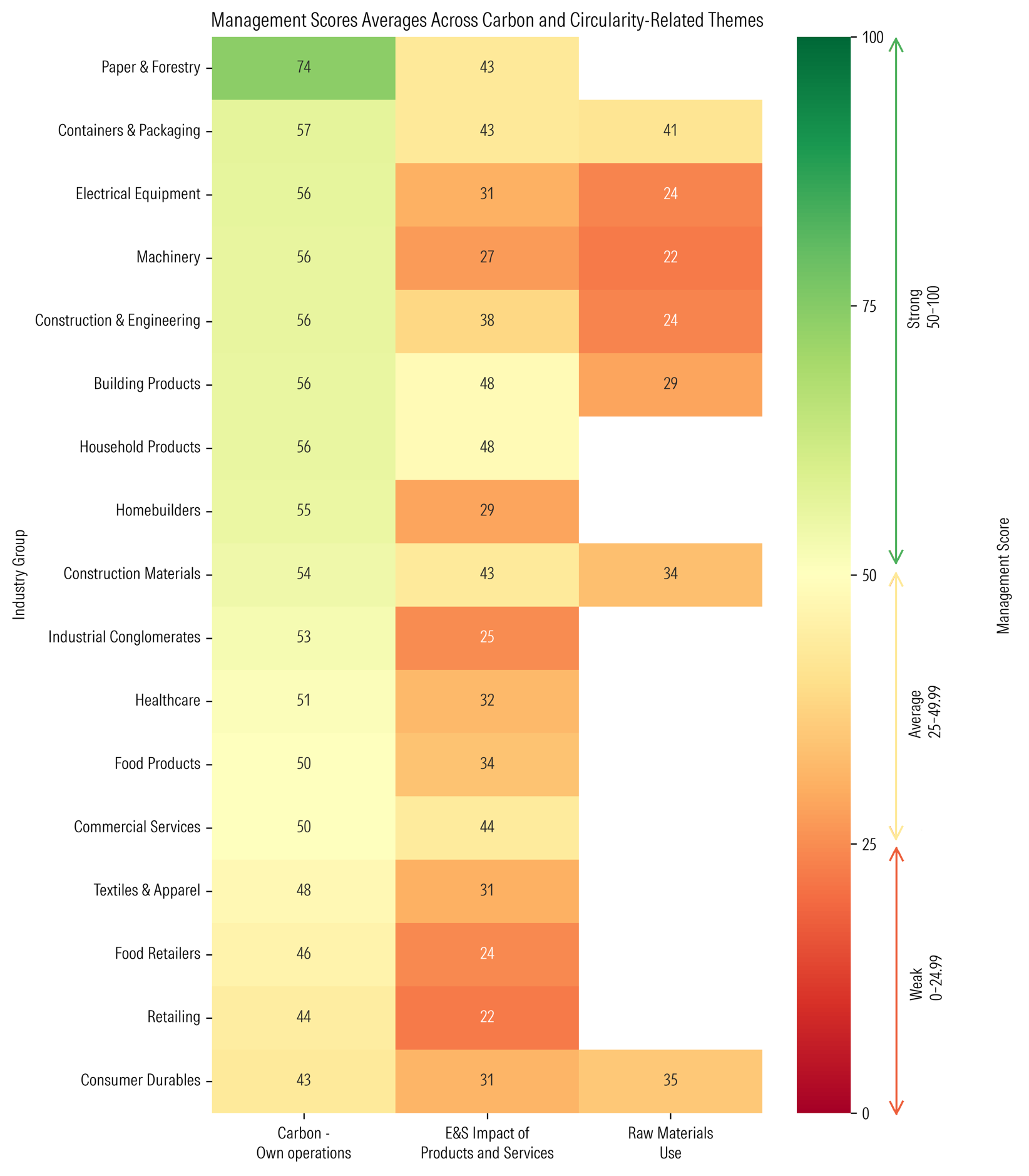
In industries where products, packaging materials and their end-of-life impacts are closely connected to the circularity challenge, management capabilities extend more clearly beyond operational carbon. However, this connection is not uniform across industries (see Figure 2).
Figure 2. Management Scores Averages Across Carbon and Circularity-Related Themes
Source: Morningstar Sustainalytics.
The containers and packaging industry provides a useful example of comparatively developed circularity-related management. Its average E&S Impact of Products and Services score reaches 43, which is relatively close to its Carbon – Own Operations score of 57. Its Raw Materials Use score of 41 is also the highest among other industries.
Based on Morningstar Sustainalytics’ data, companies in this industry tend to have:
- More mature eco-design program, which take into consideration the impact of input materials across the products’ lifecycle in the research and development stage, along with targets, deadlines and continuous monitoring.
- More robust end-of-life product stewardship programs, such as take-back or remanufacturing initiatives with targets and deadlines.
- A generally higher recycled material content: 30% recycled material on average out of total input material compared to an average 20% in our research universe.
The picture is markedly different across several industries. Machinery, industrial conglomerates and electrical equipment all have relatively strong Carbon – Own Operations management scores of 53–56 on average, but substantially lower E&S Impact of Products and Services management scores of only 25–31. Therefore, these industries show some of the largest carbon-circularity gaps in the analysis. This reinforces the broader finding that relatively developed carbon management does not necessarily imply comparable capabilities to address product- and material-related transition challenges.
For companies in the industrials sector, this gap becomes particularly relevant when considering their higher dependence on critical input materials, such as copper, or materials that proved particularly vulnerable to supply chain and geopolitical risks recently, such as steel and aluminum. Where the MEI Raw Materials Use is even more material, the management scores provide an additional indication of limited management capabilities: the machinery industry scores just 22 and electrical equipment 24. This dimension adds to the circularity challenges for companies in these sectors.
References
- Ellen MacArthur Foundation. “Tackling Climate Change with Circular Solutions.” Accessed November 04, 2026, https://www.ellenmacarthurfoundation.org/topics/climate/overview.
- United Nations Climate Change. 2026. “COP31 Presidency Announces New Targets on Global Electrification, Cutting Waste, Resilient Cities.” June 9, 2026. United Nations press release. https://unfccc.int/news/cop31-presidency-announces-new-targets-on-global-electrification-cutting-waste-resilient-cities.
- Ellen MacArthur Foundation. 2026. “The Circular Economy, Critical Minerals, and Climate Action.” June 29, 2026. https://www.ellenmacarthurfoundation.org/news/the-circular-economy-critical-minerals-and-climate-action.
- Ellen MacArthur Foundation. 2026. “The EU Circular Economy Act: A Critical Opportunity.” April 19, 2026. https://www.ellenmacarthurfoundation.org/the-eu-circular-economy-act/overview.
- European Environment Agency. 2026. “Assessing the climate mitigation potential of the circular economy.” February 19, 2026. EEA Briefing. https://www.eea.europa.eu/en/analysis/publications/assessing-the-climate-mitigation-potential-of-circular-economy.