Key Insights:
|
|
Per- and polyfluoroalkyl substances (PFAS), often referred to as "forever chemicals," have become a significant sustainability-related risk for companies. For investors monitoring such risks, corporate reporting provides only part of the picture. Litigation, regulatory action, and controversy incidents can reveal developing risks before their financial effects are quantified in company disclosure. Regulatory restrictions are expanding in some regions, litigation has spread beyond chemical manufacturers, and remediation obligations and personal-injury claims have produced multibillion-dollar liabilities. Yet one of the most important challenges for investors is recognizing that corporate disclosure alone may not provide a reliable picture of that risk.
Morningstar Sustainalytics’ recent research report, Forever Chemicals: Evaluating Risk Beyond Reported Liabilities, examines how investors can use corporate disclosure alongside controversy incidents to assess PFAS exposure. The report was published before 3M announced its November 2026 agreement to resolve most US personal-injury claims associated with aqueous film-forming foam (AFFF). The settlement adds an important new example for investors assessing how PFAS-related litigation can translate into financial exposure.
PFAS Exposure Extends Across Industries
Corporate PFAS reporting remains uneven. Some companies provide extensive information on litigation, remediation, and potential financial liabilities, while others disclose relatively little. With no globally standardized framework requiring companies to report PFAS use, contamination or related liabilities, investors can face very different levels of information when assessing companies with potentially similar exposure.
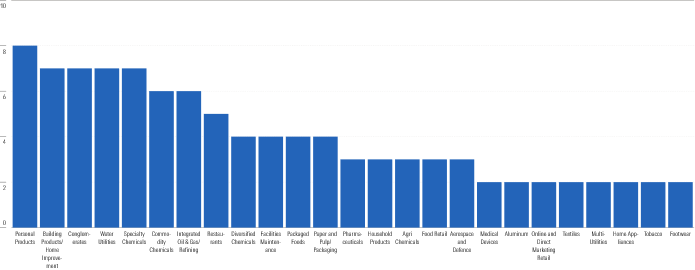
The issue is becoming more difficult to overlook. Morningstar Sustainalytics’ Controversies Research identified 469 PFAS-related incidents involving 110 companies across 49 subindustries during the most recent three-year period covered by our research.1 The incidents extend well beyond companies that manufactured PFAS. They reach companies that incorporated the chemicals into products and, in some cases, businesses further downstream that handled PFAS-containing materials.
Figure 1. Number of PFAS Incidents by Industry
Source: Morningstar Sustainalytics. Data as of February 26, 2026.
Figure 1 highlights industries where PFAS incidents affect multiple companies, illustrating how PFAS exposure extends well beyond chemical producers. It does not show every industry in which PFAS incidents were identified; industries represented by only one company are excluded for readability.
The 3M Example: From External Signals to a Quantified Settlement
In 2023, 3M entered a settlement with US public water systems with a nominal ceiling of USD 12.5 billion and a present value of up to USD 10.3 billion.2 That agreement focused principally on drinking-water claims rather than personal-injury claims. 3M reached an agreement in November 2026 covering most of the personal-injury claims connected to the federal multidistrict litigation (MDL). The agreement applies to claims against 3M; litigation involving other defendants in the MDL continues separately. The company valued its nine-year commitment at USD 5.8 billion on a present-value basis, equivalent to USD 7.35 billion in nominal payments. That total includes USD 680 million set aside for claims not otherwise resolved through the agreement.3 4
The settlement reduces uncertainty related to personal injury cases, but it does not eliminate 3M’s PFAS exposure altogether. The company also continues to face remediation obligations and other legacy PFAS claims. For example, 3M still faces claims outside the US and claims by non-public water systems.
Before the settlement supplied a company-reported financial amount, litigation had already provided information about the nature of the allegations, the products involved, and the number of claimants. This does not make litigation a substitute for corporate reporting, but it shows why external signals are important when financial exposure has not yet been quantified.
Companies vary considerably in the amount and type of PFAS-related information they disclose. For example, 3M and Chemours provide extensive reporting on PFAS litigation and settlement obligations, while Daikin’s disclosures focus more narrowly on certain regulatory and remediation matters. However, disclosure volume alone is not a reliable basis for comparison. Extensive reporting may reflect significant liabilities, a higher degree of transparency, or a combination of both, while more limited disclosure can leave key issues less clear. To supplement company disclosures, Morningstar Sustainalytics’ controversy monitoring provides an additional source of information on PFAS-related incidents and related risks.
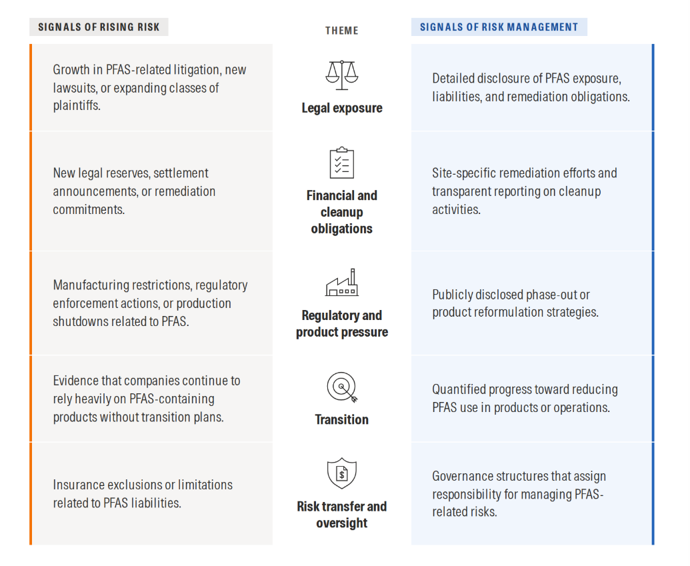
No single signal provides a complete assessment of PFAS exposure. Figure 2 groups the signals that investors can monitor into five themes and distinguishes evidence of rising risk from evidence that a company is actively managing it. The comparison is important because additional disclosure may reflect either increasing liabilities or stronger preparedness, depending on what the company reports.
Figure 2. Signals to Monitor: Increasing PFAS Risks or Improving Readiness
Building a More Complete Picture of PFAS Exposure
Litigation remains one of the clearest external signals in our PFAS data. Approximately 90% of PFAS-related incidents identified by Morningstar Sustainalytics were triggered by litigation, compared with about 7% by investigations. Court proceedings can provide information about the plaintiffs seeking redress, the products involved, and the locations from which claims are emerging.
Regulatory developments can also alter the economics of continued PFAS use through monitoring requirements, product restrictions or substitution, and their significance can vary considerably by geography. In Europe, anticipated regulatory restrictions can accelerate the need to identify PFAS uses and find substitutes,5 while the fragmented US regulatory landscape can expose companies to changing state requirements alongside litigation.
Company reporting can then provide evidence of how these pressures are affecting the business. New or increasing litigation reserves, remediation commitments or changes in insurance coverage can indicate growing financial exposure, while product reformulation and defined phase-out timelines can show how a company is responding to PFAS-related pressures.
Taken together, these indicators help investors distinguish between the existence of PFAS exposure and a company’s readiness to manage it. Repeated claims tied to similar products or facilities may point to a developing liability pattern, while financial provisions, remediation plans, and measurable phase-out targets show how far that risk has entered into corporate decision-making. The absence of such disclosure does not establish that exposure is low; it may simply leave investors with less information on which to assess it.
The 3M settlement provides greater clarity around one company’s PFAS personal-injury exposure, but it does not bring this type of litigation to an end. Other companies continue to face personal-injury claims for which the eventual financial consequences remain uncertain. Litigation and controversy activity can therefore provide an early signal of potential PFAS-related liabilities, even before their full scope and financial implications can be quantified.
Download the full report here: Forever Chemicals: Evaluating Risk Beyond Reported Liabilities.
References
- Morningstar Sustainalytics, Controversies Research, PFAS incident dataset, data as of February 26, 2026.
- 3M Company. 2024. “3M Settlement with Public Water Suppliers to Address PFAS in Drinking Water Receives Final Court Approval.” April 1, 2024. Press Release. https://investors.3m.com/news-events/press-releases/detail/1836/3m-settlement-with-public-water-suppliers-to-address-pfas.
- 3M Company. 2026. “3M Reaches Broad Resolution of AFFF Personal Injury Litigation.” November 3, 2026, 3M News Center. https://news.3m.com/2026-11-03-3M-Reaches-Broad-Resolution-of-AFFF-Personal-Injury-Litigation.
- US Securities and Exchange Commission. 2026. 3M Company, Current Report on Form 8-K. November 3, 2026. https://www.sec.gov/Archives/edgar/data/66740/000006674026000318/mmm-20261103.htm.
- European Chemicals Agency. 2026. “ECHA’s Update on the REACH Restriction on PFAS.” June 11, 2026. https://www.efsa.europa.eu/sites/default/files/2026-06/10.5.b_ECHA%E2%80%99s%20update%20on%20the%20REACH%20Restriction%20on%20PFAS_IFT.pdf.