
Key Insights:
|
|
|
Portfolio resilience starts with managing ESG risk and understanding how markets price it differently
ESG risk is often framed as binary, but Morningstar Sustainalytics’ report, ESG Resilience in Focus: What the US-EU Divergence Means for Portfolio Performance, makes the case for a more deliberate approach to understanding and managing risk to build long-term resilience.
Based on our analysis, the data show that while similar risks can translate into different financial outcomes, especially with a regional lens, overall lower ESG risk generally supports stronger, more stable performance over time. What is less well understood is how market structure and regulation shape the way that risk is reflected in asset prices, and why that distinction has real consequences for how global investors build and stress test their portfolios.
Same Risk, Different Markets
Imagine two similar industrial companies: one listed in the US, one in the EU, with nearly identical ESG risk profiles. Even with the same exposure to environmental liabilities, similar governance gaps, and comparable social risk scores, their stock performance can diverge sharply over time.
The divergence cannot be attributed solely to differences in underlying risk; it must also reflect how each market prices that risk. In the EU, structural drivers like regulation, including the Sustainable Finance Disclosure Regulation (SFDR), Corporate Sustainability Reporting Directive (CSRD), and the EU Taxonomy, don’t simply encourage investors to consider ESG factors, they require it. Investors may impose lasting valuation discounts on companies that fail to meet regulatory expectations or manage their risks effectively. In the US, ESG risk is increasingly being incorporated into investment decisions through market forces, rather than through policy-driven ones. Our recent study, ESG Resilience in Focus, finds that investors reward companies that manage ESG risk well. This preference has translated into measurable performance differences. Low ESG risk portfolios in the US have consistently delivered stronger, steadier returns, with notably lower volatility, compared to higher risk peers.
For global investors, this indicates that a company’s ESG risk score may mean different things, depending on where the company operates. Without the right lens — regional, regulatory, or market-based — it’s easy to potentially draw the wrong conclusions about where the risk actually is in a portfolio. To better understand how these market and regulatory differences translate into portfolio outcomes, it can be helpful to examine how ESG risk evolves across regimes over time.
A Structural Perspective: Drivers of Performance
In our analysis, we sorted portfolios from across the US and EU equity markets, between 2019 and 2025, into five ESG risk categories, from negligible to severe, and tracked them through three major stress periods: the covid-19 pandemic, the onset of the Russia-Ukraine conflict, and the introduction of US tariffs in early 2025.
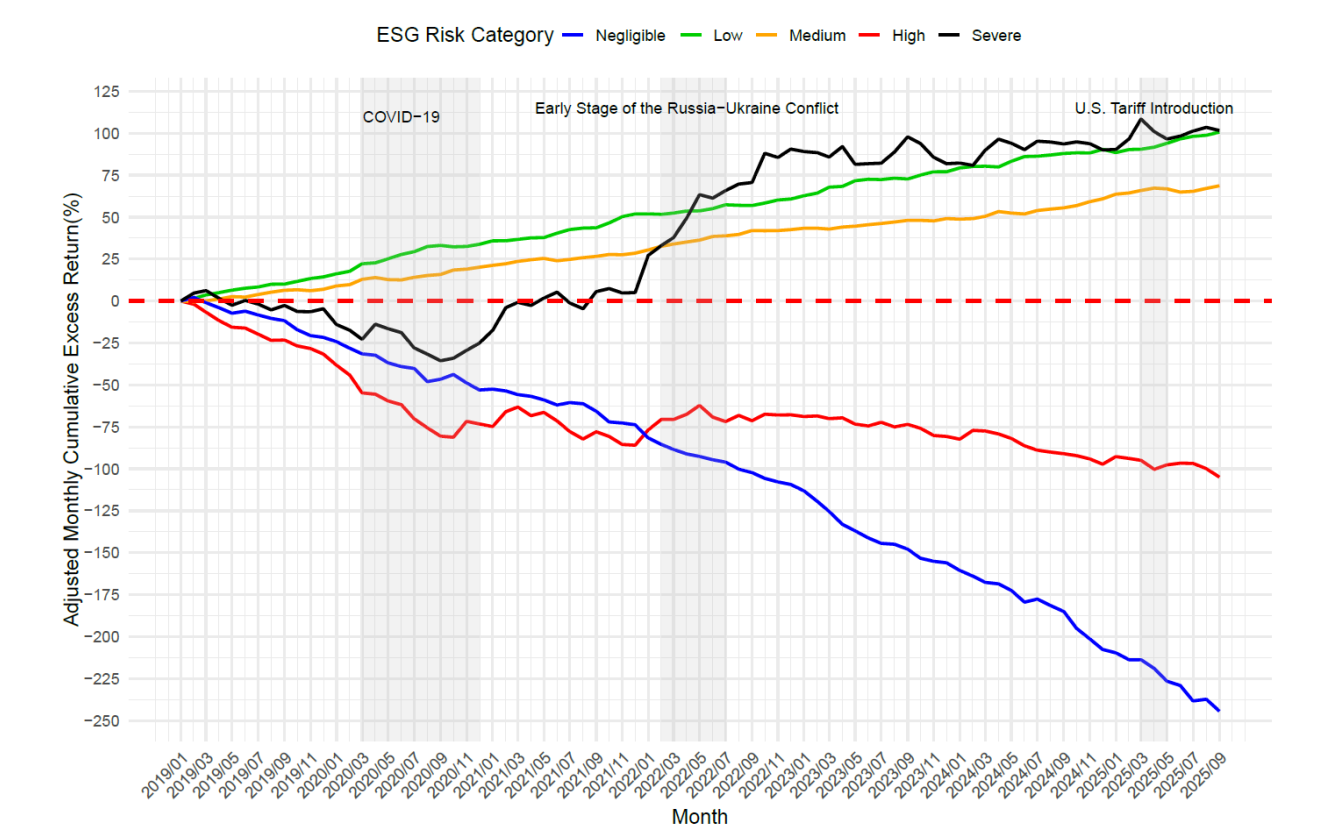
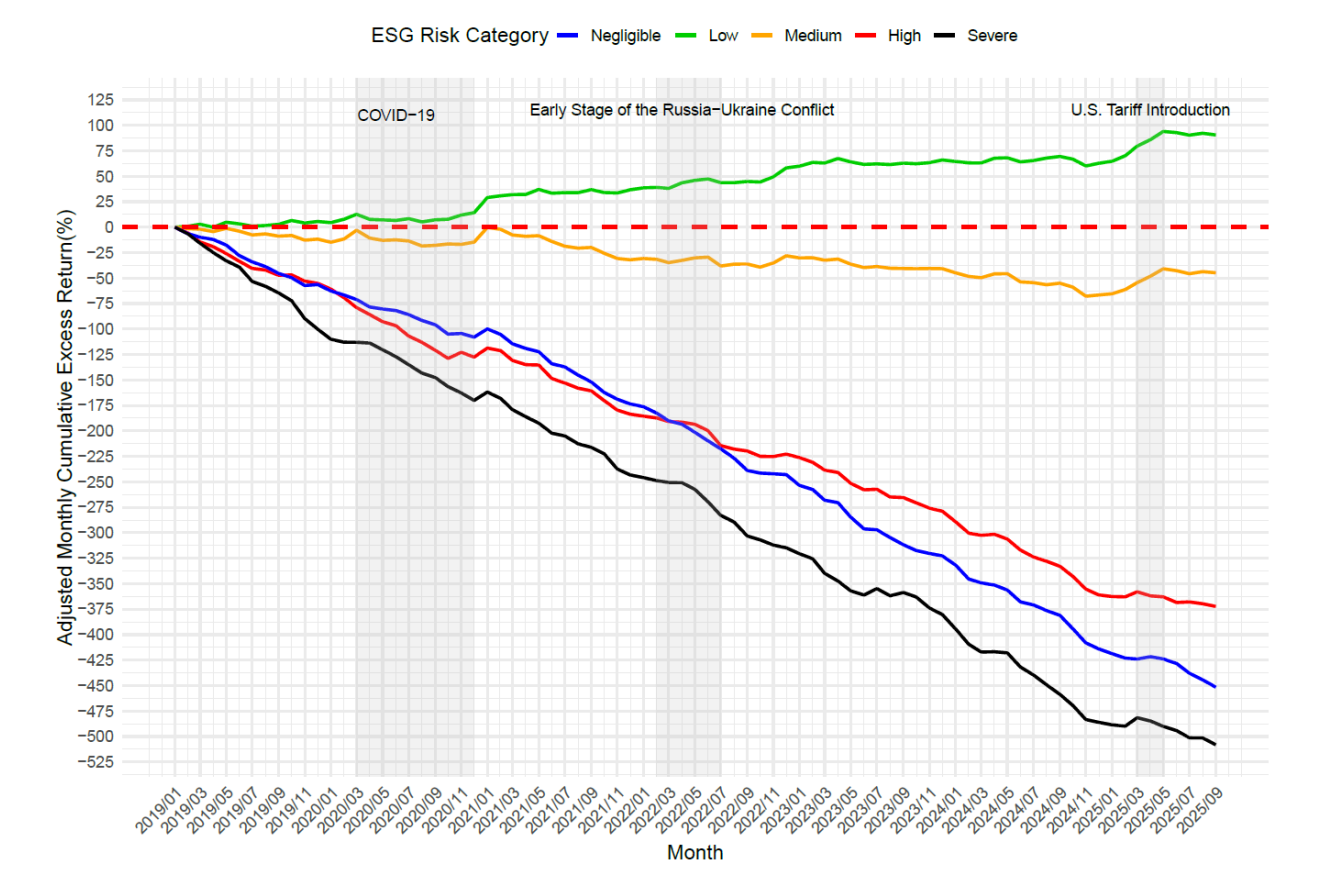
Our findings show that low ESG risk portfolios held up in both markets. In the US, they finished the period with cumulative excess returns approaching +100%, combining steady compounding with low volatility (shown in Exhibit 1). In the EU, they followed a similar upward path that approached +90%, offering portfolio stability (shown in Exhibit 2).
Exhibit 1. US Adjusted Monthly Cumulative Excess Return by ESG Risk Category (2019–2025)
Source: Morningstar Sustainalytics and Morningstar Direct. Data as of November 9, 2025. For informational purposes only.
Exhibit 2. EU Adjusted Monthly Cumulative Excess Return by ESG Risk Category (2019–2025)
Source: Morningstar Sustainalytics and Morningstar Direct. Data as of November 9, 2025. For informational purposes only.
High and severe risk portfolios underperformed in both the US and EU; however, only one market offered a path to recovery.
In the US, these portfolios underperformed but showed a partial recovery, particularly during the energy sector repricing that followed the start of the Russia-Ukraine conflict, when fossil fuel prices surged. In the EU, there was no equivalent recovery. High and severe risk portfolios declined sharply and did not bounce back. Regulatory expectations made ESG weaknesses financially material and persistent, reducing return efficiency.
One useful way to understand return efficiency is through the information ratio, a measure of how much excess return a portfolio generates per unit of risk taken. In the US, low ESG risk portfolios achieved an information ratio of +1.08, and medium risk portfolios came in at +0.89. Both are meaningfully positive. In the EU, low risk portfolios registered just +0.33, which is still positive, but reflects a market where ESG quality is already priced in and upside is more limited. Medium risk portfolios in the EU came in at –0.14, and high risk portfolios at –1.10, demonstrating that returns tend to be earned under tighter constraints, with less tolerance for risk inefficiency.
The Disappearing Middle
Once regulatory and market‑based differences are taken into account, the sharpest signal in the data is what's happening to companies in the middle of the ESG risk spectrum.
For years, investors have treated average ESG performance as neutral, not a source of upside, but not a liability either (see ESG Risk Ratings: A Protective Instrument Amid Economic Shocks). The EU data challenges that assumption directly. Medium ESG risk portfolios in Europe show negative risk-adjusted performance, even without headline controversies or extreme ESG exposure. Companies that meet basic disclosure requirements and avoid major controversies, but haven’t made meaningful progress on transition readiness or governance quality, appear to have been discounted by the market. Taken together, our findings suggest that ESG serves as a “table stakes” requirement for portfolio stability.
Consider a European utility company that is not associated with any significant ESG controversies but has partial governance gaps and limited forward-looking commitments. Our analysis suggests that even a company such as this, which is unremarkable rather than problematic in terms of ESG risk, may face persistent valuation pressure and less appeal in regulated portfolios.
In the US, a similar company could still attract capital if its near-term fundamentals are strong, but the trajectory matters. As the integration of ESG considerations in financial analysis continues to grow, the space for medium ESG risk performance is likely to shrink.
Turning Risk Signals Into Portfolio Resilience
A central implication of this research is that investors may benefit from rethinking how they use ESG risk data.
Rather than using ESG risk categories (i.e., from negligible to severe) purely as a screening filter, they can also be used as a portfolio fitness tool. Our analysis shows that lower ESG risk supports resilience and that the data is consistent on this point in both the US and EU markets. This approach can also show how regulatory maturity across regions informs risk pricing. Companies assessed with higher ESG risk tend to face greater dispersion and more persistent penalties in regulated markets, and have more room to recover in market-driven ones.
For investors, this means a few things in practice. First, investors may consider treating low ESG risk as a baseline for resilience, not a premium aspiration. Secondly, they could use industry-adjusted ratings to compare companies fairly across regions; what looks to be similar risk can carry very different implications, depending on the regulatory environment a company operates in. Thirdly, there are benefits to not looking only at where regulatory expectations are today but also to anticipating where they're heading. The EU’s experience suggests that what is considered acceptable ESG performance today, such as a medium ESG Risk Rating, may not be sufficient tomorrow.
Taken together, our findings highlight the value of sustainability risk insights to help investors navigate persistent regulatory and market structures and understand the financial materiality of risk across regions. In an environment defined by ongoing uncertainty and structural divergence, this approach may support more resilient, forward-looking portfolio decisions rather than reactive responses to short-term market or policy developments.
.tmb-thumbnl_rc.png?Culture=en&sfvrsn=a680a273_1 "2026_SUS_Blog_Exploration_V5_SIP_Resource_Center_Sans_Type (1)")