
Key Insights:
|
|
|
|
The CSRD’s Scope 3 Emissions Reporting Requirement
Reporting on scope 3 emissions (indirect value-chain emissions) was voluntary until the introduction of the EU Corporate Sustainability Reporting Directive (CSRD). In force since January 1, 2024,1,2 the directive aims to expand and standardize sustainability reporting requirements across EU countries. Under the CSRD, companies must report on material climate-related matters, including scope 3 indirect greenhouse gas (GHG) emissions, using the European Sustainability Reporting Standard (ESRS) E1.3
However, the CSRD reporting requirements, thresholds, and timelines do not apply to all companies at once. EU-based companies are first in line, having had to comply with a phased-in implementation since 2025, with the first sustainability reports due in 2026.4 Starting in 2028, the same obligations apply to non-European companies that have more than EUR 450 million (USD 530 million) in net turnover derived from the EU and at least one EU subsidiary generating more than EUR 50 million (USD 58 million).5
The European Parliament passed a package of changes meant to simplify the CSRD in December 2025, significantly narrowing its applicability.6 Despite that, the revamped CSRD still applies to nearly all (95%) packaged foods companies in Morningstar Sustainalytics’ ESG Risk Ratings universe. This is because of the thresholds set by the updated CSRD in relation to the number of EU-based employees and the companies’ consolidated net turnovers. EU companies with more than 1,000 employees and a net annual turnover of over EUR 450 million, and non-EU companies with net turnover in the EU of over EUR 450 million, and their subsidiaries and branches generating turnover higher than EUR 200 million (USD 235 million) in the EU, are all required to report under the CSRD.7
Why are Packaged Food Companies Particularly Impacted by the CSRD
Packaged food companies have highly complex and multi-tiered supply chains, often involving thousands of suppliers. In some cases, as much as 96% of a packaged food company’s GHG emissions relate to its supply chains.8,9 Accurate and complete scope 3 emissions measurement involves high administrative costs, advanced technological capabilities and extensive record keeping. Large tier 1 suppliers usually have the necessary capital, capacity, and resources to accurately measure their emissions, but that is often not the case with smaller suppliers and farmers, which often operate on much narrower margins.
Ramifications of Non-Compliance: Enterprise-Wide Risks
Non-compliance with emissions reporting obligations can lead to enterprise-wide risks, including legal and regulatory risks, reputational risks, operational risks, and market access risks.10 Fines and penalties will vary in each EU country. In Germany, for instance, a bill currently going through the federal parliament sets fines for CSRD violations at EUR 10 million (USD 11.7 million) or 5% of turnover.11
On the operational front, non-compliant companies could be forced to reduce the scale of their EU operations, choosing to either sell their products selectively in EU countries with more relaxed regulation enforcement and lower fines, or to pull their products out of the market entirely. This is expected to also lead to further industry consolidation, with larger, cash-rich companies acquiring smaller companies that are more likely to struggle with compliance.
Ramifications of Non-Compliance: Industry-Wide Risks
Compliant large manufacturers and retailers are increasingly likely to avoid or suspend business with suppliers that do not proactively monitor their greenhouse gas emissions. Replacing such suppliers is rarely straightforward and is expected to intensify demand for transparent and sustainability-aligned alternatives. These emerging supply chain bottlenecks heighten the risk of industry-wide capacity constraints. Companies’ production capacity may also be affected if raw material suppliers fail to measure and report emissions in line with regulatory requirements. This risk is particularly acute for high-exposure commodities such as cocoa, coffee, and palm oil, where supply is dominated by smallholder producers which often struggle to provide verified emissions data. This could also lead to raw material price increases, potentially increasing operating costs.
Impact on ESG Risk Ratings
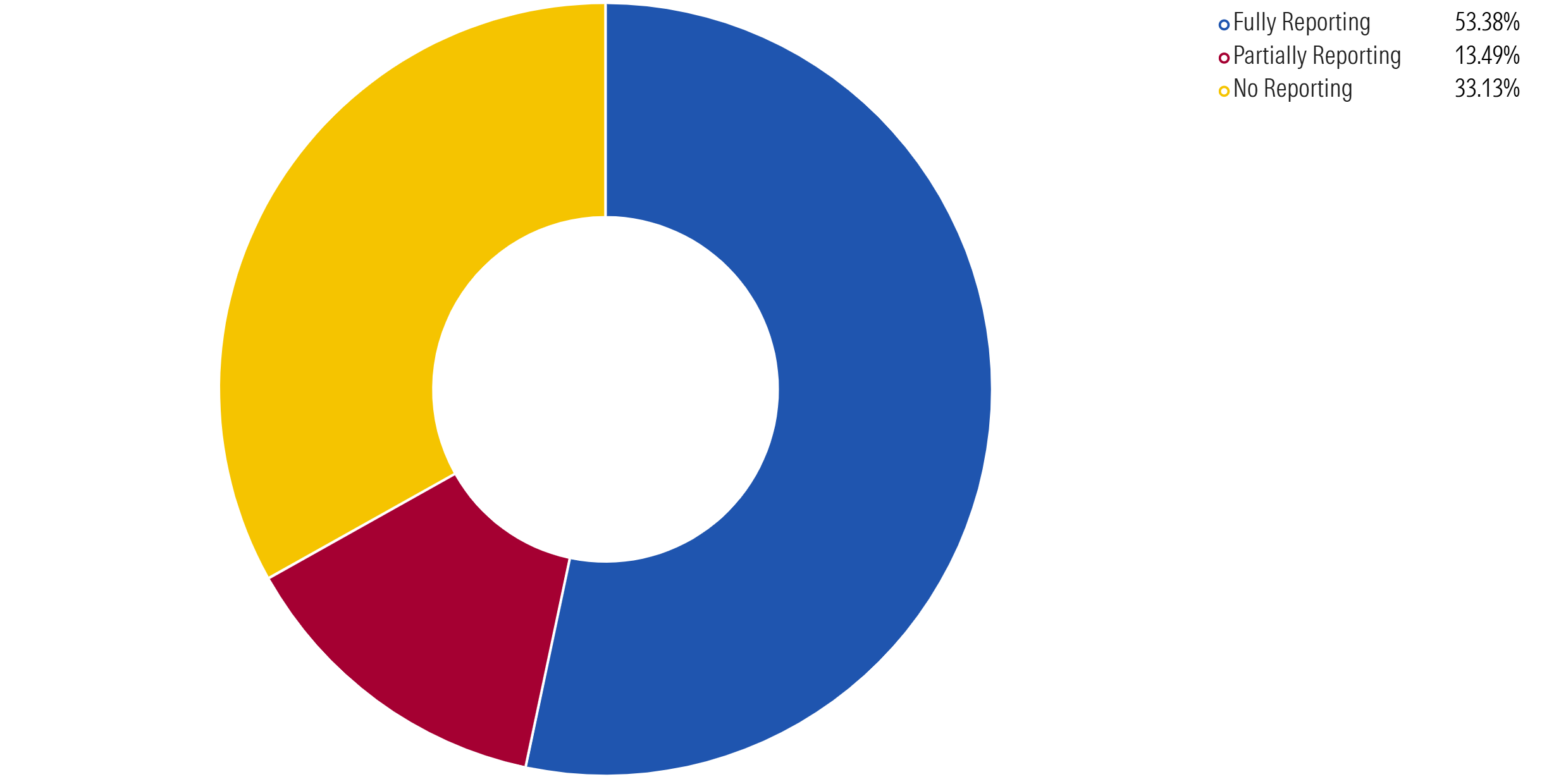
Morningstar Sustainalytics’ ESG Risk Ratings cover the topic of GHG reporting extensively. Among companies in the packaged foods subindustry, only 53% of the companies in Sustainalytics’ ESG Risk Ratings’ research universe currently disclose their full scope 3 emissions. As shown in Figure 1, this uncovers a considerable discrepancy among companies in this subindustry: nearly 33% of them do not report scope 3 emissions at all.
In practice, this may be enough for these companies to be downgraded, for example, from medium to high risk in our ESG Risk Ratings because companies that do not report scope 3 emissions at all can only score 50 points (out of 100) for the Scope of GHG Reporting indicator. This indicator, in turn, contributes to each company’s Issue Management score, ultimately affecting the company’s overall ESG Risk Rating score.
Our internal testing shows that a company’s ESG Risk Rating increases by approximately 1% when it does not report scope 3 emissions at all, compared to companies that report fully on scope 3 emissions. That 1% difference is sometimes enough to downgrade a company’s risk category, for example, from medium risk to high risk.
Figure 1. Percentage of Packaged Food Companies Reporting Scope 3 Emissions
Source: Morningstar Sustainalytics. Data as of September 19, 2025.
Note: Companies in the Packaged Food subindustry are categorized as belonging to the comprehensive universe, which covers 97 companies in this subindustry.
Scope 3 Emissions Reporting By Region: EU-based Companies Take The Lead
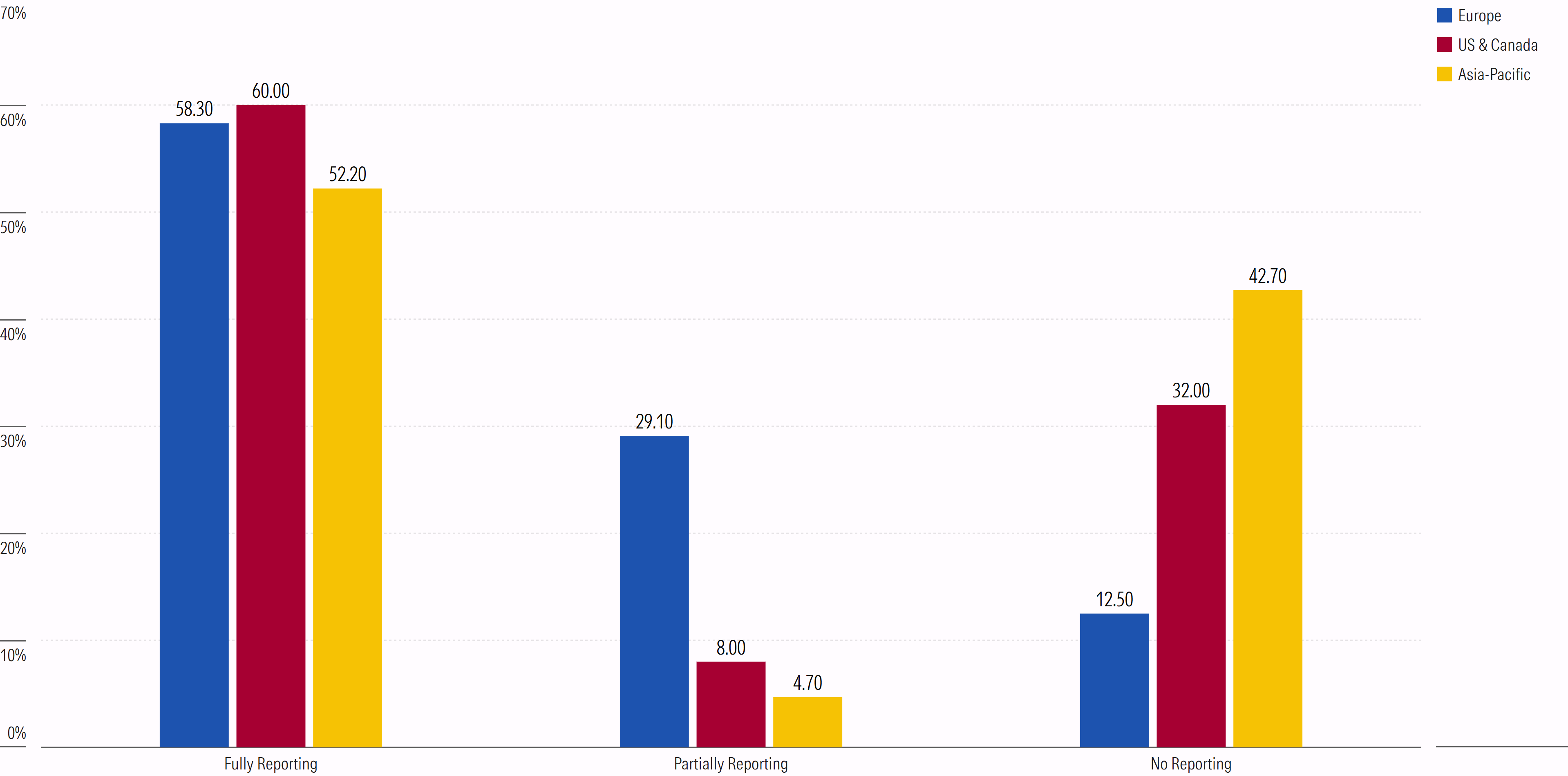
Sustainalytics’ ESG Risk Ratings consider not only if companies report their scope 3 emissions, but also whether they do so following the GHG Protocol by identifying relevant emissions from each of the GHG Protocol’s 15 upstream and downstream categories.12 This shows that EU-based packaged food companies are leaders on scope 3 emissions disclosure, despite being directly targeted by the CSRD. As shown in Figure 2, approximately 87% of the EU-based companies in our research universe disclose scope 3 GHG emissions either fully or partially.
Companies in other regions are lagging, particularly in Asia-Pacific, where more than 42% of companies do not disclose their scope 3 emissions. Also, in the United States and Canada, nearly a third (32%) of companies do not disclose scope 3 emissions. Not all of those companies must comply with CSRD reporting requirements by default, but many do because they have operations in or derive sufficient revenue from EU countries. For example, Tyson Foods, Mondelez International, Charoen Pokphand Foods, BRF, Lamb Weston, and Tata Consumer Products are all non-EU based companies that do not yet disclose full scope 3 emissions but sell products in the EU and meet the CSRD revenue thresholds. The impact on these companies, therefore, is expected to be particularly heightened.
Figure 2. Percentage of Packaged Food Companies Reporting Scope 3 Emissions, by Region
Source: Morningstar Sustainalytics. Data as of September 19, 2025.
CSRD Compliance and Opportunities for Packaged Food Companies
The new emissions reporting scenario also offers opportunities. The CSRD obligations can also act as a catalyst, shifting companies’ focus towards sustainability. Some of the benefits of complying with the CSRD include:
- Improved overall supply chain collaboration and resilience
- Enhanced investor confidence and access to capital
- Stronger customer and stakeholder trust
- Improved transparency and accountability
- Enhanced risk management
- A positive contribution to global climate goals
Other benefits are less obvious. For example, scope 3 emissions measuring and reporting is a prerequisite for net zero target setting in line with the Science Based Targets initiative (SBTi). Companies that adequately measure and report scope 3 emissions can set net zero targets following the SBTi standards, or have them validated by the SBTi, which may contribute to improved sustainability ratings for these companies.
Small-Cap Companies Can Be Leaders Too
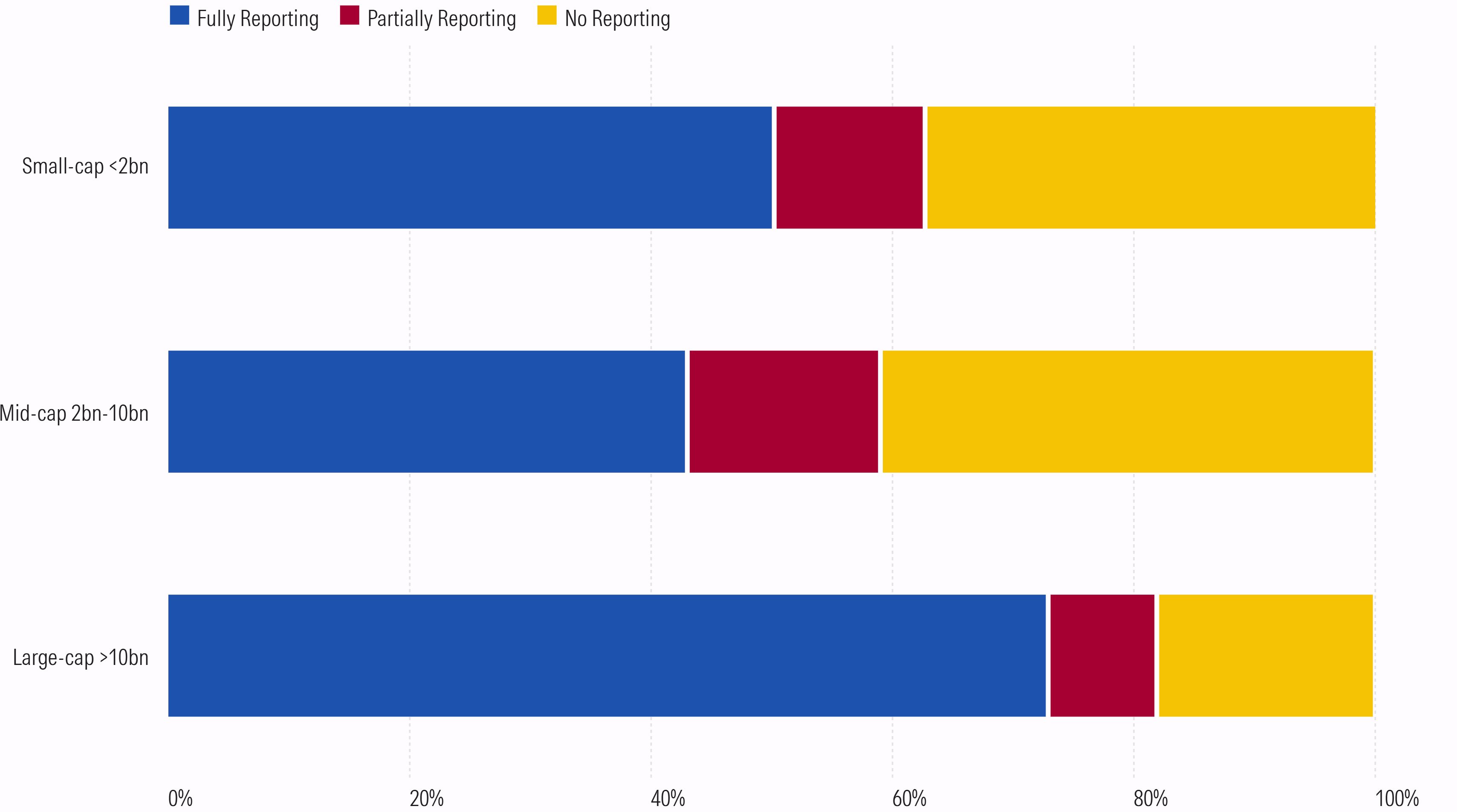
Sustainalytics data shows that large-cap packaged food companies usually stand out when it comes to mapping and reporting scope 3 emissions (see Figure 3). Companies such as Nestlé, PepsiCo, Danone, Hershey, Lindt & Sprüngli, and Kraft Heinz are all leaders in full scope 3 emissions disclosures.13 However, not all large-cap companies manage to successfully map and report value chain emissions. Mondelez International, for example, only partially reports scope 3 emissions, likely due to data limitations arising from its large base of small-farm suppliers.14 Other large-cap companies, such as Foshan Haitian, do not report scope 3 emissions at all.
At the same time, some smaller companies, such as Hilton Food Group, manage to report scope 3 emissions fully. This suggests that all companies, small or large, can be proactive with their scope 3 emissions disclosures and become leaders on this ESG issue. To reiterate the opportunities listed above, these examples help illustrate how tracking, measuring, and reporting on scope 3 emissions serve to improve overall supply chain synergies, and enhance transparency and confidence for investors, in addition to improving ESG Risk Rating scores, as well customer and stakeholder trust.
Figure 3. Percentage of Packaged Food Companies reporting Scope 3 Emissions, by Market Cap
Source: Morningstar Sustainalytics. Data as of September 19, 2025.
Brief Case Study: Danone’s Journey to Scope 3 Mapping
Even the most extensive multi-layered supply chains can still be accurately mapped and monitored, despite their inherent complexity and challenges. Danone, for example, has a supply chain that involves more than 58,000 dairy farmers worldwide.15 To successfully capture emissions from all those suppliers, Danone takes a multifaceted approach, starting with integrating the GHG Protocol Corporate Accounting and Reporting Standard as the foundation of its scope 3 methodology framework. Next, Danone breaks down its value chain into specific categories that form two common clusters in value chains emissions measurement: forest, land, and agriculture (FLAG), and packaging, logistics, and co-manufacturing (non-FLAG). This further narrows the focus on emissions’ source identification.
After controlling for data gaps and emissions’ sources, Danone actively engages with suppliers, farmers, and other stakeholders to address gaps and reduce emissions, including measures such as shifting general practices towards regenerative agriculture, and improving seed, soil health, and animal feed. To that end, the company provides training to farmers and offers technical guidance and the diagnostic tools necessary to monitor KPIs and strengthen traceability. Danone also uses a variety of other measurement tools that are specific to its subindustry and business model, such as the Cool Farm Tool, which helps quantify agricultural emissions at the farm level. Finally, to reinforce accuracy and reliability, Danone obtains independent third-party verification of its scope 3 emissions reporting annually.16
What Does the Future Hold?
The CSRD regulation may be the frontrunner, but similar regulations17,18 are currently being developed, proposed or already in the roll-out phase in many parts of the world. Examples include the Aotearoa New Zealand Climate Standards (NZ CS)19 and the Climate Reporting and Assurance Roadmap introduced by Singapore’s Accounting and Corporate Regulatory Authority.20 As this scenario unfolds over the coming years, taking charge of value chain emissions is certain to be a contributing factor to investors’ and companies’ success in the packaged foods subindustry.
For companies, proactively collaborating with suppliers to map and report value chain emissions has never been more critical. For investors, this is a strategic moment to assess whether portfolio holdings are aligned with evolving regulatory expectations and long-term financial resilience.
References
- Borenius. 2022. “The CSRD Has Been Adopted – a New Directive Reforms Corporate Sustainability Reporting in the EU.” November 30. https://www.borenius.com/legal-alerts/2022/11/30/the-csrd-has-been-adopted-a-new-directive-reforms-corporate-sustainability-reporting-in-the-eu/.
- Duvernay, Guillaume. 2024. “CSRD timeline: When should your company report?” planA, May 29.https://plana.earth/academy/timeline-csrd.
- Normative. 2026. “Corporate Sustainability Reporting Directive (CSRD), explained,” 22 January. https://normative.io/insight/csrd-explained/.
- Schnakenberg, Jan Horst. 2025. “CSRD & Scope 3: Why Value Chain Emissions Demand a Closer Look.” iPoint, July 09. https://go.ipoint-systems.com/blog/csrd-scope-3?.
- Duvernay, Guillaume. 2024. “CSRD timeline: When should your company report?” planA, May 29. https://plana.earth/academy/timeline-csrd.
- European Parliament. 2025. “Simplified sustainability reporting and due diligence rules for businesses.” December 16. https://www.europarl.europa.eu/news/en/press-room/20251211IPR32164/simplified-sustainability-reporting-and-due-diligence-rules-for-businesses.
- Morningstar Sustainalytics data extrapolated by geographical location, employees’ number and net revenue turnover.
- Nestlé. 2020. “Nestlé accelerates climate action with suppliers through the Exponential Roadmap Initiative.” December 07. https://www.nestle.com/media/news/nestle-accelerates-climate-action-suppliers-exponential-roadmap-initiative?.
- Dolsak, Nives and Prakash, Aseem. 2020. “Unilever’s Climate Plan: Emissions From Supply Chain and Consumers Are the Real Challenge.” Forbes, June 20. https://www.forbes.com/sites/prakashdolsak/2020/06/18/unilevers-climate-plan-emissions-from-supply-chain-and-consumers-are-the-real-challenge/?.
- Nguyen, Anh. 2024. “CSRD Penalties for Non-Compliance: Understanding the Stakes.” Seneca ESG. November 25. https://senecaesg.com/insights/csrd-penalties-for-non-compliance-understanding-the-stakes/?.
- Battistoni, Roberto. n.d. “Complying with the Corporate Sustainability Reporting Directive”. Business Reporter, Accessed February 04, 2026. https://www.business-reporter.com/sustainability/complying-with-the-corporate-sustainability-reporting-directive#:~:text=For%20some%20countries%20such%20as,of%20a%20company%27s%20annual%20revenue.
- Greenhouse Gas Protocol. 2011. “Corporate Value Chain (Scope 3) Accounting and Reporting Standard.” World Resources Institute and World Business Council for Sustainable Development. https://ghgprotocol.org/sites/default/files/standards/Corporate-Value-Chain-Accounting-Reporing-Standard_041613_2.pdf.
- Morningstar Sustainalytics data – extrapolated by assessment of E.1.6 Scope of GHG Reporting Indicator.
- Mondelez International. 2024. “Snacking Made Right 2024 Report.” https://www.mondelezinternational.com/assets/Snacking-Made-Right/SMR-Report/2024/2024-MDLZ-Snacking-Made-Right-ESG-Report.pdf.
- Danone. n.d. “Regenerative agriculture”. Accessed February 05, 2026. www.danone.com/sustainability/our-approach/policies-positions-reports/policies-and-positions/regenerative-agriculture.html.
- Danone. 2025. “Universal Registration Document. Annual Financial Report 2024.” https://www.danone.com/content/dam/corp/global/danonecom/investors/en-all-publications/2025/registrationdocuments/urd2024accessibleversion.pdf.
- External Reporting Board. Aotearoa New Zealand Government. 2022. “Aotearoa New Zealand Climate Standard 3 General Requirements for Climate-related Disclosures (NZ CS 3).”xrb.govt.nz/dmsdocument/4764/.
- Singapore Accounting and Corporate Regulatory Authority. 2024. “Response to Public Consultation on Climate Reporting and Assurance Roadmap for Singapore.” February. https://www.acra.gov.sg/legislation/legislative-reform/listing-of-consultation-papers/response-to-public-consultation-on-climate-reporting-and-assurance-roadmap-for-singapore?.
- External Reporting Board. Aotearoa New Zealand Government. 2022. “Aotearoa New Zealand Climate Standard 3 General Requirements for Climate-related Disclosures (NZ CS 3).” xrb.govt.nz/dmsdocument/4764/.
- Singapore Accounting and Corporate Regulatory Authority. 2024. “Response to Public Consultation on Climate Reporting and Assurance Roadmap for Singapore.” February. https://www.acra.gov.sg/legislation/legislative-reform/listing-of-consultation-papers/response-to-public-consultation-on-climate-reporting-and-assurance-roadmap-for-singapore?.
.tmb-thumbnl_rc.png?Culture=en&sfvrsn=a680a273_1 "2026_SUS_Blog_Exploration_V5_SIP_Resource_Center_Sans_Type (1)")