
Key Insights
|
|
|
Risks Related to Access and Pricing Policies Are Intensifying
US healthcare spending remains structurally high and continues to accelerate compared to peer markets. In 2024, US healthcare expenditure reached an estimated USD 14,775 per capita, nearly double the international average of approximately USD 7,860.1 As the country’s healthcare market operates without a centralized price-setting system, value chain dynamics are defined by overlapping commercial incentives, consolidation, and negotiation-based pricing. These characteristics create structural inefficiencies, administrative overhead, inflated costs of products and services, opaque pricing practices, and persistent barriers to care.2
Against a backdrop of mounting fiscal constraints and bipartisan political support, US healthcare access and pricing have been pushed to the forefront of the country’s policy agenda. Recent federal legislation and regulatory initiatives have focused on increasing pricing transparency requirements and oversight, as well as on reimbursement reform, with bargaining power shifting away from companies and toward government programs and consumers. This signals a structural shift toward tighter cost controls across the fragmented US healthcare system.
This article highlights key insights from Morningstar Sustainalytics’ US Healthcare Market: Access and Pricing Pressure Risks Intensify report. We explore how access and pricing policy risks are intensifying and shifting across the US healthcare value chain, with associated pressure and potential material impact on profit margins being distributed unevenly among healthcare sector players.
Where Will Pricing Pressure Hit Next?
The speed, scope, and scale of potential material impact of future US healthcare policy dynamics will hinge on the political environment over the next two to five years, as well as industry lobbying and fiscal pressures. While the near-term impact of access and pricing policy is likely to be specific to companies’ position in the value chain, the degree of impact will vary by business model exposure, pricing influence, and access to basic services management and preparedness, among other considerations.
Understanding how access and pricing pressure manifests across the value chain is critical for assessing system vulnerabilities and how these may translate into material risks that affect margins and growth prospects for companies in the sector, as well as broader patient and stakeholder impact.
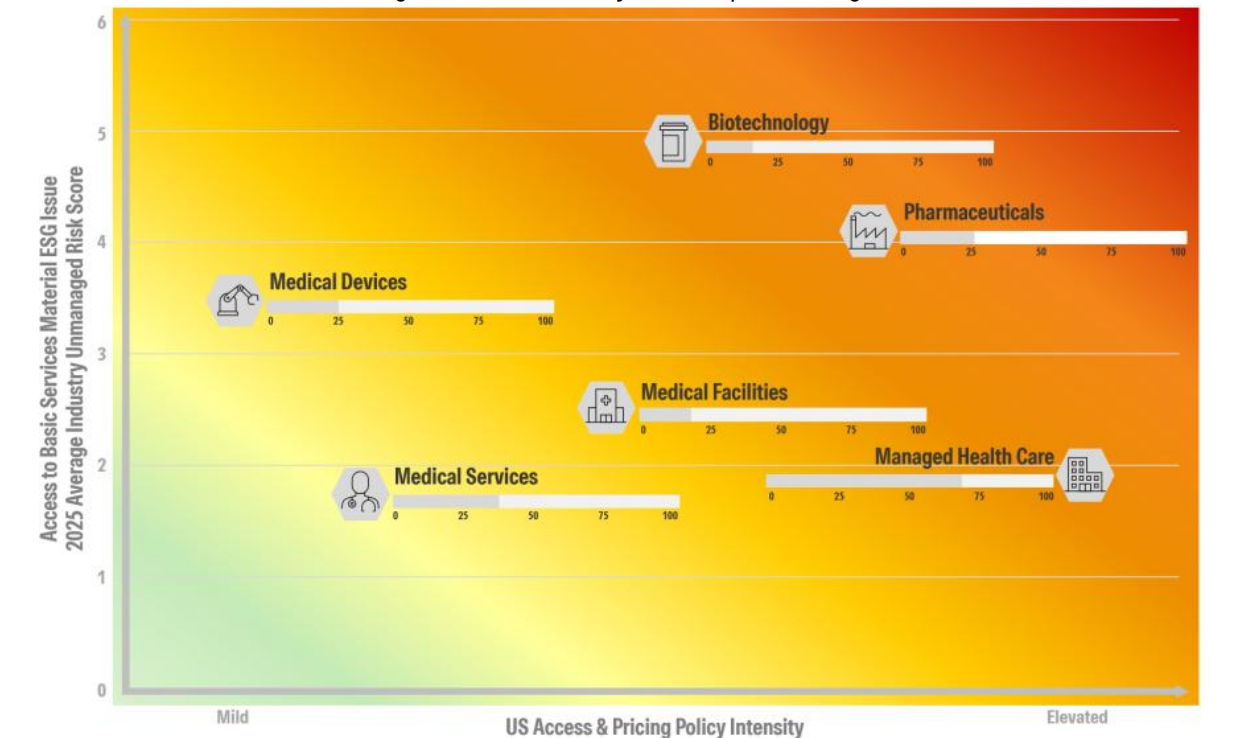
Morningstar Sustainalytics’ scenario-based qualitative analysis of near-term policy intensity (Figure 1), highlights where access and pricing pressure is intensifying and which healthcare industries may be best positioned to absorb it:
- Managed healthcare faces elevated policy risks, driven by the US administration’s focus on curbing payers’ opaque pricing practices and lowering drug prices. The Consolidated Appropriations Act of 2026 includes a package of reforms that will significantly reshape pharmacy benefit managers’ (PBMs) rebate models and operations across the commercial market, as well as adjustments to Medicare Part D, which will take effect in early 2028. Anti-competition claims and direct federal drug price negotiations with manufacturers also add to mounting pressure. However, the industry also demonstrates the strongest preparedness in terms of access to basic services management and adaptation of pricing strategies, suggesting strong capacity to mitigate potential policy headwinds.
- Biopharma companies are set to face moderate to elevated policy risks in the near term, with potential associated downside pressure on margins. A full adoption of a most-favored-nation (MFN) policy remains highly unlikely, whereas incremental adoption appears more likely, including expansions of voluntary MFN negotiations, codifying existing MFN deals as part of the Great Health Care Plan, or adopting international reference pricing mechanisms for Medicare (GUARD and GLOBE models). Further pressures may stem from expanding the Inflation Reduction Act or extending price controls beyond Medicare, alongside increased emphasis on linking pricing to value and outcomes and enhanced transparency requirements. Company-level impact will likely vary materially depending on portfolio composition, exposure to the US market, and pricing strategies. In terms of preparedness, the pharmaceutical industry exhibits average management, whereas the biotech industry shows weak preparedness.
- Healthcare providers, including medical facilities and services companies, overall face mild to moderate policy risks. These risks are driven by ongoing pressure on subsidies and reimbursement rates due to potential site-neutral payments and a decline in patient-insured rates as a result of Medicaid and Affordable Care Act provisions brought by the One Big Beautiful Bill Act of 2025. While these mainly expose large, inpatient hospital systems, facilities’ overall weak access management increases vulnerability to margin compression, whereas services companies’ average preparedness, combined with a shift toward outpatient care, may provide partial insulation.
See our US Healthcare Market report for the full analysis of US healthcare access and pricing risks.
Figure 1. US Healthcare Sector Pricing Pressure Heatmap: Looming Risks
Source: Morningstar Sustainalytics. Data as of April 2026.
Note: The access to basic services (AtBS) material ESG issue captures companies’ management of access and pricing-related issues. Management scores range from weak (0-25), average (25-50), to strong (50+). US access & pricing policy intensity provides a qualitative, relative assessment of access and pricing policy risks across the US healthcare value chain. Industry positioning reflects comparative and directional qualitative exposure and does not imply any numeric scoring or rating.
Which Healthcare Industries Are Best Positioned for the Future?
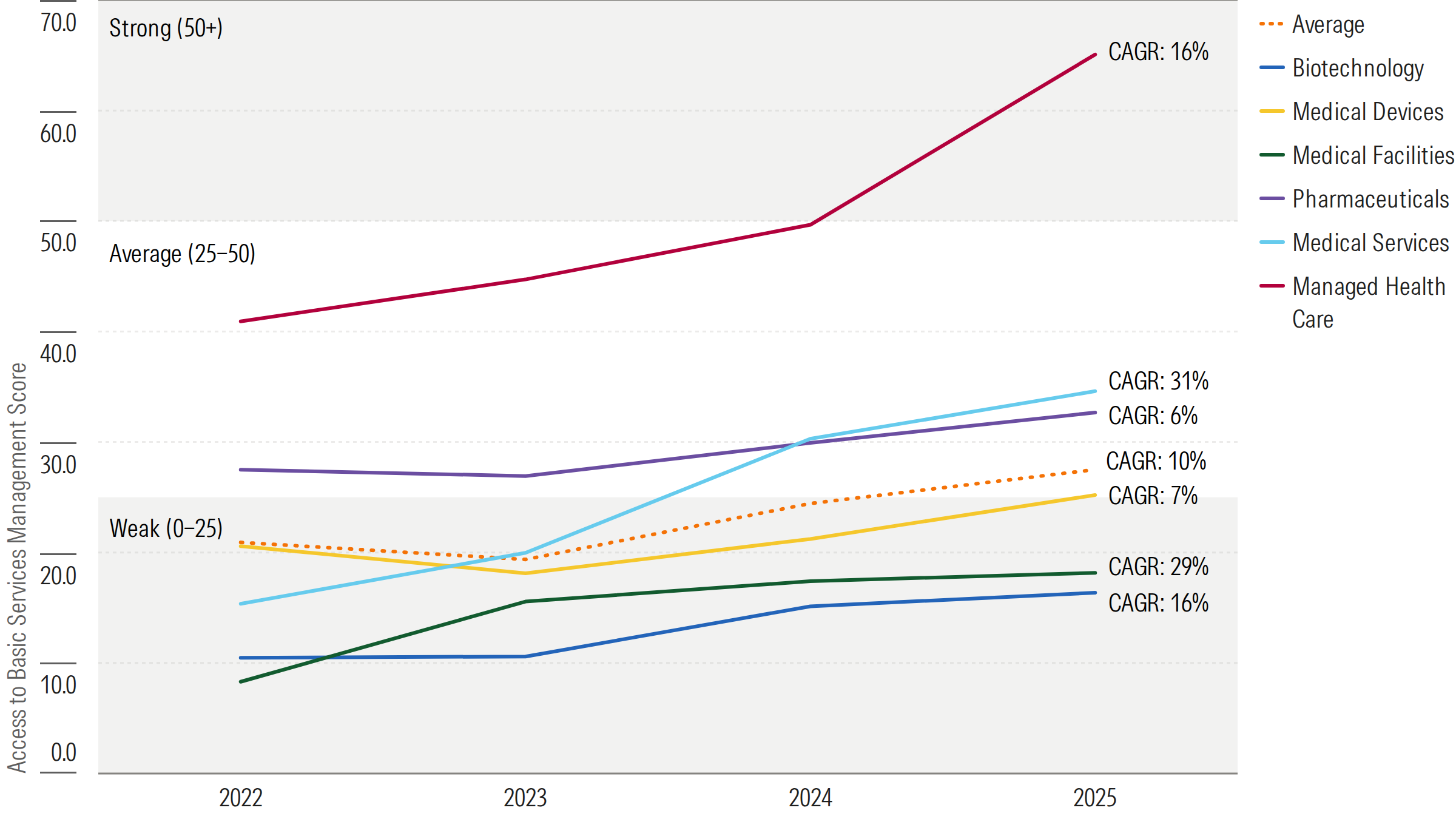
As the US policy landscape evolves, pricing and access pressures are reshaping the financial outlook across the healthcare value chain, positioning strong access and pricing-related management as key differentiators for investors. Figure 2 shows the evolution of industry-level access and pricing management trajectories between 2022 and 2025, as captured by Sustainalytics’ material ESG issue (MEI) related to access to basic services. Managed healthcare companies continue to stand out, combining strong absolute performance with sustained improvement, positioning the industry well to mitigate current and emerging pricing pressures (Figure 2). Companies in the industry are already adopting and reporting several measures aimed at increasing access and affordability.
Figure 2. Access to Basic Services MEI Risk Management Score Evolution
Source: Morningstar Sustainalytics. Data as of February 2026.
Note: The access to basic services (AtBS) MEI captures companies’ management of access and pricing-related issues; management scores range from weak (0-25), average (25-50), to strong (50+). Compound annual growth rates summarize changes in access to basic services MEI risk management scores between 2022 and 2025 and are shown to facilitate cross‑industry comparison.
Historically, the healthcare sector has proved resilient and able to stabilize margins. Looking ahead to 2030, sector companies’ management of risks related to the access to basic services MEI is likely to continue improving, assuming stable methodologies and a continuation of recent trends. However, the pace of improvement is likely to moderate over time, as maintaining strong access performance increasingly requires more sophisticated approaches to pricing, coverage design, and value and outcome-based strategies, particularly amid evolving policy and compliance requirements.
US Pricing Reform Has Potential for Global Consequences
US healthcare developments are set to have global spillover effects, potentially shaping access and affordability of medicines for governments and patients worldwide. Such ripple effects are likely to have an impact on the biopharma industry’s mitigation and adaptation strategies, potentially reshaping global markets.
To offset pricing pressure in their largest profit pool, biopharma companies are likely to raise their prices outside the US, delay product launches in low-cost markets, or reallocate pipeline budgets toward higher margin therapy areas. Early signs of these shifts are already emerging. In 2025, Eli Lilly raised the UK list price of weight‑loss drug Mounjaro by 170%, citing the need to address global price imbalances.3 At the same time, new drug launches across the EU have declined sharply (approximately 35%) following the US administration’s push toward MFN pricing.4
While such strategies may protect near-term earnings, they heighten global access risks and raise the probability of regulatory backlash in other developed markets. Over time, reduced affordability and delayed access could prompt tighter price controls abroad, revisions to international reference pricing frameworks, or wider adoption of value-based pricing, reinforcing the double materiality of access and pricing risks for investors.
Which Companies Are Best Positioned to Outperform Peers in Managing the Intensifying Pressure?
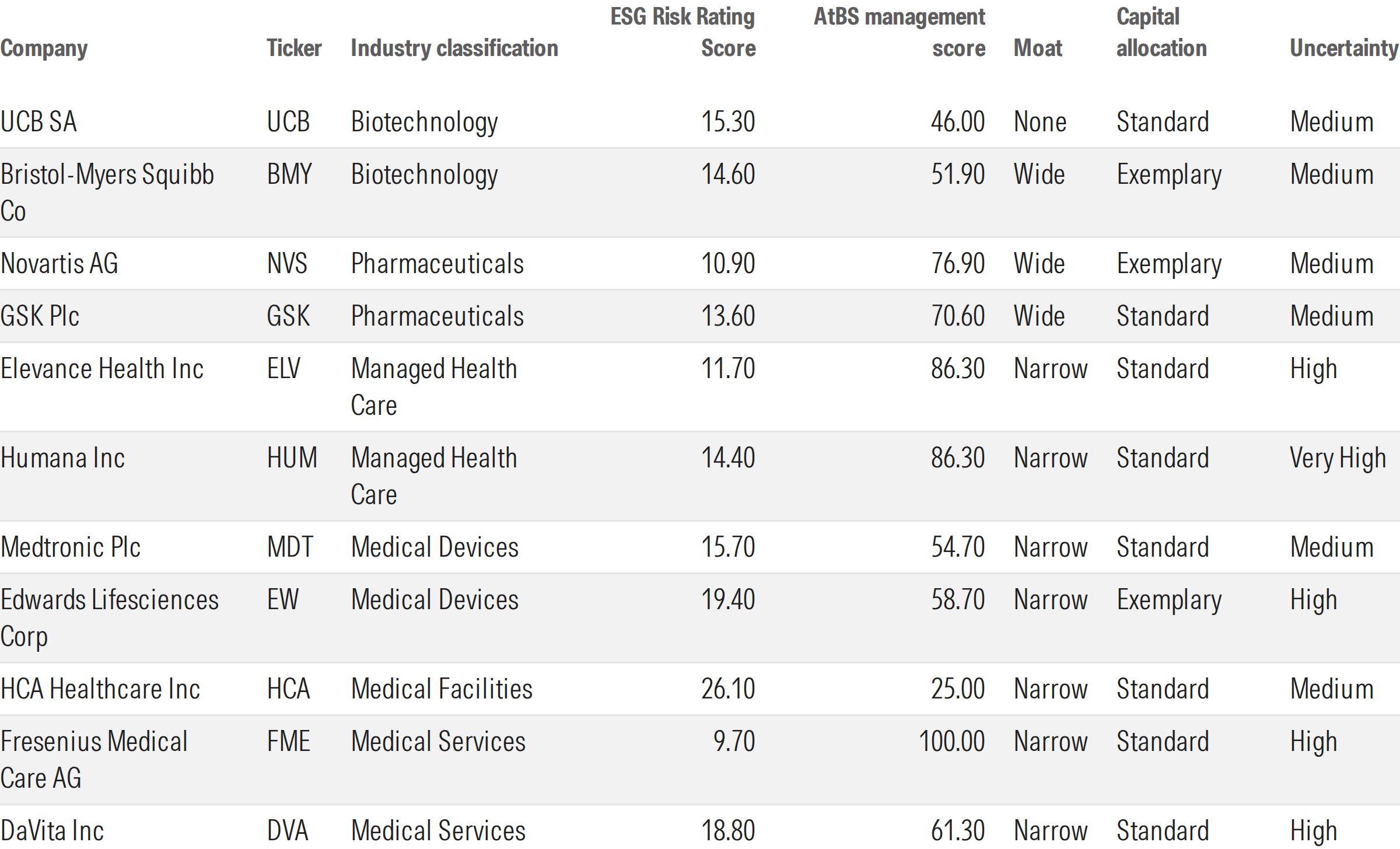
As the US healthcare policy landscape evolves and pricing pressure mounts, benchmarking access and pricing management provides a critical lens for assessing risk mitigation capacity and identifying gaps that could amplify companies’ exposure to policy risks. At the same time, strong performance on access-related ESG metrics helps differentiate companies that may be better positioned to navigate current and emerging regulatory headwinds — and potentially emerge as more resilient, sustainable investment opportunities for investors.
Table 1. Select Outperformers in ESG and Access to Basic Services
Source: Morningstar Sustainalytics, Morningstar Equity Research, and company reports. Data as of July 20, 2026.
Note: Morningstar Sustainalytics ESG Risk Rating scores range from negligible (0-10), low (10-20), medium (20-30), high (30-40), to severe (40+). The access to basic services (AtBS) material ESG issue captures companies’ management of access and pricing-related issues; management scores range from weak (0-25), average (25-50), to strong (50+).
What distinguishes these companies (Table 1) is not lower exposure to pricing reform but stronger governance, higher transparency, and more credible access strategies. For investors, integrating ESG considerations provides practical insights into which companies may be better equipped to manage emerging policy volatility.
Access and pricing pressures are structural, long-term ESG risks for the healthcare sector, and are particularly pronounced in the US. However, treating pricing reform as a uniform, sector-wide risk might be misleading. Instead, investment outcomes will increasingly depend on where companies sit in the US healthcare value chain and how effectively they manage access and affordability risks.
Read the full Morningstar Sustainalytics report for deeper industry analysis, proprietary ESG risk metrics, and company level insights.
References
- Telesford, I., et al. "How Does Health Spending in the U.S. Compare to Other Countries?" Peterson–KFF Health System Tracker. March 11, 2026. www.kff.org/health-costs/health-spending-in-the-u-s-as-compared-to-other-countries-slideshow/.
- Burns, L. R. "The Healthcare Value Chain: Demystifying the Role of GPOs and PBMs." Springer International Publishing. 2022. www.springerprofessional.de/en/the-healthcare-value-chain/23620418.
- Fick, M. "Lilly to Hike UK Price of Mounjaro Weight-Loss Drug by 170%." Reuters. August 14, 2025. https://www.reuters.com/business/healthcare-pharmaceuticals/lilly-hike-uk-price-mounjaro-weight-loss-drug-by-170-2025-08-14/.
- Fick, M. "Drugmakers Delay Some European Launches With a Wary Eye on Trump's Pricing Policies." Reuters. March 31, 2026. https://www.reuters.com/business/healthcare-pharmaceuticals/drugmakers-delay-some-european-launches-with-wary-eye-trumps-pricing-policies-2026-03-31/.
.tmb-thumbnl_rc.png?Culture=en&sfvrsn=a680a273_1 "2026_SUS_Blog_Exploration_V5_SIP_Resource_Center_Sans_Type (1)")