

Key Insights:
|
|
|
New regulations are bringing natural rubber sourcing into sharper focus, creating both challenges and opportunities for tire manufacturers. Morningstar Sustainalytics’ latest research report examines how deforestation, biodiversity loss, and supply chain transparency are becoming increasingly material factors for the industry.
For years, natural rubber has received less scrutiny than other forest-risk commodities such as palm oil or soy, but this is rapidly changing. As regulators, investors, and customers demand greater transparency around supply chains and nature-related impacts, tire manufacturers are facing growing pressure to demonstrate that the natural rubber used in their products is free from deforestation and biodiversity-related harm.
The shift is being driven largely by the European Union Deforestation-Free Products Regulation (EUDR), which will require companies selling natural rubber-based products in the EU to prove that their products are not linked to deforestation or forest degradation. The regulation introduces stringent traceability requirements that extend all the way back to the origin of raw materials and carries potential penalties of up to 4% of a company's EU revenue for noncompliance.1
Why Does the EUDR Impact the Tire Industry?
The tire industry is particularly exposed to these developments because it consumes more than 70% of the world's natural rubber supply.2 Natural rubber remains a critical component in tire manufacturing and is difficult to replace at scale. Tires generally contain between 20% and 40% natural rubber, making reliable sourcing essential for production.
At the same time, many of the world's rubber-producing regions are biodiversity hotspots. Approximately 90% of global natural rubber production is concentrated in Southeast Asia, with Thailand and Indonesia among the leading producers. Expansion of rubber cultivation has contributed significantly to land-use change, with millions of hectares of forest converted to plantations over recent decades. Research cited in our report estimates that at least 4.1 million hectares of forest have been cleared for rubber plantations since 1993.3
Figure 1. Scale of Rubber-Linked Deforestation in Southeast Asia
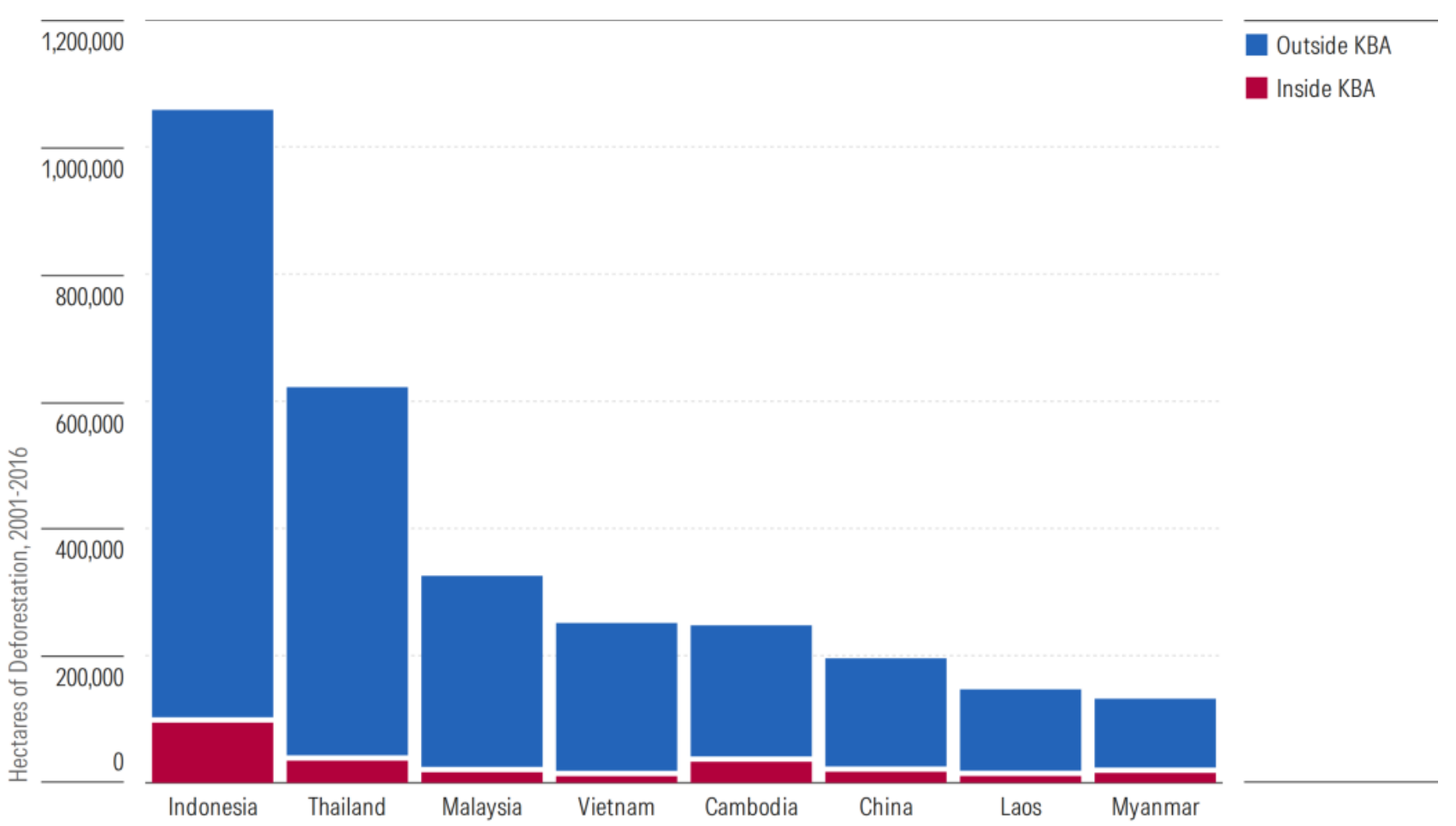
Source: Wang, Y. et. al. 2023.4
Growing demand may further intensify these pressures. The global tire market is expected to continue expanding, while natural rubber supplies are forecast to remain constrained by factors including adverse weather conditions, aging trees, and competing land uses. As demand rises, access to verified deforestation-free rubber could become increasingly competitive.
The Traceability Challenge
For many manufacturers, the greatest hurdle may not be establishing sustainability commitments but demonstrating compliance in practice.
Natural rubber supply chains are highly fragmented. More than 85% of global production comes from smallholder farmers,5 and raw rubber often passes through multiple intermediaries before reaching processors and ultimately tire manufacturers. This complexity can make plot-level traceability difficult to achieve.
Figure 2. Natural Rubber Supply Chain
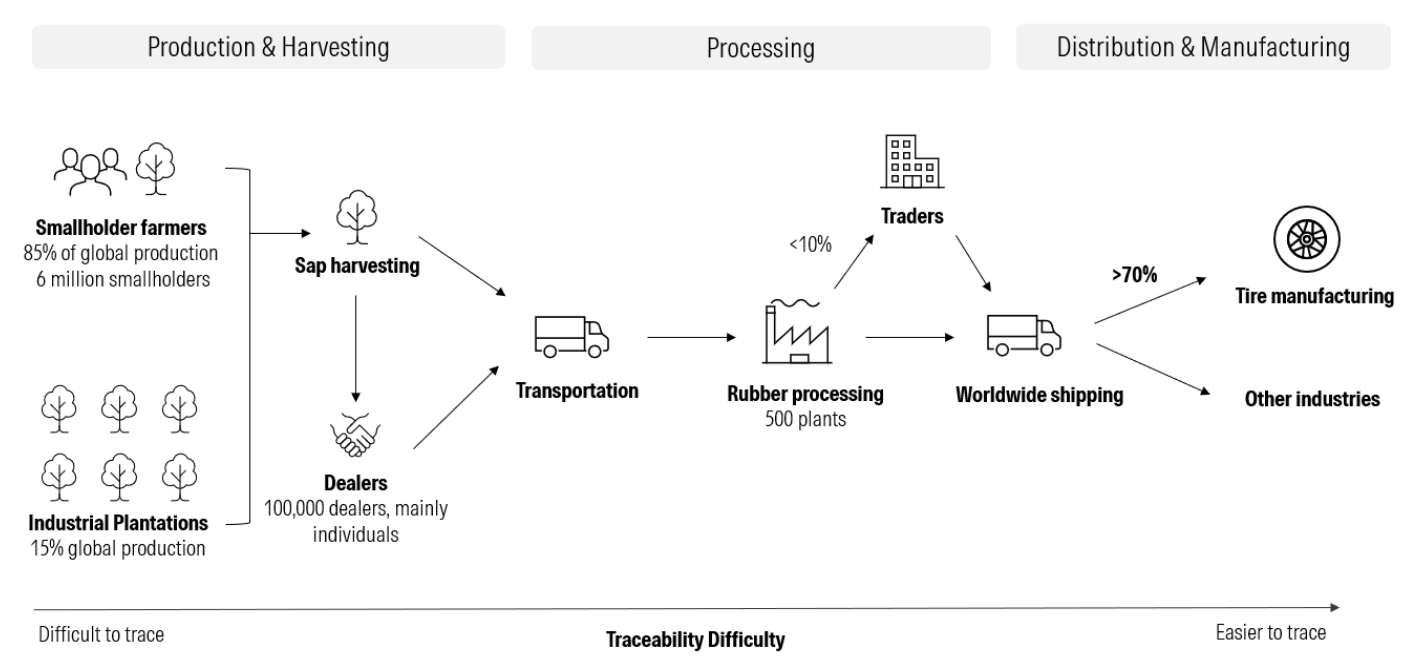
Source: Tyres Europe6 and company filings.
To comply with emerging regulations, companies may need to invest in new digital traceability systems, supplier monitoring programs, and data management processes. They must also conduct ongoing due diligence and risk assessments to verify that sourcing remains free from deforestation risks. These requirements could increase operational costs and create sourcing challenges, particularly for companies with limited visibility into their upstream supply chains.
In parallel, broader sustainability reporting requirements, including those linked to the Corporate Sustainability Reporting Directive (CSRD), are increasing expectations around biodiversity and ecosystem-related disclosures. As a result, transparency around natural rubber sourcing is becoming an increasingly important business issue rather than simply a voluntary sustainability initiative.
A Gap Between Commitments and Implementation
Sustainalytics’ review of the world's largest tire manufacturers reveals encouraging progress, but also significant gaps.
Among the top tire companies analyzed, 91% have established formal deforestation-related policies or commitments. Many have adopted zero-deforestation goals or aligned their approaches with recognized frameworks designed to protect high-carbon-stock forests. Most companies also acknowledge deforestation-related risks in their supply chains and have begun discussing EUDR preparedness in their public reporting.
However, commitments do not always translate into traceability.
Only 55% of the companies reviewed as part of Sustainalytics’ research disclose traceability efforts within their natural rubber supply chains. This suggests that many manufacturers may still lack the visibility needed to meet future regulatory requirements.
Some industry leaders are making notable progress. Michelin reports that 98% of its natural rubber farmers had been geolocated as of the end of 2024 and has committed to sourcing deforestation-free rubber by 2030.7 Bridgestone reports that 42% of its global natural rubber volume is traceable to the farm level.8 While neither company has achieved full traceability, their disclosures suggest they may be better positioned for upcoming regulatory demands than peers providing limited information.
What Investors Should Watch
As implementation deadlines approach, differences in preparedness are becoming increasingly visible. Companies that disclose traceability initiatives, outline implementation plans, and demonstrate progress toward supply chain transparency may be better positioned to manage compliance requirements, secure access to compliant supply, and mitigate sourcing disruptions.
Conversely, organizations with limited visibility into their natural rubber supply chains could face increased operational complexity, higher costs, and greater compliance risk as regulatory enforcement strengthens.
Natural rubber sourcing is evolving from a niche sustainability topic into a strategic business and investment consideration. Regulatory developments, biodiversity concerns, and supply chain transparency expectations are creating new risks and differentiators across the tire industry. Sustainalytics' decision to start assessing the tire industry in terms of an additional material ESG issue, i.e., Land Use and Biodiversity in Supply Chains, further reflects the growing financial materiality of these risks and their relevance for ESG risk assessment.
Download the Full Report
For a deeper analysis of the regulatory landscape, emerging traceability requirements, company disclosure trends, and the implications for ESG risk assessment, download the full report, Tire Supply Chains Face Rising Deforestation & Biodiversity Risks.
References
- European Commission. 2023. “Regulation (EU) 2023/1115 of the European Parliament and of the Council of 31 May 2023.” June 9, 2023. https://eur-lex.europa.eu/legal-content/EN/TXT/?uri=CELEX%3A32023R1115&qid=1687867231461.
- Tyres Europe. “About Tyres.” Accessed June 2026. https://tyreseurope.org/about-tyres/.
- Wang, Y. et. al. 2023. “High-resolution maps show that rubber causes substantial deforestation.” Nature 623, (2023): 340-346. October 18, 2023. https://doi.org/10.1038/s41586-023-06642-z.
- Ibid
- Global Platform for Sustainable Natural Rubber. 2024. “GPSNR supports the inclusion of smallholder farmers in EU natural rubber supply chains, and affirms their customary and native land use rights.” April 12, 2024. https://sustainablenaturalrubber.org/gpsnr-supports-the-inclusion-of-smallholder-farmers-in-eu-natural-rubber-supply-chains-and-affirms-their-customary-and-native-land-use-rights/.
- Tyres Europe. “About Tyres.” Accessed June 2026. https://tyreseurope.org/about-tyres/.
- Michelin. 2024. "2024 Universal Registration Document." https://agngnconpm.cloudimg.io/v7/https://dgaddcosprod.blob.core.windows.net/cxf-corporate/attachments/m0tiueu4lcna0lvkt39l0unt-2024-universal-registration-document.pdf.
- Bridgestone. 2025. "Bridgestone 3.0 Journey: 2025 Integrated Report." https://www.bridgestone.com/ir/library/integrated_report/pdf/2025/ir2025_spread.pdf.