


Key Insights:
|
|
|
Sustainability-focused investors are re-examining the role of defense-related companies within their portfolios amid rising geopolitical tensions, increased defense spending, and evolving regulatory frameworks. Simultaneously, questions around ethics, transparency, and responsible investment continue to shape how the sector is assessed and understood.
This article looks at the evolving investment case for defense, exploring the environmental, social, and governance (ESG) challenges that remain, and what impact these developments could have for asset owners and asset managers.
Why Sustainability Investors are Rethinking Defense
Investors have historically considered defense to be fundamentally incompatible with sustainability objectives, thus excluding them from sustainable investment portfolios and funds.
Now, the world is undergoing rapid rearmament, with Stockholm International Peace Research Institute reporting that global military expenditure rose in 2025 to a record USD 2.887 trillion, up 2.9% in real terms and marking the 11th consecutive year of growth.1 This, in turn, is driving greater investor interest in aerospace and defense.
The Morningstar Developed Markets Europe Aerospace & Defense Index gained 249% between January 2022 and June 2025, beating its US counterpart, which gained 78% over the same period. Meanwhile, the broad European developed equity market benchmark returned 26%.2 According to Morningstar data, European active ESG funds have increased their exposure to aerospace and defense since 2022 and, looking at performance, it's apparent that excluding or underweighting the defense sector has penalized returns, both for ESG and non-ESG funds.3
How Regulatory Momentum Is Reshaping Defense Investability
Europe remains at the center of many recent defense-financing developments, driven by a series of policy initiatives which aim to remove barriers to investing in defense. These include:
- The European Defense Industrial Strategy
- The ReArm Europe Plan (Readiness 2030)
- The EUR 150 billion (USD 174 billion) Security Action for Europe financing instrument
- The European Defense Industry Programme
- The EU Defense Readiness Omnibus package
Most significantly for sustainable investing, the European Commission issued a notice clarifying that existing sustainable finance regulations do not prevent sustainability-focused investors from financing defense companies.4 Instead, investors are encouraged to adopt a case-by-case approach supported by robust ESG due diligence and appropriate risk mitigation measures, as they would for sustainable investing in any sector.
These developments also came at a time in which NATO has agreed to increase defense spending targets from 2% to 5% of member nations’ gross domestic product by 2035,5 which is particularly significant given that 2025 was the first year that NATO estimates all members met or exceeded the previous 2% target.6
As regulatory frameworks have made it clear that financing defense is not prohibited, the discussion has shifted to individual sustainable investment policies in the private sphere. The crux of the discussion is split between the traditional view that remains concerned about the potential dangers of peace washing and new perspectives that consider defense as “security”. Under these perspectives, security enables sustainability, and without stability, progress in other areas — including climate, healthcare, and education — becomes difficult to sustain.
Aerospace and Defense Remains a High ESG Risk Sector
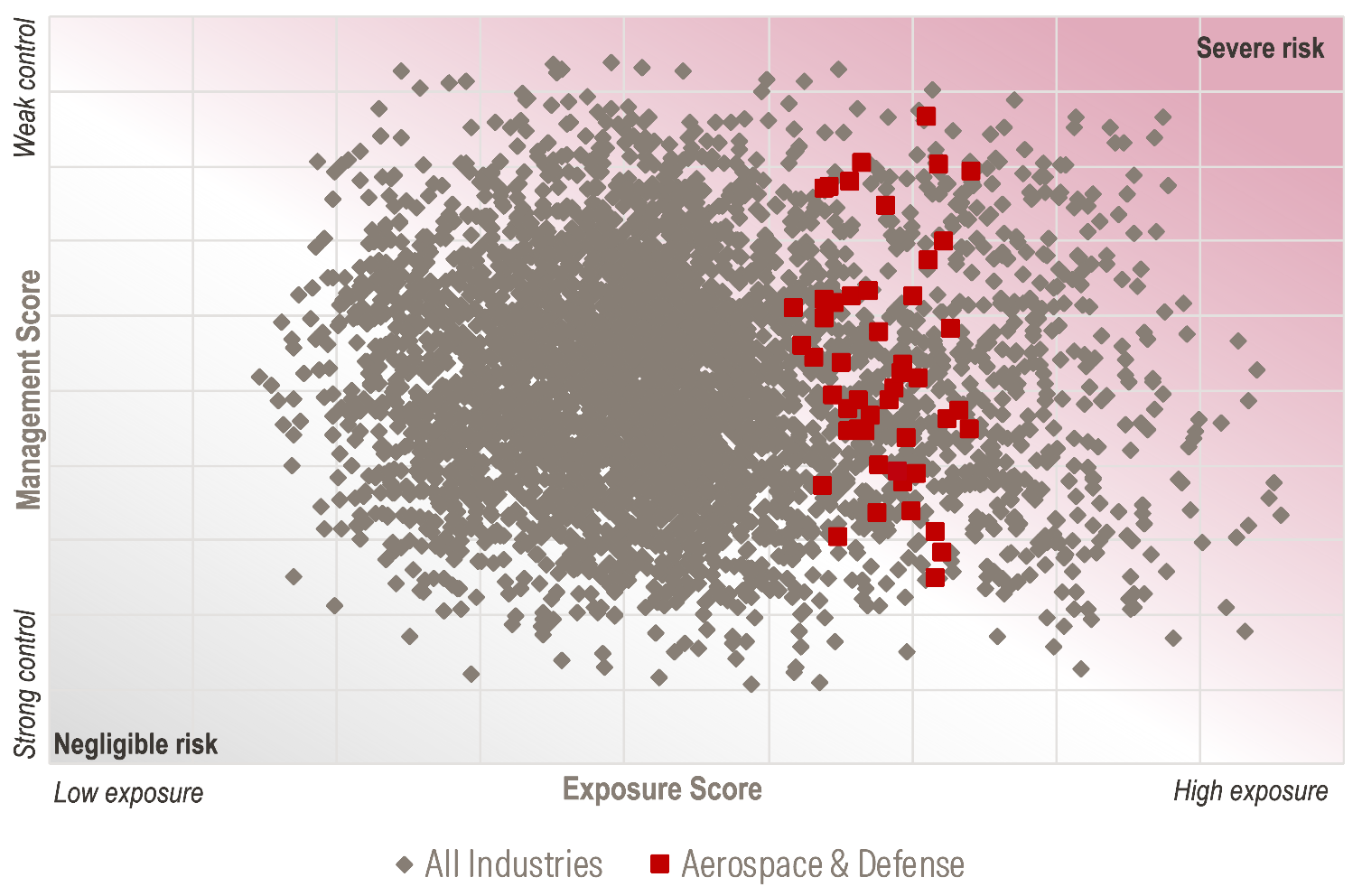
Although perceptions of defense may be evolving, aerospace and defense is still considered a high-risk sector from an ESG perspective (see Figure 1).
Figure 1. Risk Exposure Score of Aerospace and Defense Companies Compared to All Industries
Source: Morningstar Sustainalytics. Data as of March 2026.
Aerospace and defense companies generally face greater ESG risk exposure than companies in other industries within Sustainalytics’ coverage universe. However, there are significant regional differences. European companies tend to manage these risks more effectively, perhaps due to stricter regulation and reporting requirements. As a result, they are more frequently assessed as medium risk compared to North American and Asia-Pacific companies, which are more likely to fall into the high- or severe-risk categories.
There are ten material ESG issues facing the sector, including business ethics, which represents one of the most pressing areas of concern. Large, long-term defense contracts, often involving government customers, create elevated exposure to corruption, anti-competitive behavior, and governance-related risks. The growing influence of artificial intelligence (AI) and other advanced technologies also introduce new ethical and human rights considerations.
Product governance issues may also create risks for defense companies. While high product governance risks in the aerospace and defense sector are primarily driven by the strict product compliance requirements for commercial aircraft, defense companies are facing increasing pressures to accelerate production at a pace that is unusual for the sector. Such pressure increases the risk of product quality issues and operational failures.
Emerging Technologies Are Creating New Opportunities and Risks
The current geopolitical environment marks a phase in which new technologies – namely AI, autonomous systems, and advanced drones – are becoming central to military resilience and adaptability. Innovation within the defense sector continues at a rapid pace, as governments seek new capabilities and contractors respond to rising demand.
Technological advancements, however, also introduce new ESG considerations. Many companies within the sector currently demonstrate relatively strong cybersecurity management practices, with the average management score for the Data Privacy and Cybersecurity MEI and the Cybersecurity Program indicators being 48.6 and 56 respectively. However, the integration of artificial intelligence into critical production and operational systems creates new avenues of potential cybersecurity risks.
Cybersecurity threats increasingly target both deployed defense systems and the companies responsible for manufacturing them. Examples in recent years include multiple cyberattacks on Rheinmetall,7 Thales,8 and RTX’s subsidiary, Collins Aerospace.9 As recently as March 2026, Lockheed Martin was allegedly hit by a cyberattack from Iran-sponsored actors.10
Beyond specific public examples, The Guardian11 and Google12 have reported on extensive threats and hacks targeting defense companies and contractors, including pinpoint attacks against individual employees or through organized recruitment campaigns targeting weaknesses in human resource systems. Companies must therefore manage cyber risks across all operational and production system pathways, and throughout the entire lifecycle of a platform or product.
Aerospace and Defense Supply Chains Are Under Increasing Pressure
Supply chain resilience is also a growing concern across the aerospace and defense sector. Rising defense production is exposing constraints in critical raw materials13 such as aluminium and tungsten,14 as well as semiconductors and electronics, and other key components.15 Geopolitical tensions are intensifying these pressures further, creating bottlenecks and increasing operational risk for companies looking to scale production.
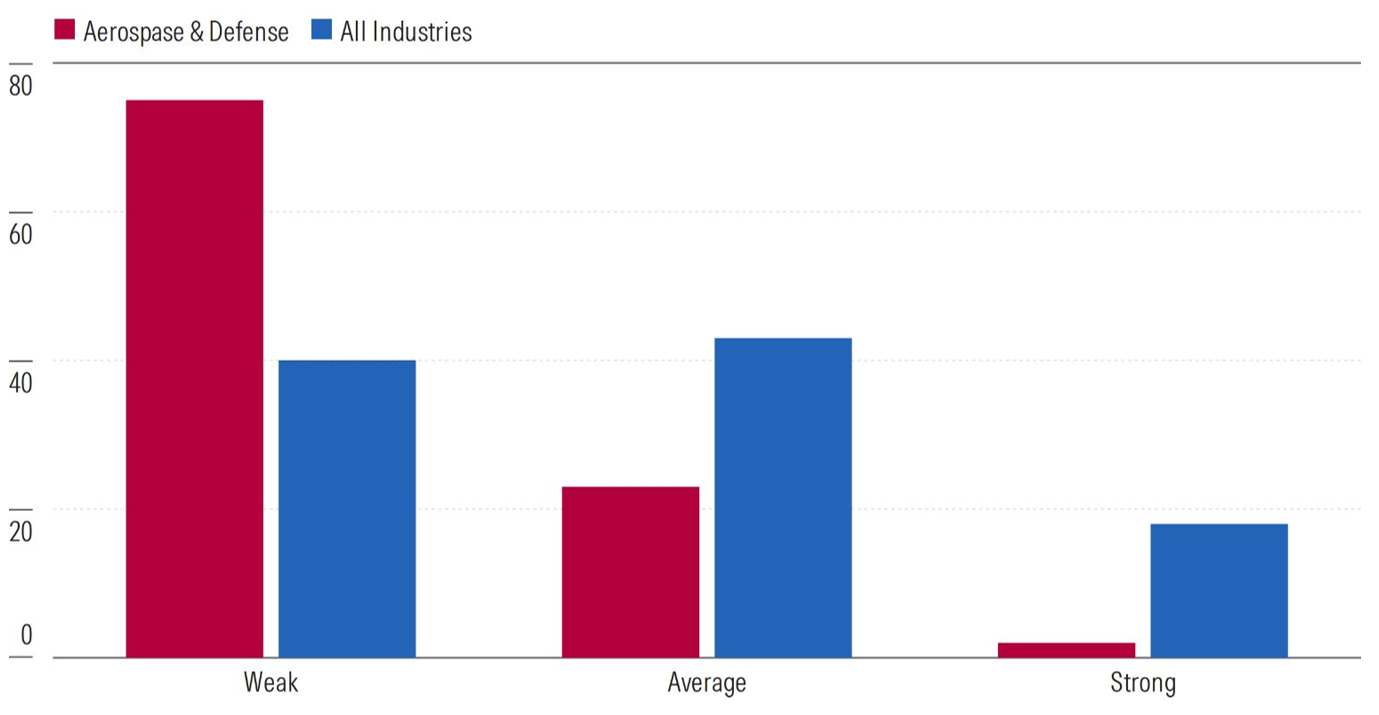
Many companies within the sector demonstrate weak management and disclosure practices related to raw material sourcing (see Figure 2). Enhanced regulatory requirements are expected to improve transparency over time, but material gaps remain today.
Figure 2. Management of Raw Material Use for Aerospace and Defense Companies Compared to All Industries
Source: Morningstar Sustainalytics. Data as of March 2026.
Defense companies often operate through complex, multi-tiered supply networks, making it difficult to trace environmental and social risks throughout the value chain. Additionally, national security considerations and classified contracts also limit public disclosure.
While increasing investor scrutiny and evolving reporting frameworks may lead to the gradual improvement of transparency, it is unlikely that defense will ever offer the same level of visibility as other, less sensitive industries.
How Controversies Inform ESG Due Diligence
Interestingly, when it comes to controversy assessments, relatively few aerospace and defense companies are associated with Sustainalytics’ most severe controversy categories. This is primarily driven by low levels of potential or realized financial risks stemming from controversies in the defense sphere. Governments and military organizations, which represent key customers for defense contractors, rarely terminate long-term relationships because of reputational concerns alone. Therefore, many controversies within this industry have limited financial consequences, despite attracting significant public attention.
However, controversies are still relevant for investors. Incidents involving confirmed breaches of arms embargoes, attacks against civilians resulting in casualties, or failures to protect personnel in high-risk environments can still have significant implications from an ESG perspective and could be an issue for investors concerned with due diligence risks.
Thus, even with limited financial risks for defense companies, controversy assessments can still be used to determine whether a defense company remains aligned with an investors’ sustainable investment strategies and exclusion criteria.
Looking Beyond Traditional Defense Companies
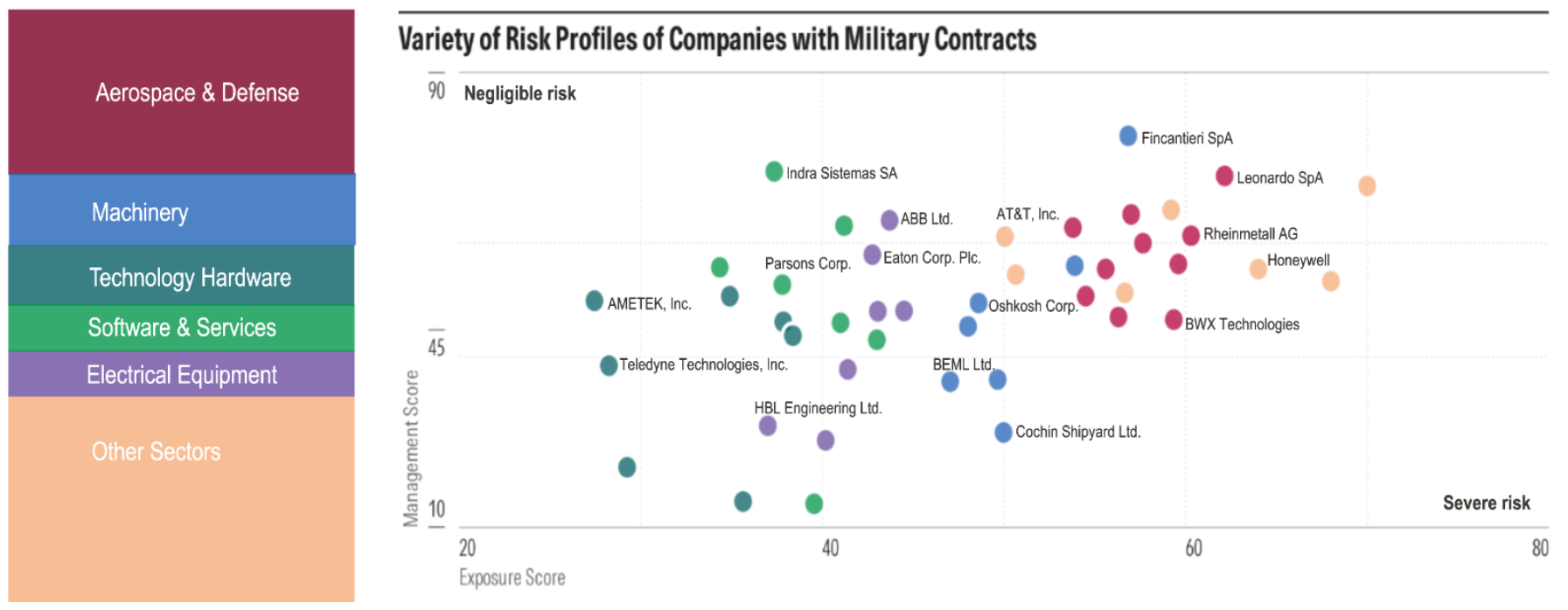
The Defense Omnibus package, which seeks to simplify regulatory requirements and improve access to finance for the defense sector, promotes investment in dual-use technologies, including AI, biotechnology, nanotechnology, and drones. This means that investors may encounter defense exposure within sectors such as technology and machinery. In fact, nearly a quarter of companies with military contracts operate outside of aerospace and defense in the technology hardware, electrical equipment, and software services sectors (see Figure 3).16
Figure 3. Top 5 Sectors of Companies Holding Military Contracts
Source: Morningstar Sustainalytics. Data as of March 2026.
For example, heavy machinery and transport companies, such as shipbuilders, heavy equipment manufacturers, and truck producers, are increasingly looking to capitalize on rising defense spending. In some organizations, according to Sustainalytics’ data, defense-related business is actually growing faster than group revenues and, in certain cases, generating a disproportionate share of profits.
While these companies generally carry lower ESG Risk Ratings than traditional aerospace and defense firms, investors should continue monitoring how growing defense exposure influences underlying risk profiles over time.
The Bottom Line for Investors
The aerospace and defense sector is undergoing a significant re-evaluation within sustainable investing. Growing geopolitical instability, expanding defense budgets and new regulatory frameworks have moved the conversation beyond a simple inclusion-versus-exclusion debate.
At the same time, the sector continues to face substantial sustainability challenges. Business ethics, product governance, cybersecurity, supply chain transparency, and controversy exposure all remain material considerations for investors. As defense opportunities expand across both traditional and adjacent industries, thorough ESG due diligence will remain essential in assessing risk, identifying opportunities, and aligning investment decisions with portfolio objectives.
References
- Stockholm International Peace Research Institute. 2026. "Global military spending rise continues as European and Asian expenditures surge." April 27, 2026. https://www.sipri.org/media/press-release/2026/global-military-spending-rise-continues-european-and-asian-expenditures-surge.
- Bioy, H. 2025. "EU ESG Funds' Exposure to Defense Continues to Increase." Morningstar Sustainalytics. August 15, 2025. https://www.sustainalytics.com/esg-research/resource/investors-esg-blog/eu-esg-funds--exposure-to-defense-continues-to-increase.
- Schiffler, A. 2025. “How ESG Funds Learned to Love Weapons.” Morningstar. July 15, 2025. https://global.morningstar.com/en-eu/sustainable-investing/how-esg-funds-learned-love-weapons.
- European Commission. 2025. “Commission Notice on the Application of the Sustainable Finance Framework and the Corporate Sustainability Due Diligence Directive to the Defense Sector.” June 17, 2025. https://defense-industry-space.ec.europa.eu/document/download/ac79ebc7-d2f1-4e7a-a79c-71a06a5fdbf8_en.
- North Atlantic Treaty Organization. 2026. "Secretary General Annual Report 2025." March 26, 2026. https://www.nato.int/content/dam/nato/webready/documents/publications-and-reports/annual-reports/sgar25-en.pdf.
- Ibid.
- Martin, A. 2023. "German arms company Rheinmetall confirms Black Basta ransomware group behind cyberattack." The Record. May 22, 2023. https://therecord.media/rheinmetall-confirms-black-basta-ransomware-group-behind-cyberattack.
- Reuters. 2022. "Thales confirms hackers have released its data on the dark web." November 12, 2022. https://www.reuters.com/technology/hackers-release-thales-data-dark-web-franceinfo-says-2022-11-11/.
- Reuters. 2025. "EU agency confirms ransomware attack behind airport disruptions." September 22, 2025. https://www.reuters.com/business/aerospace-defense/eu-agency-says-third-party-ransomware-behind-airport-disruptions-2025-09-22/.
- Jones, D. 2026. "Lockheed Martin targeted in alleged breach by pro-Iran hacktivist." Cybersecurity Drive. March 23, 2026. https://www.cybersecuritydive.com/news/lockheed-martin-breach-pro-iran-hacktivist/815430/.
- Down, A. 2026. "State-sponsored hackers targeting defence sector employees, Google says." The Guardian. February 10, 2026. https://www.theguardian.com/world/2026/feb/10/state-sponsored-hackers-targeting-defence-sector-employees-google-says.
- Google Threat Intelligence Group. 2026. "Beyond the Battlefield: Threats to the Defense Industrial Base." Google Cloud. February 10, 2026. https://cloud.google.com/blog/topics/threat-intelligence/threats-to-defense-industrial-base.
- King, A. 2025. "Military demand strains metal supply chains." Chemistry World. June 19, 2025. https://www.chemistryworld.com/news/military-demand-strains-metal-supply-chains/4021695.article.
- Home, A. 2026. "Every missile fired over Iran is burning through US tungsten stocks." Reuters. March 23, 2026. https://www.reuters.com/markets/commodities/every-missile-fired-over-iran-is-burning-through-us-tungsten-stocks-2026-03-23/.
- Bean, J., and Kuehn, A. 2025. "The U.S. Defense Industry Still Faces a Chip Challenge." ORF America. April 1, 2025. https://orfamerica.org/orf-america-comments/us-defense-industry-chip-challenge.
- Bioy, H, et al. 2025. “Defense: Assessing New Investment Opportunities Through an ESG Lens.” Morningstar Sustainalytics, September 18, 2025. https://www.sustainalytics.com/esg-research/resource/investors-esg-blog/defense--assessing-new-investment-opportunities-through-an-esg-lens.