

Written in collaboration with Principles for Responsible Investment (PRI).
Four investor surveys show how sustainability is shaping value creation, due diligence, environmental, social, and governance (ESG) data, and decision-making across private markets.
As sustainable value creation comes into sharper focus, four recent surveys from the PRI, PitchBook, Morningstar and Morningstar Sustainalytics provide an opportunity to test where the market is aligned and where perspectives diverge. Taken together, they point to a clear conclusion: sustainability in private markets is still going strong and is not disappearing. Instead, it is becoming more intentional, pragmatic, focused on financial relevance and dependent on credible data.
Limited partners (LPs) and asset owners remain an important source of demand. Both Morningstar’s Asset Owner Perspectives Survey and PRI’s inaugural Sustainability Value Creation: Global Investor Insights (in collaboration with Bain & Company) found that investment firms are using sustainability insights most consistently during due diligence, but less consistently during the rest of the investment lifecycle. Across the ecosystem, investors want clearer evidence of value, better data, and tools that work within existing private markets workflows.
LPs and Asset Owners Continue to Drive Demand
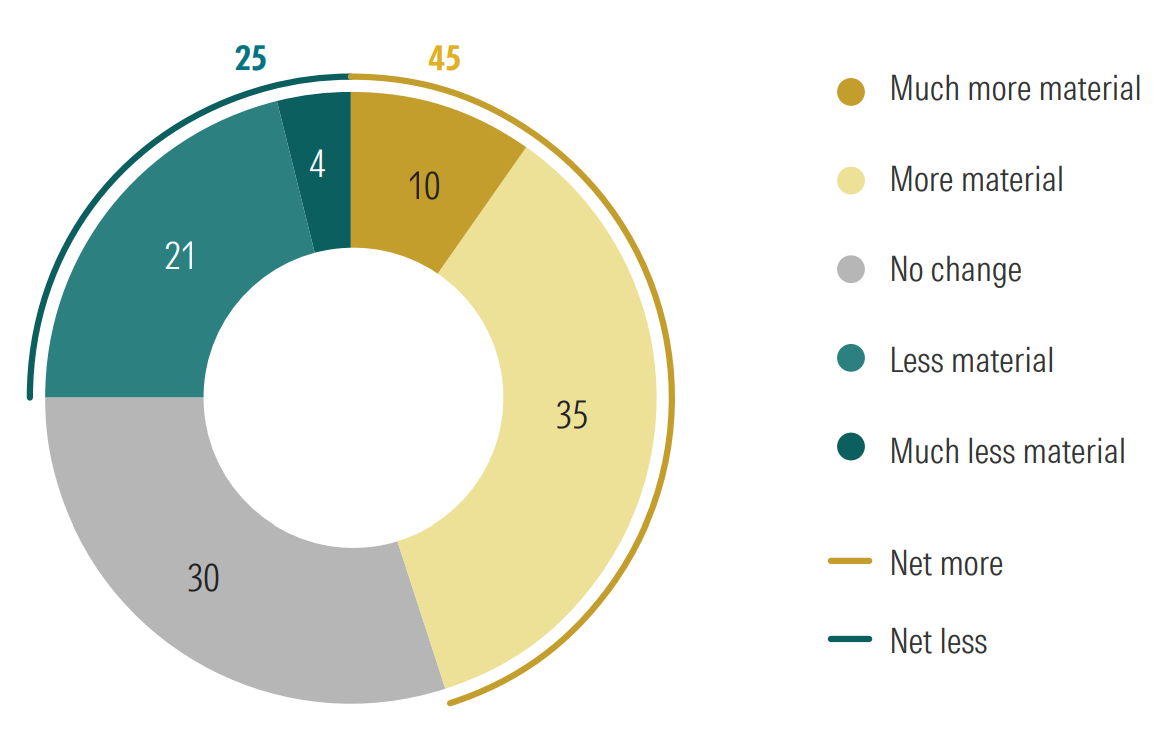
One finding is consistent across the surveys: LPs and asset owners continue to create strong demand for sustainable investing practices in private markets. PitchBook’s 2026 Sustainable Investment Survey found that nearly half of general partners (GPs) cite client and stakeholder expectations as a key reason for incorporating ESG, reinforcing the role of LPs as a durable force behind adoption. Morningstar Sustainalytics’s upcoming State of ESG Data Survey reached a similar conclusion across a broader respondent base that also includes public markets participants: 63% identify client or investor preferences as one of the biggest influences on their sustainable investing strategies over the next 12 months. The Asset Owner Perspectives Survey provides further context: among asset owners that incorporate ESG, 47% say it has become more material to investment decisions over the past five years.
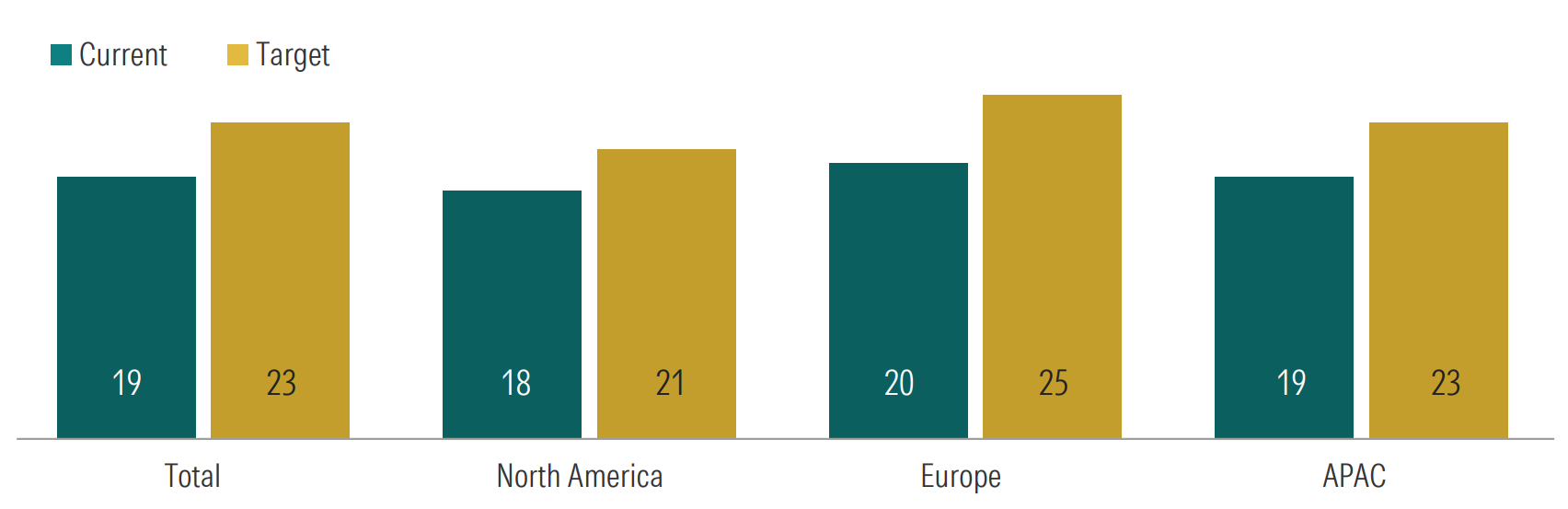
Meanwhile, the Morningstar survey also found that average allocations to private markets are expected to increase from 19% of AUM today to 23% within five years (see Figure 1), driven primarily by diversification and return objectives.
Figure 1. Current and Five-Year Targeted Percentage of Total AUM Invested in Private Markets (Average) (%)
Source: Asset Owner Perspectives Survey 2026: Quantitative Analysis. Morningstar.
This reframes the market narrative. Sustainable investing in private markets is not being sustained primarily by public commitments or regulation, it is being sustained by capital owners seeking better visibility into how sustainability-related risks and opportunities affect long-term value. For asset managers and GPs, the implication is clear: sustainability focus and capabilities should primarily be aligned to financial outcomes and/or value across better diligence, risk management and reporting, not labels alone.
The survey samples differ in ways that are important for interpreting the results. European investors account for 44% of PRI respondents, while the PitchBook and Sustainalytics samples are more US-weighted. Fifty-nine percent of PitchBook respondents are from the US, and 65% of Sustainalytics respondents are from the Americas, 90% of whom are US-based. The Asset Owner Perspectives survey is more evenly distributed across Europe, APAC and North America. The fact that similar themes emerge across these different samples strengthens the overall signal, while the composition helps explain some areas of divergence.
Integration is Most Advanced in Due Diligence
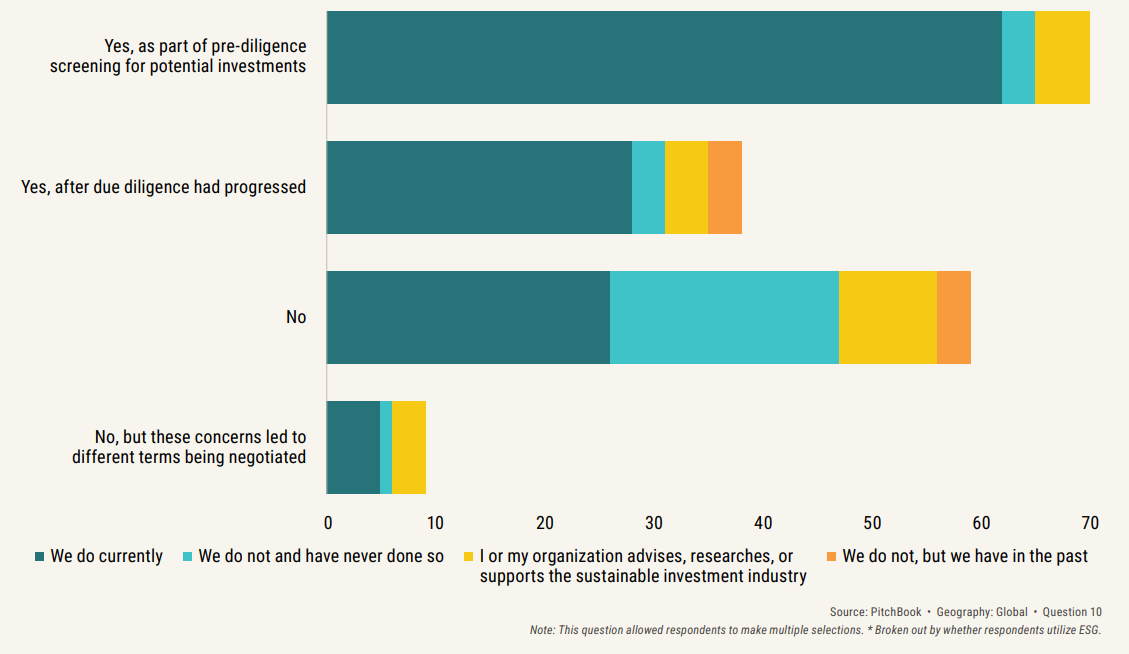
The clearest progress is at the pre-investment stage. The PRI found that most private markets investors assess the financial impact of material sustainability topics during due diligence. PitchBook provides an additional proof point: 60% of current ESG practitioners say they have turned down an investment during pre-diligence because of ESG concerns (see Figure 2). Morningstar Sustainalytics points in the same direction, with ESG insights used most often in screening and deal sourcing (55%) and due diligence and investment committee decisions (56%). The PRI’s survey went deeper and found that the majority of investors assessed the impact of sustainability on future performance considering downsides (79%), while 41% considered potential upsides. Across all three surveys, sustainability considerations are most firmly embedded before capital is committed.
Figure 2. Percentage of Respondents That Have Declined to Make or Recommend an Investment Due to ESG Concerns in the Past Five Years
Source: 2026 Sustainable Investing Survey. PitchBook.
The bigger question is what happens after the deal closes. The PRI found that sustainability-linked value creation is less consistently embedded during the holding period and at exit. Across regions, fewer than 40% allocate capex and opex to sustainability goals. Sustainalytics’ survey also shows a clear drop-off between pre-investment use cases and post-investment portfolio management, where only 24% say ESG insights directly inform decisions. The market has made progress using sustainability to inform capital allocation. The next opportunity is to translate those insights into operating priorities, measurable performance indicators and a more consistent approach to value creation throughout ownership and at exit.
Financial Relevance is Gaining Ground, But Measurement Still Lags
The surveys also show growing recognition that sustainability can be financially relevant in private markets. The PRI found that approximately 72% of investors believe sustainability has a moderate-to-significant positive impact on financial value today, and expect that impact to grow over the next three years. PitchBook found that 77% of respondents, excluding those that advise or support the industry, currently incorporate ESG factors, up from 72% in 2025. Sustainalytics adds an important nuance; the largest share of respondents continues to use sustainability data but may be reframing how they communicate that work. The Asset Owner Perspectives survey provides the allocator view: among asset owners that consider ESG, more say it has become more material to investment decisions over the past five years than less material (see Figure 3).
Figure 3. Whether ESG Has Become More or Less Material in the Past Five Years (%)
Source: Asset Owner Perspectives Survey 2026: Quantitative Analysis. Morningstar.
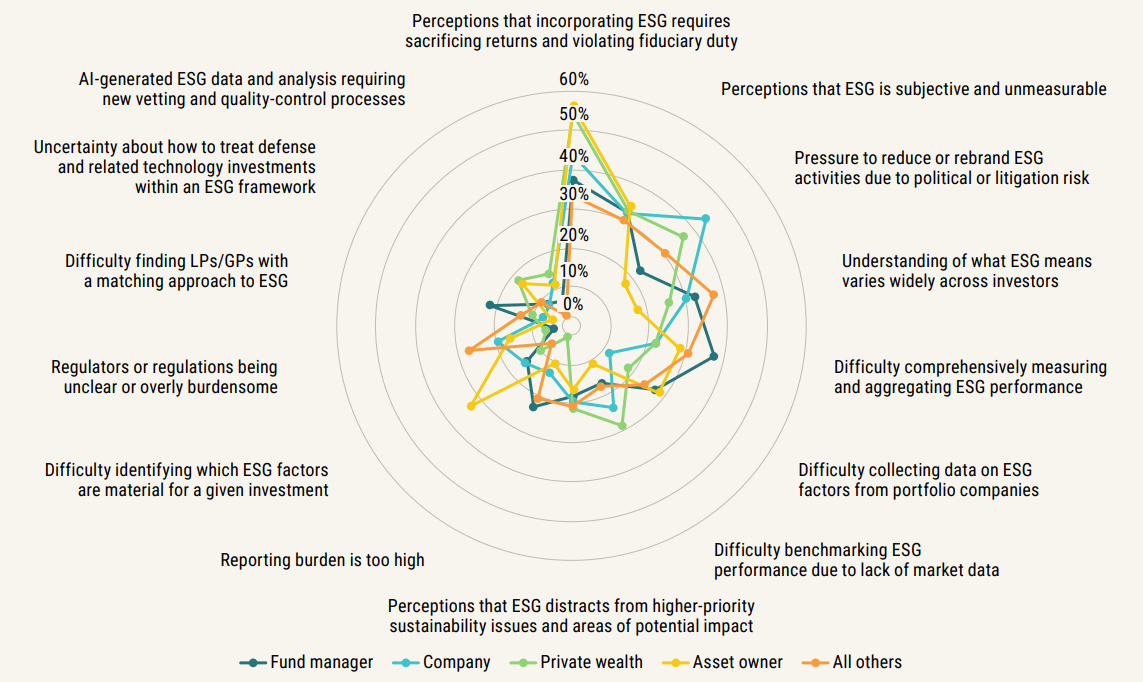
However, evidence is not keeping pace with conviction. Quantifying the profit and loss (P&L) impact of sustainability is a key challenge across regions and firm sizes in the PRI survey. PitchBook points to the same underlying credibility gap: 32% of respondents cite the perception that ESG is subjective and unmeasurable as a key challenge. Sustainalytics highlights the practical data barriers behind this concern: 46% cite collecting ESG data as a top private markets challenge, while 43% point to inconsistent reporting across companies. Asset owners continue to identify data quality as a leading weakness in the ESG information and tools available to them. Together, these findings underscore the need to move from directional evidence of value to more consistent measurement of how sustainability initiatives affect revenue, costs, risk and exit outcomes.
This measurement gap also helps explain why sustainability-linked incentives remain limited. The PRI found that only about 30% of investment firms have such incentives, while portfolio-company incentives are concentrated among leadership and are rare for mid-management and non-management roles. In practice, this suggests that sustainability ambitions are not yet consistently translated into accountability across the organization. Firms may have strategies, teams and priorities in place, but without agreed metrics and a clear line of sight to financial outcomes, it remains difficult to tie compensation to delivery.
Climate, Energy and AI Are Converging
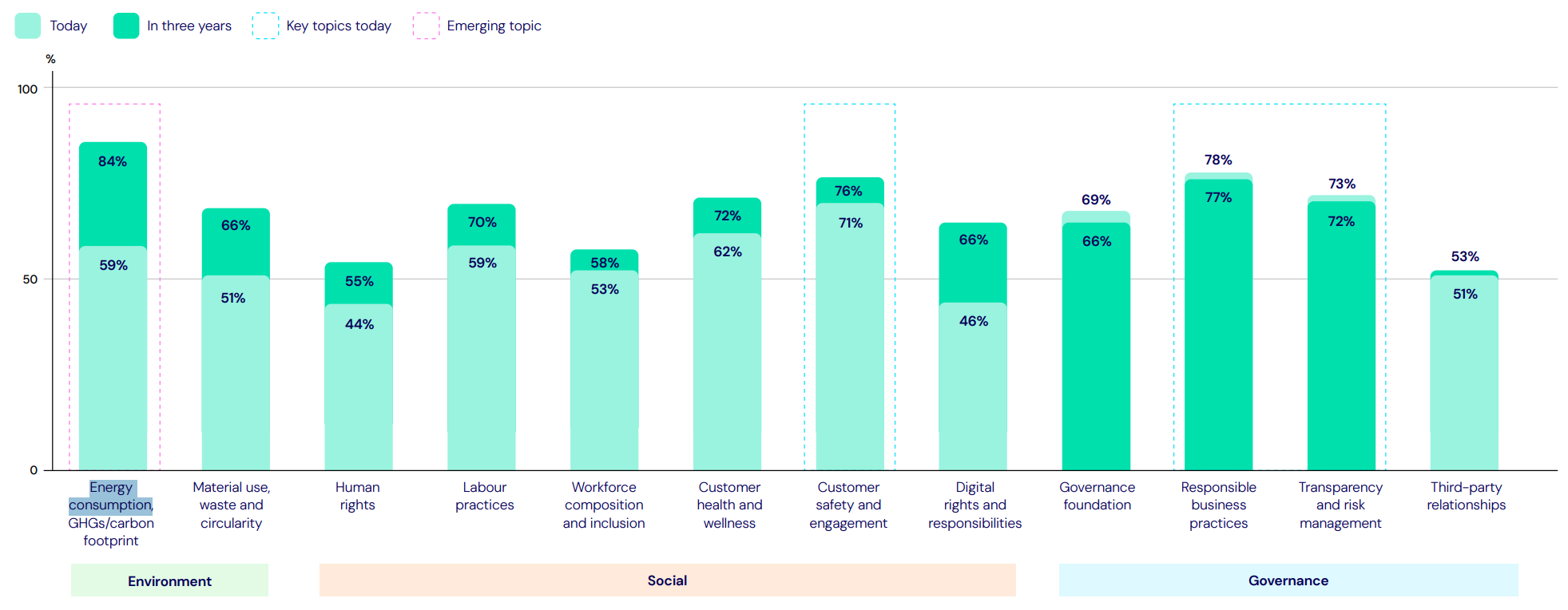
The surveys are closely aligned on investment priorities. The PRI found that energy consumption and greenhouse gas (GHG) reduction is expected to become the leading sustainability topic for financial value creation over the next three years, selected by more than 80% of respondents across regions (see Figure 4). PitchBook similarly found that climate and energy remain the top impact investing themes, selected by 67% and 65% of respondents, respectively. The Asset Owner Perspectives Survey identified climate transition readiness and energy management as leading environmental considerations. In North America, the PRI data also points to rising importance for energy consumption, GHG emissions and water stewardship, themes that are increasingly connected to infrastructure investment and AI-related demand.
Figure 4. Importance of Sustainability Topics – Today and in Future
Source: Sustainability Value Creation: Global Investor Insights. PRI.
AI is reshaping the sustainability conversation across asset classes. It is not only a potential solution to data, analytics and workflow challenges, it is also creating new sustainability and infrastructure risks. The Asset Owner Perspectives Survey, which reflects asset owners’ overall investment portfolios rather than private markets specifically, shows a sharp increase in concern about AI’s environmental impact: 58% are concerned that AI-driven demand for data centers and power could contribute to higher energy costs or inflation. PitchBook shows how these broader concerns translate into private-market investment considerations. Respondents highlighted AI, data centers, power demand and resource constraints, with potential consequences for infrastructure investments, portfolio-company costs, capital requirements and resilience. Geopolitical and supply-chain pressures are also shaping impact priorities. Waste and circularity ranked third in PitchBook’s survey, selected by 50% of respondents. This reflects a greater focus on operational efficiency, disciplined growth and reducing dependence on imported raw materials and volatile commodity markets. For investors, climate, digital infrastructure, resource efficiency and portfolio resilience are becoming increasingly interconnected.
The Data Challenge Is Increasingly About Trust
Each survey approaches data differently, but the conclusion is consistent: investors do not simply need more ESG data in private markets, they need data that is credible, comparable and decision useful. PitchBook found that the perception that ESG is subjective and unmeasurable is the second most frequently cited challenge (32%). Sustainalytics shows how that concern manifests in practice, with collecting ESG data (46%) and inconsistent reporting across companies (43%) identified as the leading private markets data challenges. The PRI found that during the due diligence stage, when sustainability value creation activities are most integrated, investors struggle to quantify the financial impact of sustainability on target company P&L, signaling that financial measurement remains in its early stages.
There are signs of progress, however. PitchBook found that difficulty collecting ESG data from portfolio companies declined to 21% in 2026 from 30% in 2025, while difficulty benchmarking ESG performance fell to 20% from 25% (see Figure 5). More standardized collection tools, reporting templates and third-party data providers appear to be making these challenges more manageable. But progress remains uneven. The PRI is working with over 500 private markets investors, in addition to academia and advisors globally, on its flagship Sustainability Value Creation project for private markets. The project is designed to provide guidance to investors on this topic across private markets and real assets. PitchBook also reported lower awareness of the ESG Data Convergence Initiative among both GPs and non-GPs, while Sustainalytics found low adoption of shared data workflows: 65% of private markets respondents use neither the EDCI dataset or the IDP questionnaire. Standardisation is helping where it is used, but industry-wide adoption remains slow.
Figure 5. Top Three Challenges for ESG in Private Markets
Source: 2026 Sustainable Investing Survey. PitchBook.
Voluntary frameworks remain an important part of the disclosure landscape. PitchBook found that PRI reporting requirements are the second most frequently cited framework influencing sustainable investing practices, selected by 34% of respondents, ahead of most mandatory regimes. This suggests that widely recognized, cross-market frameworks can help drive disclosure even without a government mandate. At the same time, the Asset Owner Perspectives Survey shows that investors no longer view ESG data improvement as a solely regulatory responsibility. Regulators still rank first, but specialized data providers and rating agencies are close behind. Private markets data must therefore be transparent enough for LP reporting, practical enough for investment teams and defensible enough to support methodology-driven decisions.
This is where methodology becomes critical. Estimated data, AI-enabled analysis and new collection workflows can help close information gaps, but only if investors understand how the data is produced, where it is reliable and where judgment is still required. In private markets, the advantage may not come from having the most data, it may come from turning fragmented information into credible, decision-useful insights.
The Takeaway
Taken together, the surveys point to a private markets sustainability landscape that is maturing, not fading. The debate is shifting from broad commitments to practical questions: how does sustainability affect risk, return, resilience and, most importantly, value creation? How can LPs compare managers and portfolio companies more consistently? How can GPs collect meaningful data without creating unnecessary burden? And how can asset managers turn fragmented information into insights that investment teams can use?
The next phase will be defined less by whether investors care about sustainability and more by whether the market can build the methodology, playbooks, data and workflows needed to apply it consistently across the investment lifecycle.