
Key Insights:
|
|
|
The apparel industry has spent many years discussing circularity as a sustainability ambition. Now, in Europe, circularity is rapidly becoming a business requirement.
A wave of new regulations is poised to reshape how apparel companies design products, collect data, manage inventory, and even price garments. A Morningstar Sustainalytics report, How EU Circularity Rules Could Reshape the Apparel Industry, highlights two regulatory tools at the center of this shift that could alter the economics of fashion: the Digital Product Passport (DPP) and eco-modulated Extended Producer Responsibility (EPR) fees. Together, they move circularity from corporate sustainability reports into day-to-day operations, with potentially significant implications for costs, compliance and market access.
Circularity Is Becoming a Market-Access Issue
The European Union's circular economy agenda is aimed at tackling a stubborn problem. Textile production has grown rapidly over the past two decades, while garment utilization (how frequently and how often a garment is used or worn)1 has declined and textile waste continues to mount. Yet less than 1% of material used in clothing is recycled back into new clothing.2
To address these challenges, the EU is implementing a regulatory framework that links market access to sustainability performance. The Ecodesign for Sustainable Products Regulation (ESPR) gives regulators authority to impose product-specific requirements related to durability, repairability, recycled content, and traceability. Textiles are among the priority categories expected to be addressed early under the framework.
For apparel brands, the message is clear: sustainability claims alone will no longer be enough. Companies will increasingly need evidence, systems and product-level data to support them.
Sustainalytics’ research suggests the industry may not be fully prepared for this transition. Across the footwear, luxury apparel and retail apparel industries covered by our ESG Risk Ratings research, only 12% of companies achieve a strong management score (above 50) on impact-related product management indicators, highlighting substantial room for improvement as regulatory expectations rise.
The Digital Product Passport: More Than a QR Code
The DPP is often described as a digital identity card for products. But viewing it as a disclosure exercise risks underestimating its significance.3
The DPP is being rolled out progressively across select product groups. Initial sectors include certain types of batteries, with additional product groups expected to follow. It is expected that passports for the textiles and apparel industry will follow in 2027 or 2028 in line with the ESPR workplan.4
The DPP is designed to make sustainability, compliance, and traceability information accessible throughout the value chain. In the textiles and apparel industry, this means linking data about materials, suppliers, and product characteristics at the stock-keeping unit (SKU) level.5
That requirement could create a new operational layer for many textiles and apparel companies. Brands may need to connect fragmented internal systems, improve supplier data collection, and build more sophisticated traceability capabilities. As product assortments become larger and more complex, implementation challenges can multiply.
Along with added operational complexities, DPP compliance will create additional costs for companies within scope. These will include one-time expenditures as well as recurring operational fees (see Table 1).
Importantly, the biggest risk may not be regulatory fines. Under the ESPR, authorities could block non-compliant products from entering the EU market or require products already in the market to be withdrawn or recalled. Incomplete data could therefore translate into lost sales, inventory disruptions, and working-capital pressures.
The result is a major shift in how investors and companies think about circularity. The critical question is increasingly whether companies have the systems needed to demonstrate compliance at the product level.
This matter is likely to be particularly acute for apparel companies operating complex product portfolios. Sustainalytics’ research indicates that retail apparel companies face structurally higher exposure to product-related sustainability risks because of factors such as high SKU turnover, private-label offerings, and business models built on large product volumes. These characteristics could make compliance with product-level traceability requirements more challenging.
Table 1. Digital Product Passport Cost Overview
| Digital Product Passport Cost Bucket | Estimated One-Time Capex | Recurring Annual Opex Impact |
|---|---|---|
Software Subscription | Usually limited upfront setup cost. |
|
IT Systems Integration | EUR 5,000-EUR 100,000+ per system. Costs rise with the number of systems, brands, and suppliers that must be connected. |
|
Data Carrier | Usually limited fixed capex for standard quick response, or QR, solutions; higher when brands adopt secure NFC (near field communication)/RFID (radio frequency identification) authentication hardware (encoders, readers, scanners) across production, logistics, and stores. |
|
Source: Renoon. 2025; CircularTech. 2025; PassportCraft Team. 2026; Tianjun NFC Tag. 2025; NFCWORK. 2026.
Eco-Modulated Fees Put a Price on Product Design
The second major development may prove even more consequential over the long term as it effectively links product design decisions more directly to compliance costs.
The revised EU Waste Framework Directive requires member states to implement textile EPR schemes with eco-modulated fees by April 2028. Under these systems, producers pay for the collection, sorting, and treatment of products at end of life. However, fees will increasingly vary according to environmental performance. In practical terms, products that are durable, repairable, and recyclable could incur lower fees. Products that are difficult to repair, recycle, or disassemble could face higher charges. For companies operating high-volume business models with frequent product turnover, small fee differences applied across thousands or millions of units could become meaningful. France offers an early glimpse of how this might evolve. Its long-standing textile EPR scheme already uses eco-modulation to differentiate fees among products. The experience suggests that companies lacking product-level evidence of eco-design could face higher compliance costs.
Circularity Leaders and Laggards May Emerge Quickly
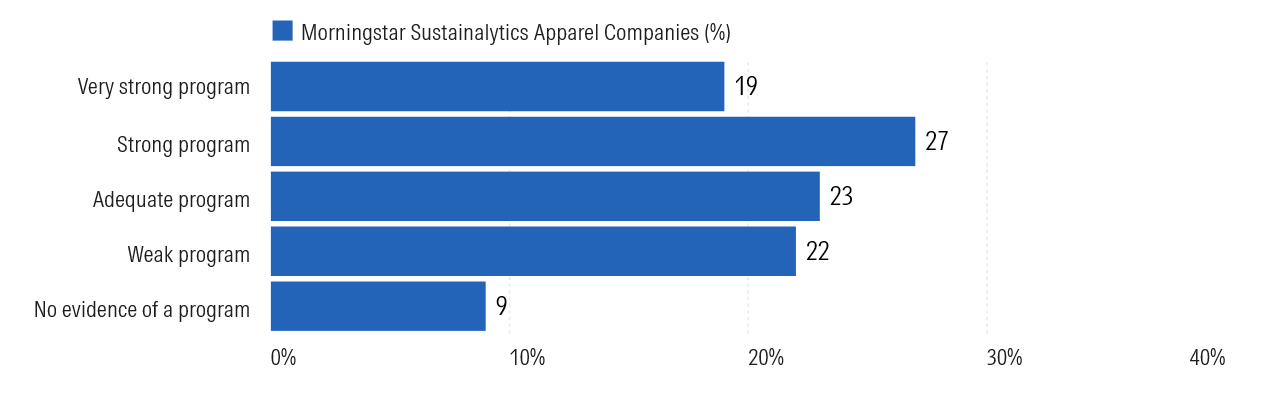
Sustainalytics’ data show significant differences in preparedness across the industry (see Figure 1). Nearly 10% of companies assessed score zero on our eco-design management indicator, while only 20% demonstrate very strong eco-design programs, suggesting that a relatively small group of companies may be positioned to adapt more effectively to circularity requirements.
Figure 1. Eco-Design Indicator Score Distribution
Source: Morningstar Sustainalytics. Data as of July 2026.
Businesses with high SKU counts, fragmented supplier networks, and limited product traceability may face steeper compliance costs and greater implementation challenges. Fast-fashion and low-price retailers could be particularly vulnerable if durability, repairability, and recyclability become important determinants of future fees.
At the other end of the spectrum, companies that have already integrated lifecycle assessments into product development, established eco-design targets, and built stronger data systems may be better positioned to adapt. These firms could potentially reduce future compliance costs while avoiding disruptions tied to market-access requirements.
In other words, regulatory readiness may become an increasingly important differentiator within the industry.
Beyond Compliance: A New Competitive Advantage?
What makes the current moment noteworthy is that these regulations extend well beyond reporting obligations. They introduce mechanisms that can directly influence how products are designed, sourced, and managed throughout their lifecycles.
For investors, the challenge is identifying which companies are building the operational capabilities needed for this new environment. For apparel brands, the challenge is ensuring that circularity is embedded in product development rather than added as a compliance exercise later.
Sustainalytics’ research suggests the companies best positioned for the emerging regulatory environment are those embedding circularity into product-development processes rather than treating it as a reporting exercise. Our analysis identified leaders such as On Holding AG, H&M Hennes & Mauritz AB, and LVMH Moët Hennessy Louis Vuitton SE, which combine measurable eco-design targets, lifecycle-based product development, and regular disclosure of performance indicators. As Digital Product Passports and eco-modulated EPR fees become embedded within the European regulatory framework, these operational capabilities may prove increasingly important in managing compliance costs, reducing disruption risk, and maintaining market access.
To learn more about how Digital Product Passports, eco-modulated EPR fees, and other emerging regulations could reshape the apparel sector, and to see how Sustainalytics’ data can help identify circularity leaders and laggards across the footwear, luxury apparel, and retail apparel industries, download Sustainalytics' full report, How EU Circularity Rules Could Reshape the Apparel Industry.
References
- Definition from sustainability-directory.com.
- European Environment Agency Textiles (updated 10 April 2026) accessed July 2026. https://www.eea.europa.eu/en/topics/in-depth/textiles.
- European Parliament, Panel for the Future of Science and Technology (STOA). 2024. Digital Product Passport for the Textile Sector. June 2024. https://www.europarl.europa.eu/RegData/etudes/STUD/2024/757808/EPRS_STU%282024%29757808_EN.pdf.
- European Commission. 2025. Ecodesign for Sustainable Products and Energy Labelling Working Plan 2025–2030. Brussels, April 16, 2025. https://environment.ec.europa.eu/document/download/5f7ff5e2-ebe9-4bd4-a139-db881bd6398f_en?filename=FAQ-UPDATE-4th-Iteration_clean.pdf.
- Data.europa.eu. 2024. “EU’s Digital Product Passport: Advancing Transparency and Sustainability.” September 27, 2024. https://data.europa.eu/en/news-events/news/eus-digital-product-passport-advancing-transparency-and-sustainability.