-(1).png?sfvrsn=de16e4a1_1 "Lorena Tobosaru")
Key Insights:
|
|
|
Western biopharma companies face mounting structural challenges from drug pricing pressure to looming patent expiries, to rising drug development costs.1,2 Against this backdrop, China is rapidly emerging as a source of biopharmaceutical innovation, supported by significant investment, regulatory reform, and large‑scale research and manufacturing capacity.3 In recent years, China has overtaken Europe in drug discovery and early‑stage development and is narrowing the gap with the US, with more than 1,250 novel drugs entering early‑stage development in 2024.4
Cross‑border licensing deals and research and development (R&D) partnerships with Chinese biopharma firms allow Western companies to diversify pipelines, expand therapeutic area focus, and lower in-house R&D costs through clinical or regulatory milestone-based risk sharing; positioning such deals as cost-effective alternatives to accessing external innovation compared with traditional mergers and acquisitions.5
However, these partnerships may raise important ESG risks and considerations, particularly in relation to geopolitics, product governance, and business ethics.
Geopolitics as a Potential ESG Risk Multiplier
Cross-border licensing deals and R&D partnerships increasingly sit at the intersection of broader geopolitical dynamics, as the US and Europe become more sensitive to intellectual property protection, data security, supply chain resilience, and broader economic reliance on China.
Rising US-China tensions, alongside incentives to onshore drug manufacturing, tariffs, and emerging biosecurity legislation, are contributing to a more uncertain environment for cross-border collaborations in the US.6 Recent US measures signal a shift towards a more protective biopharmaceutical policy stance potentially restricting outbound investment. Among such measures, the Biosecure Act (2025) and the potential expansion of the COINS Act (2025) to include biotechnology. Such developments are likely to increase compliance costs and tighten oversight. Over time they may also restrict or complicate certain forms of cross-border licensing deals with Chinese firms.
In parallel, the EU has its own initiatives aimed at strengthening resilience and derisking regional drug supply, manufacturing and innovation. However, these initiatives are not focused on China-specific decoupling, as more explicitly seen in the US. The proposed Critical Medicines Act (2025) and revisions to the EU Pharmaceutical Package may also elevate expectations surrounding governance, transparency, compliance and risk management. All of these could affect partnerships involving Chinese firms.7,8
Taken together, this evolving geopolitical and national security landscape potentially exposes cross-border licensing deals with Chinese firms to heightened regulatory scrutiny and compliance obligations. This could translate into potential delays, audits, contract renegotiations or, in more extreme cases, blocked collaborations.
Strong ESG management may help support Western biopharma’s response to the emerging and shifting geopolitical landscape. In effect, firms that exhibit strong governance structures, comprehensive due diligence, and proactive risk mitigation may be better prepared to manage the related risks and uncertainties through improved risk oversight, monitoring processes, and stronger controls, potentially rendering companies more resilient and agile amid geopolitical uncertainty.
For a deeper dive into the risks related to the evolving geopolitical landscape linked to these partnerships, please read As Biopharma Turns to China for Growth, ESG Risks Remain in Focus.
Product Governance and Business Ethics in Focus
Beyond geopolitics, differences between the environmental, social and governance (ESG) performance of Chinese and Western biopharma companies, particularly on product governance and business ethics, may further influence cross-border licensing deals. Key areas include product quality and safety, clinical trial oversight, and data transparency.
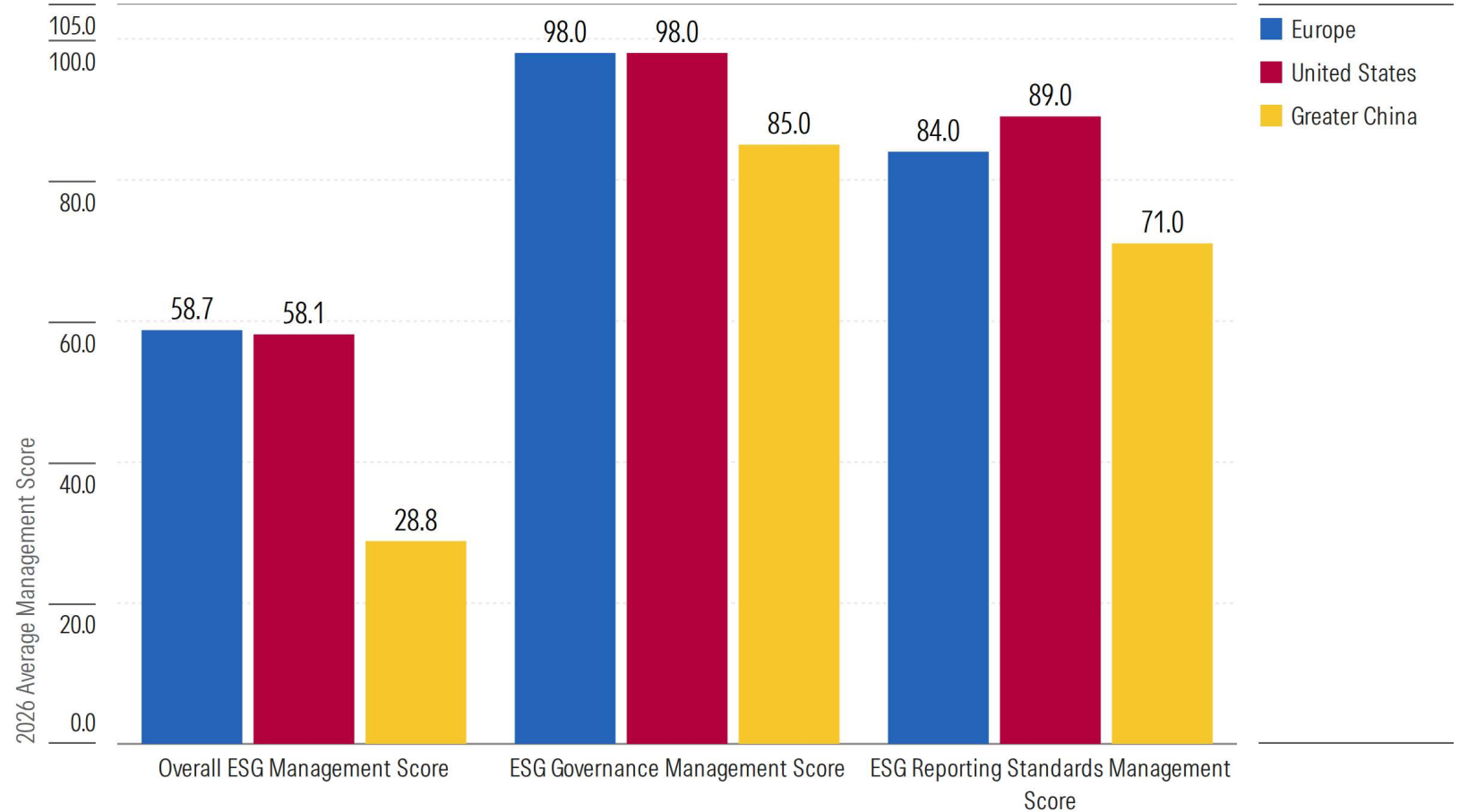
Sustainalytics’ ESG Risk Ratings data highlights meaningful regional disparities in ESG management across overall ESG management, as well as for product governance and business ethics. On average, US- and Europe-domiciled biopharma companies exhibit stronger governance frameworks, disclosure practices, and risk mitigation systems related to product governance and business ethics. By contrast, Chinese biopharma firms score materially lower on these same select metrics (see Figure 1). This may partly reflect disclosure differences, but also points to structural gaps in governance, oversight, transparency, and ESG risk management.
These metrics are critical in investor assessments, as they reflect the robustness of companies’ governance, risk management, and transparency practices in areas linked to patient safety, regulatory compliance, and product integrity. Strong performance signals an ability to proactively manage operational and ethical risks. These are increasingly important considerations in cross-border collaborations with biopharma firms based in China, where differences in regulatory frameworks, oversight standards, and disclosure practices may amplify execution and compliance risks.
For Western licensees, weaker ESG practices at the partner level may translate into elevated ESG risks, potentially impeding the success of cross-border licensing deals, particularly amid rising geopolitical tensions.
Exhibit 1. Overall ESG and MEI Management Scores Across Regions in 2026
Source: Morningstar Sustainalytics. Data as of May 2026.
Note: Greater China includes firms domiciled in China, Hong Kong, and Taiwan. Europe includes firms domiciled in EU member states, as well as Switzerland and the UK. Data includes companies in the biotechnology and pharmaceuticals subindustries. Management scores range from weak (0-25), average (25-50), to strong (50+).
Forward Looking Risk Considerations
As China’s biopharmaceutical market matures, certain ESG risks could decline if Chinese regulatory standards continue to converge with international ones. This may potentially reduce ESG transmission risks for Western licensee firms. This is particularly true for those risks related to quality and safety, clinical trial oversight, and data transparency. However, this possibility may be offset by an increasingly complex geopolitical environment and more security driven policymaking in the US and Europe.
For investors, the long-term sustainability of cross-border biopharma collaboration will depend not only on scientific success, but on companies’ ability to navigate an increasingly volatile geopolitical environment, as well as ESG risks. Companies that effectively manage ESG and geopolitical risks may retain strategic flexibility and competitive advantage, while those that fall short risk heightened execution risk and potential value erosion.9
References
- Deloitte. 2026. "Navigating the GLP-1 Boom." May 4, 2026. https://www.deloitte.com/us/en/Industries/life-sciences-health-care/perspectives/navigating-the-glp-boom.html.
- Anderson, K., Lee, K. "Healthcare Observer: Biopharma Product Pipelines Rise to Meet Steeper Patent Cliffs." May, 2026. Morningstar.
- Walrath, R. 2025. "China’s Biotech Industry is on the Rise. Will it Reshape US Pharma?" September 5, 2025. Chemical & Engineering News. https://cen.acs.org/pharmaceuticals/drug-development/Chinas-biotech-industry-rise-reshape/103/web/2025/09.
- Tong, A., et al. "China Biotech’s Stunning Advance is Changing the World’s Drug Pipeline. Bloomberg. July 13, 2025. Bloomberg. https://www.bloomberg.com/news/features/2025-07-13/china-drugmakers-catching-up-to-us-big-pharma-with-new-medicine-innovation.
- Zercher, B. 2026. "Analyst Note: The Chinese Biopharma Landscape: Where New Assets Are Born." January 23, 2026. PitchBook. https://pitchbook.com/news/reports/q1-2026-pitchbook-analyst-note-the-chinese-biopharma-landscape-where-new-assets-are-born.
- National Security Commission on Emerging Biotechnology. 2025. "The Future of U.S.–China Biotechnology Competition." December, 2025. https://www.biotech.senate.gov/wp-content/uploads/2025/12/NSCEB-Future-of-U.S.-China-Biotech-Competition-Dec-2025.pdf.
- Stevens, C. 2025. "EU–China Relations in 2025: De‑risking, Rivalry, and the Search for Balance." October 17, 2025. EU Reporter. https://www.eureporter.co/world/china-2/china-eu/2025/10/17/eu-china-relations-in-2025-de-risking-rivalry-and-the-search-for-balance/.
- Krukover, A. 2025. "The Critical Medicines Act: A New Pillar of European Pharmaceutical Resilience." June 26, 2025. Taylor Wessing. https://www.taylorwessing.com/en/insights-and-events/insights/2025/06/the-critical-medicines-act.
- Zercher, B. "Analyst Note: The Chinese Biopharma Landscape: Where New Assets Are Born." January 23, 2026. PitchBook. https://pitchbook.com/news/reports/q1-2026-pitchbook-analyst-note-the-chinese-biopharma-landscape-where-new-assets-are-born.