Low Carbon Transition Ratings

Unrivaled analysis for financial stakeholders

Financial institutions are looking for the right balance of top-level signals and granular, flexible climate transition data to support their investment and reporting processes.

Navigating the climate transition requires comprehensive data that assesses both a company's low carbon ambitions and the actions it is taking to effectively align with a low carbon pathway.

Investors are looking deeper into the factors underlying the credibility of a company's transition plan to form their own tailored assessments.


Morningstar Sustainalytics’ Low Carbon Transition Ratings 
OUR SOLUTION
Insightful Research and Clear Analysis Across a Broad Set of Indicators
LCTR-solution-img

Morningstar Sustainalytics’ flagship Low Carbon Transition Ratings (LCTR) provide the solution – empowering investors and financial institutions to allocate capital to companies taking genuine action to reach their low carbon goals.

Benefits
Our Unique Approach to Climate Transition Research
icon-arrowIntersection

Highly Versatile Dataset

The LCTR is an end-to-end solution combining granular issuer-level data, high-level directional metrics like Implied Temperature Rise (ITR), and sector level insights for portfolio analysis and reporting.

icon-arrowIntersection

Company Action is a Priority 

While most research on the market focuses on companies’ low carbon ambitions, the LCTR assesses a company’s alignment with external standards, its future vulnerability from a shift to a low carbon economy, and the actions it is taking to manage transition risk.

icon-arrowIntersection

Comprehensive Company Assessment 

By looking both at stated targets and beyond, LCTR shows not just where companies say they're going - but whether their actions are in line with their goals. They surface two complementary signals: Performance-based Implied Temperature Rise (ITR), which projects a company's decarbonization trajectory based on a company's current practices, management actions and allocated CAPEX, and its Ambition Temperature, which models outcomes if stated targets are achieved. Together, they provide a multi-dimensional assessment of both trajectory and intent across the value chain.

icon-arrowIntersection

Experienced and Dedicated Team

The LCTR’s unparalleled insights build on Morningstar Sustainalytics’ 30-year history of assessing management risks. Each analysis is developed by a team of 120 professionals and specialists, offering over 200 data points for every company in our universe of over 10,000 issuers across various low carbon scenarios. This includes the UN PRI IPR Required Policy Scenario, IEA Net Zero 2050 Scenario, UN PRI IPR Forecast Policy Scenario, and the IEA Stated Policies Scenario.

icon-arrowIntersection

Deep Insight into Transition Plan Credibility

This gives LCTR users maximum transparency into the credibility of a company’s transition plans and management preparedness, making it easy to integrate granular insights into all stages of the investment process and map companies or funds to globally accepted frameworks like IIGCC’s NZIF 2.0. 

KEY FEATURES
Comprehensive Insights for the Low Carbon Transition
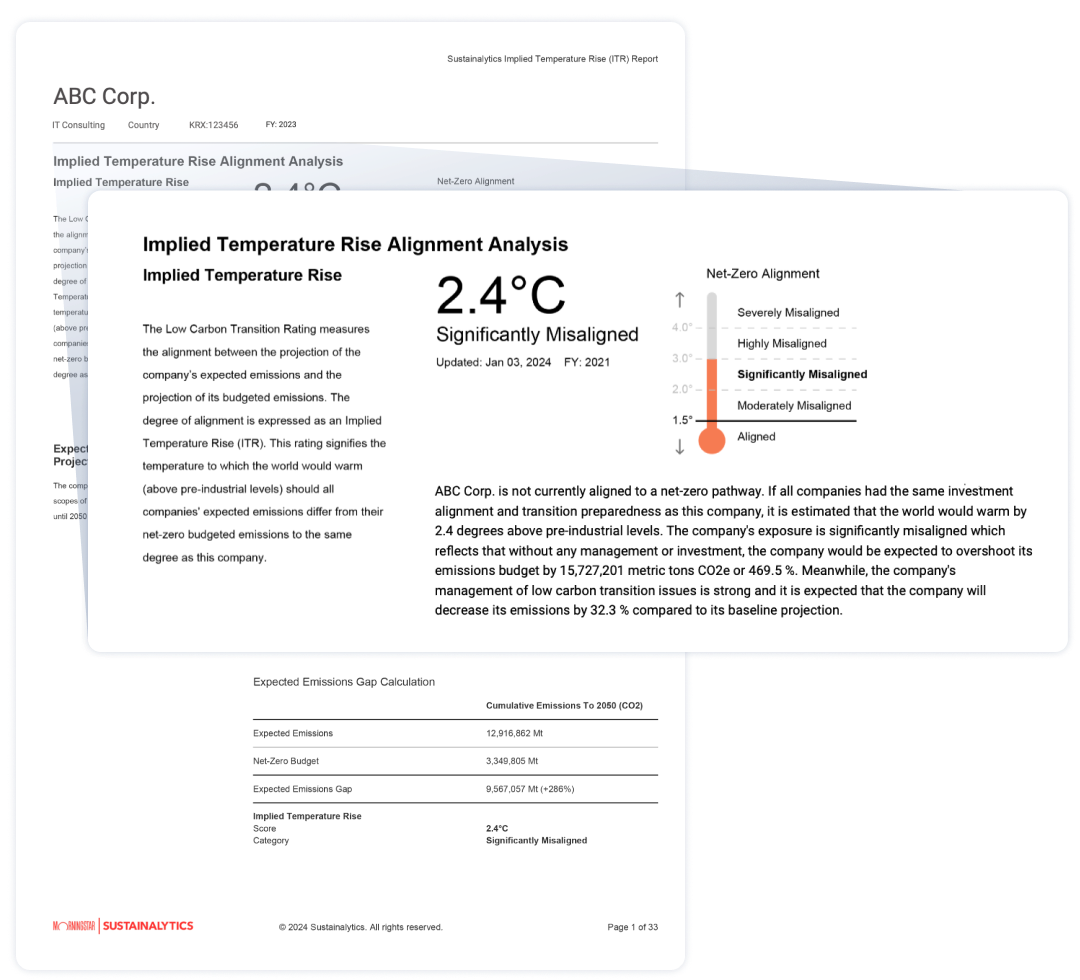
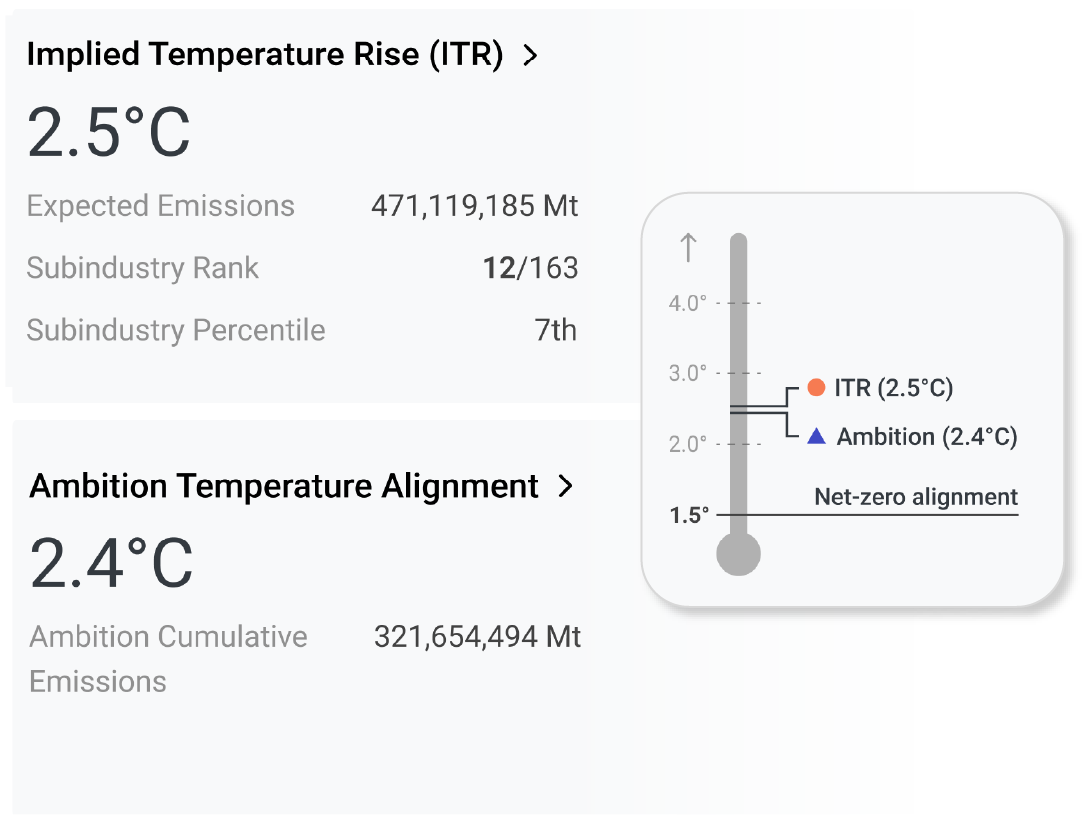
The LCTR’s top-level rating is expressed as the likely increase in global temperature – the Implied Temperature Rise (ITR) – by 2050 if the world economy had the same percentage of misaligned emissions as the company in question. The ITR is adjusted for the company’s future performance and an extensive analysis of its management actions.The Ambition-based ITR is presented as a separate comparative metric, expressing a measure of the company’s alignment if it meets its stated targets.
Compares the company’s performance-based ITR to its peers in global public equity and bond markets, as well as industry and sub-industry specific peers. Summarizes the top peers by market capitalization, including their overall rating, exposure, and management scores.
Summarizes overall alignment to the low carbon budget for each emission scope in an issuer’s value chain, indicating their contribution to the rating. Provides a separate analysis for exposure and management components to identify areas for additional action or investment.
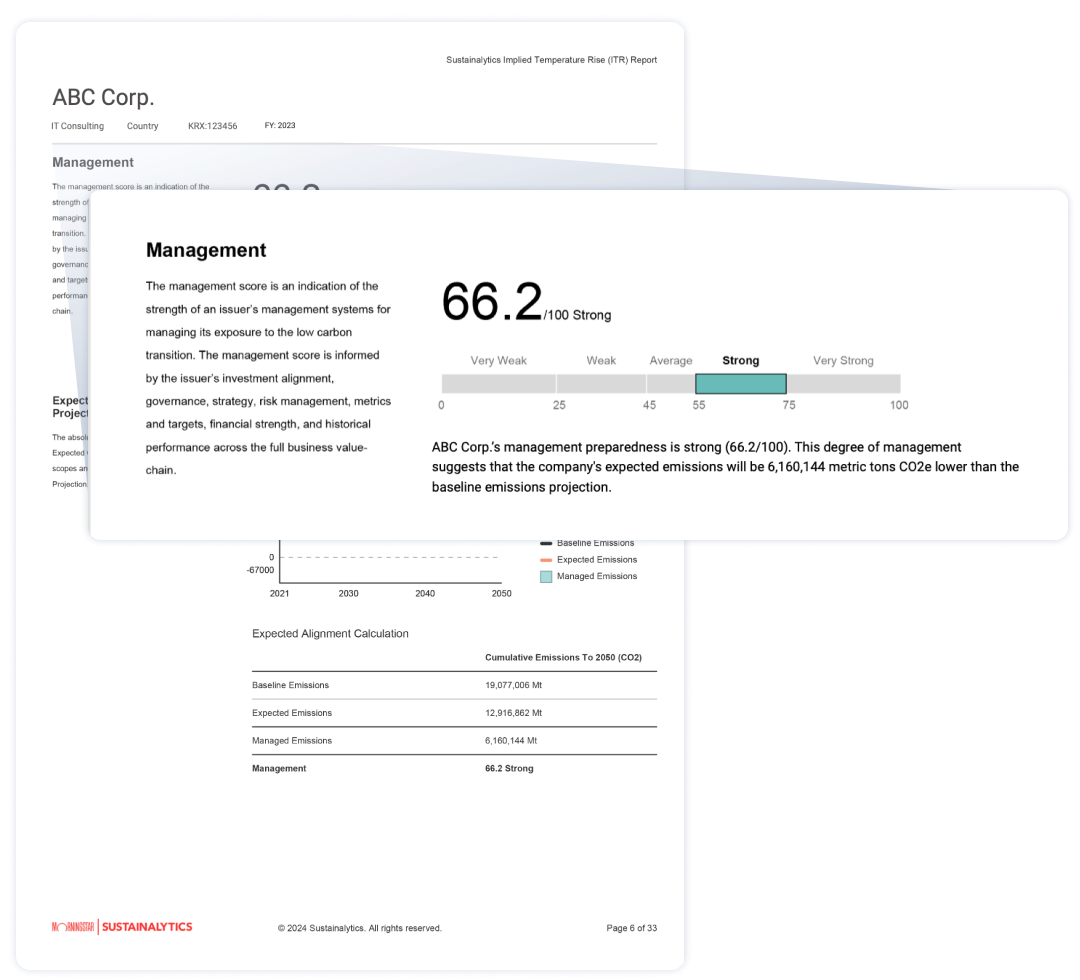
Using more than 85 general and subindustry-specific management indicators, this score evaluates the company capacity to manage its exposure to fossil fuel investments, likely changes in government policy, and the transition’s impact on its workforce and their communities, as well as its managers’ and board’s ability to guide the company through the transition.
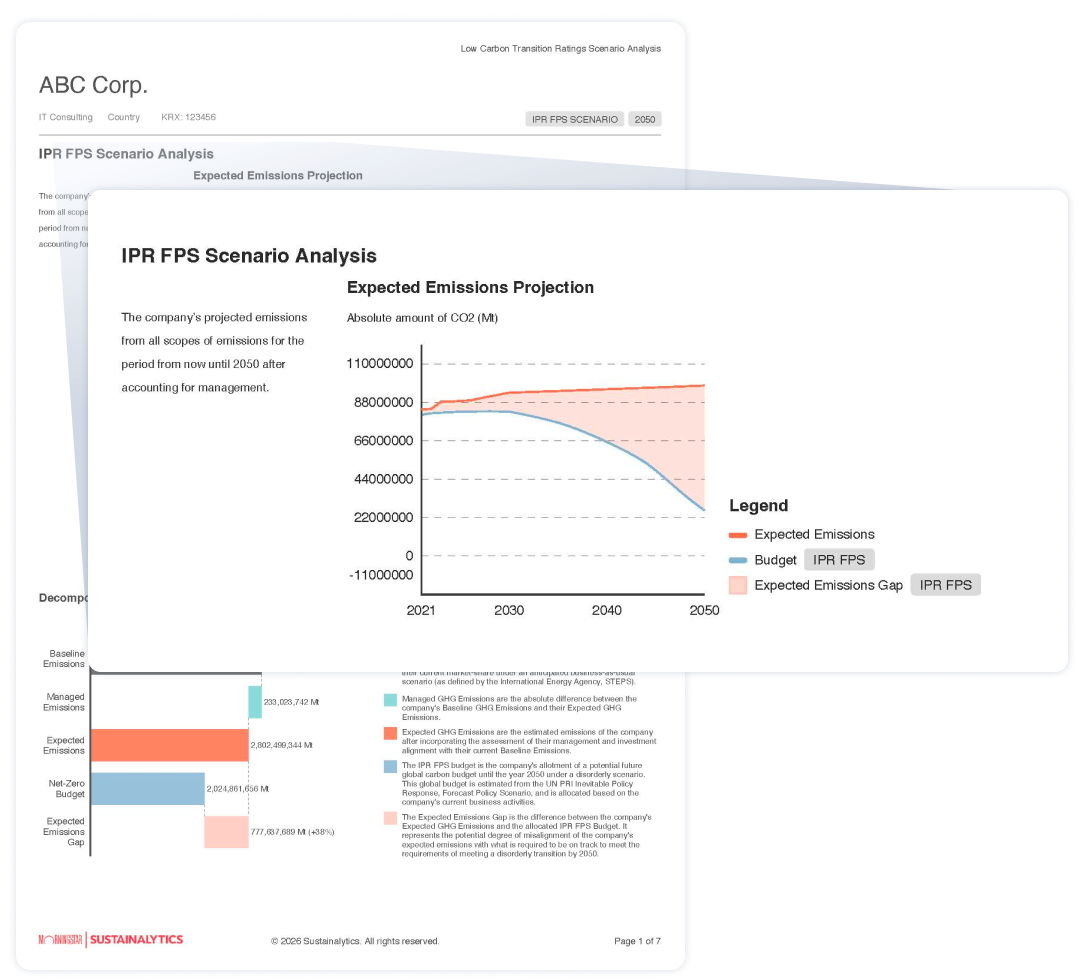
Analyze the annual and cumulative projections for issuers across 4 different transition pathway scenarios: 2 orderly, 1 disorderly, and 1 hot house.
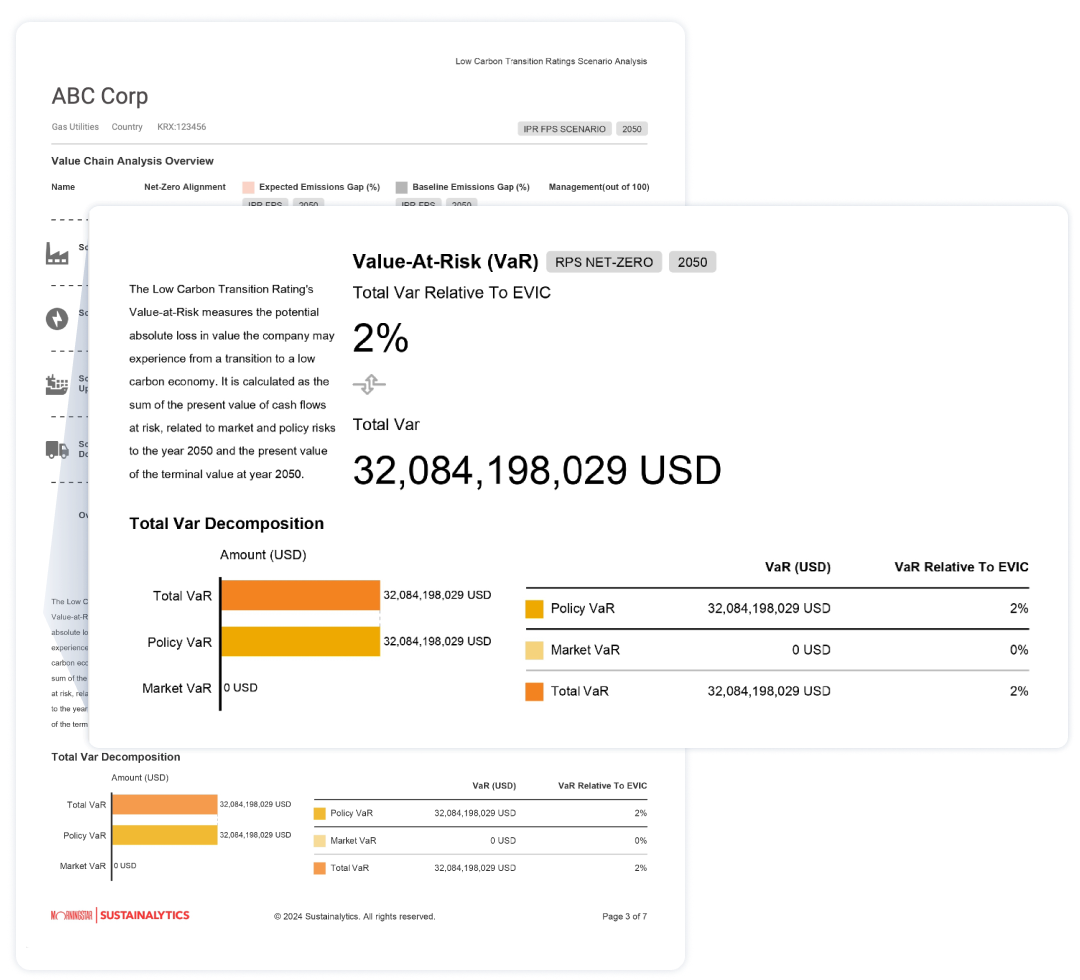
Reflects potential losses by 2050 from misalignment with low carbon targets. This financial metric assists investors in engaging with portfolio companies, preparing for regulations, and optimizing investments for transition scenarios. VaR is calculated for 4 transition pathway scenarios: 2 orderly, 1 disorderly, and 1 hot house.
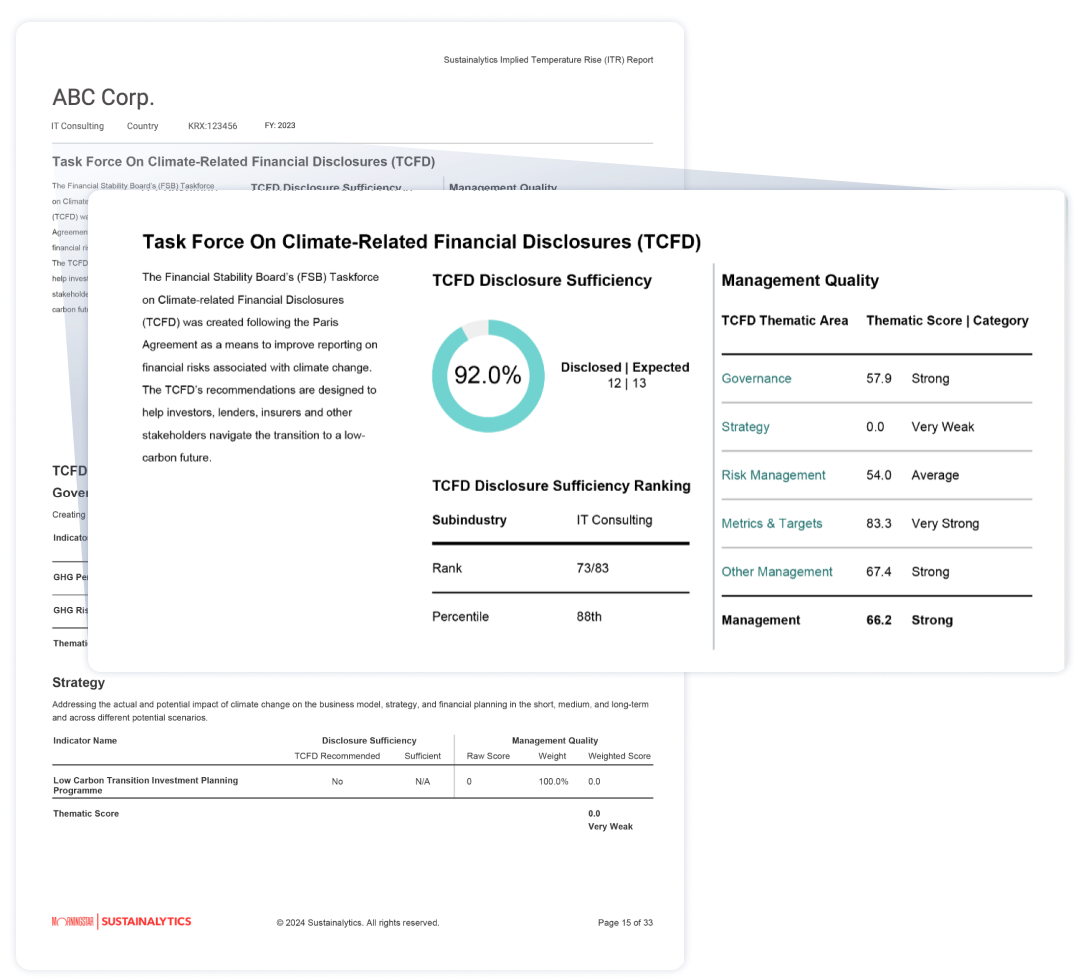
Provides an overall score and detailed analysis of a company’s carbon-related disclosures, using the key TCFD* thematic areas of governance, strategy, risk management, and metrics and targets.
text
*To learn more about using the Low Carbon Transition Ratings for your ISSB/TCFD reporting, see Morningstar Direct Reporting and Analytics: Climate Risk Analytics | Morningstar
METHODOLOGY
Performance-based ITR and Ambition Temperature Alignment

Morningstar Sustainalytics' performance-based Implied Temperature Rise (ITR) provides a comprehensive measure of low carbon transition exposure and management preparedness. We do this by analyzing a company’s expected alignment to a low carbon pathway and its management actions to reduce emissions.

The Ambition Temperature Alignment calculates a company’s expected alignment to a low carbon pathway based on its stated emissions reduction targets (if available).

Here's how we create the performance-based ITR and Ambition Temperature Alignment:

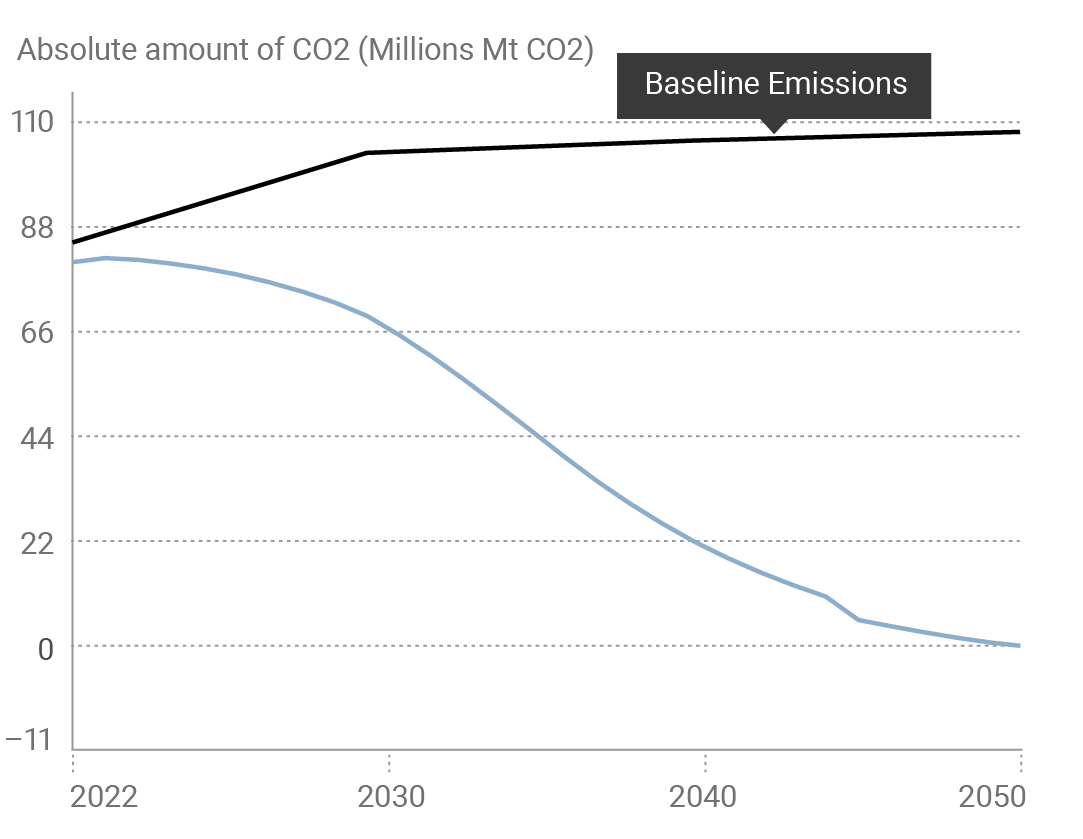
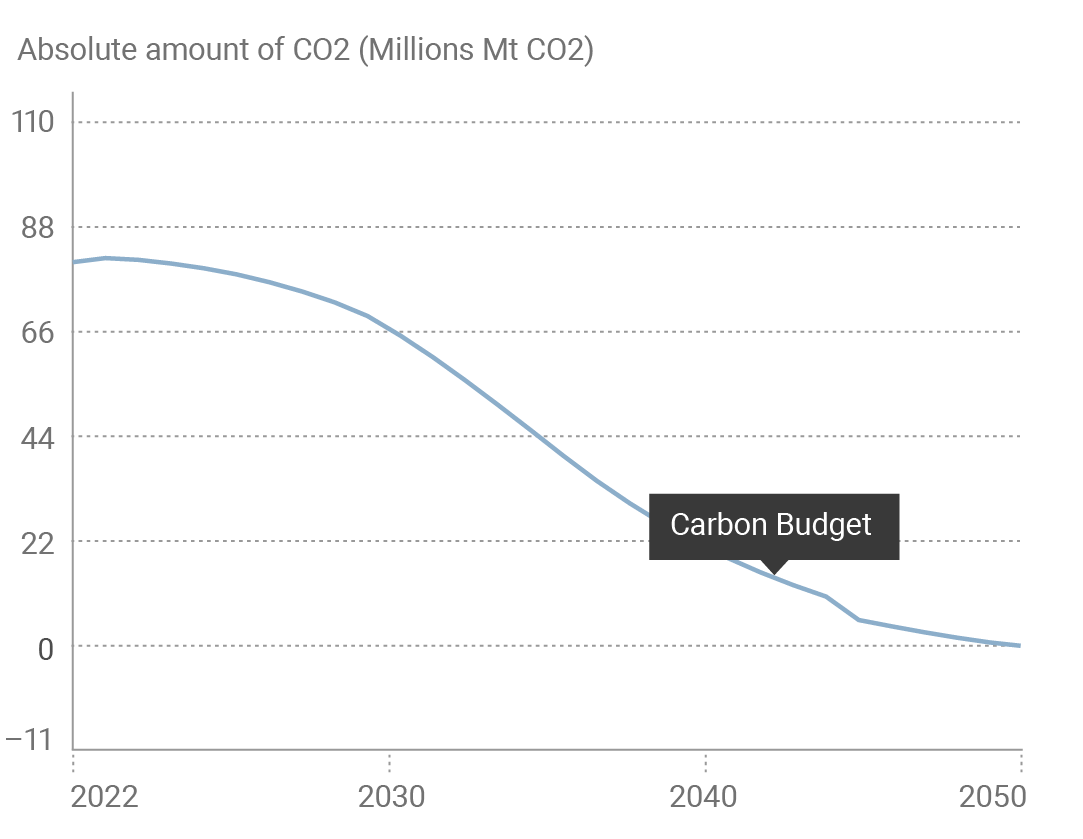
We begin by determining the company’s sector- and region-specific emissions limit based on the IPR RPS, necessary for aligning with a net-zero pathway by 2050. Carbon budgets are also available for other decarbonization pathways: 2 orderly, 1 disorderly, and 1 hot house in total.
We then establish a business-as-usual scenario derived from corporate reporting and estimation modeling across all three scopes, including upstream and downstream scope 3 emissions.
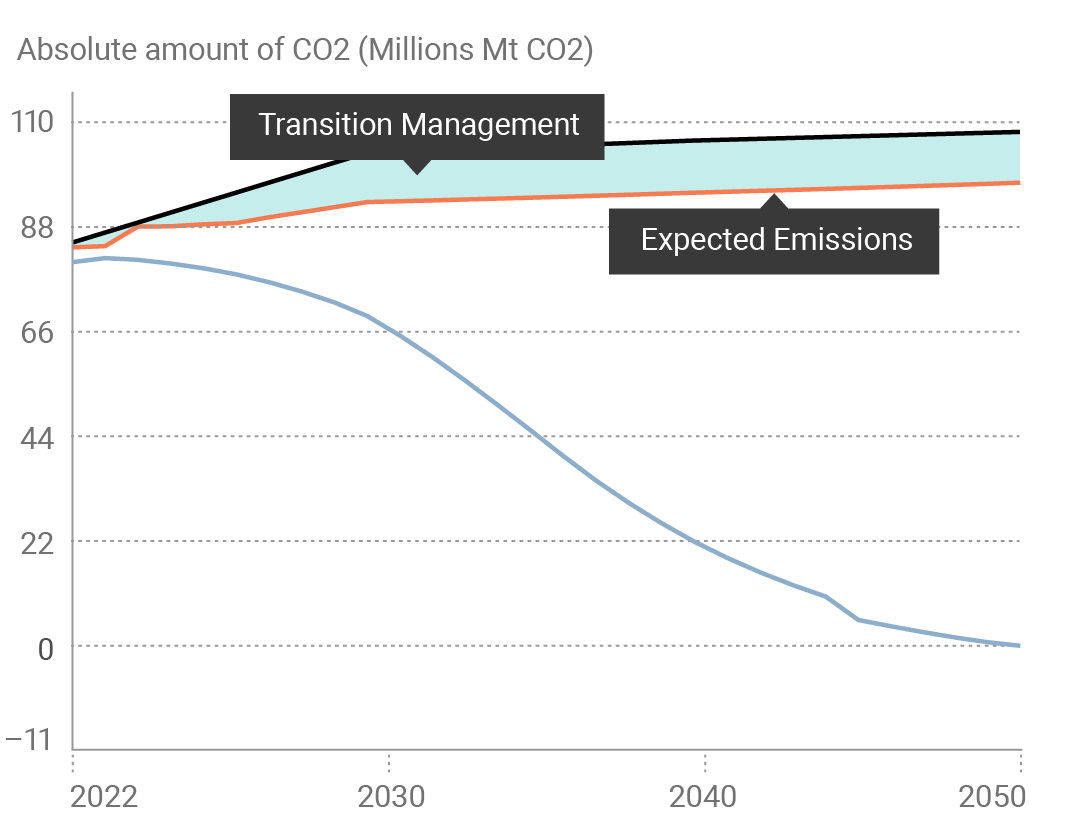
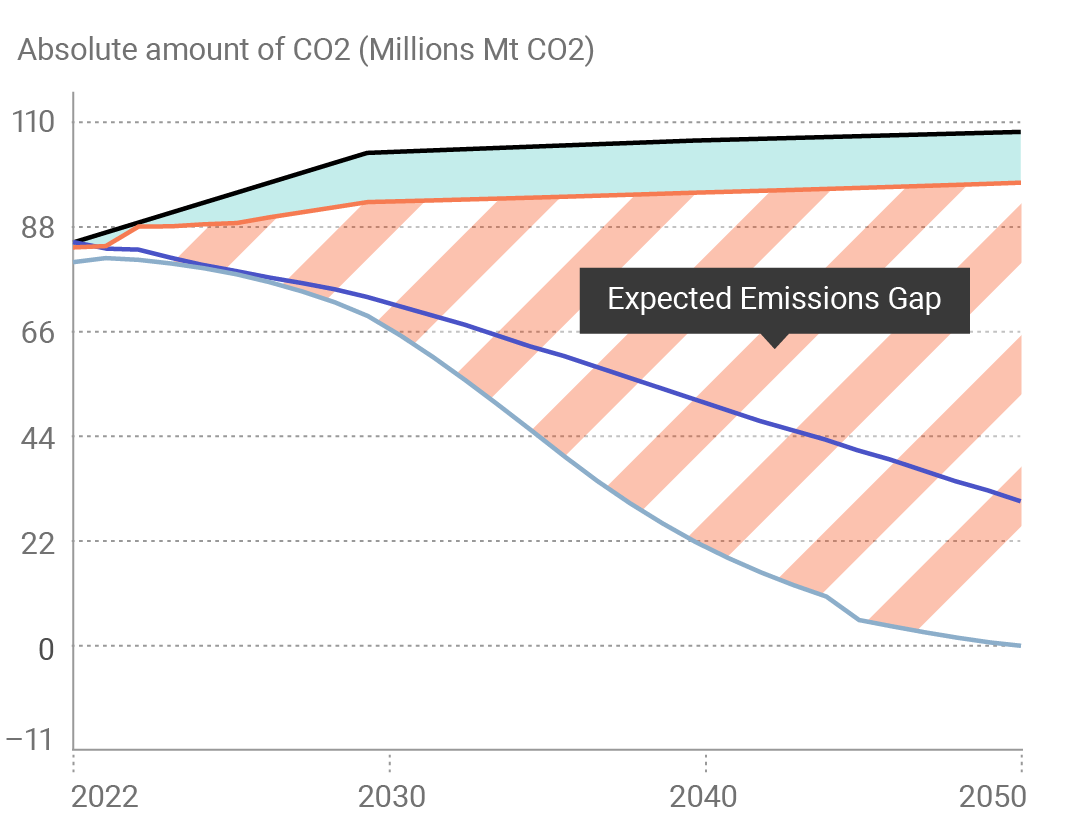
Next, we model how the company’s policies, strategy, governance, and financial position will enhance Transition Management and lower its impact below the baseline, resulting in the Expected Emissions estimate through 2050. This calculation is used for the Performance-based ITR metric.
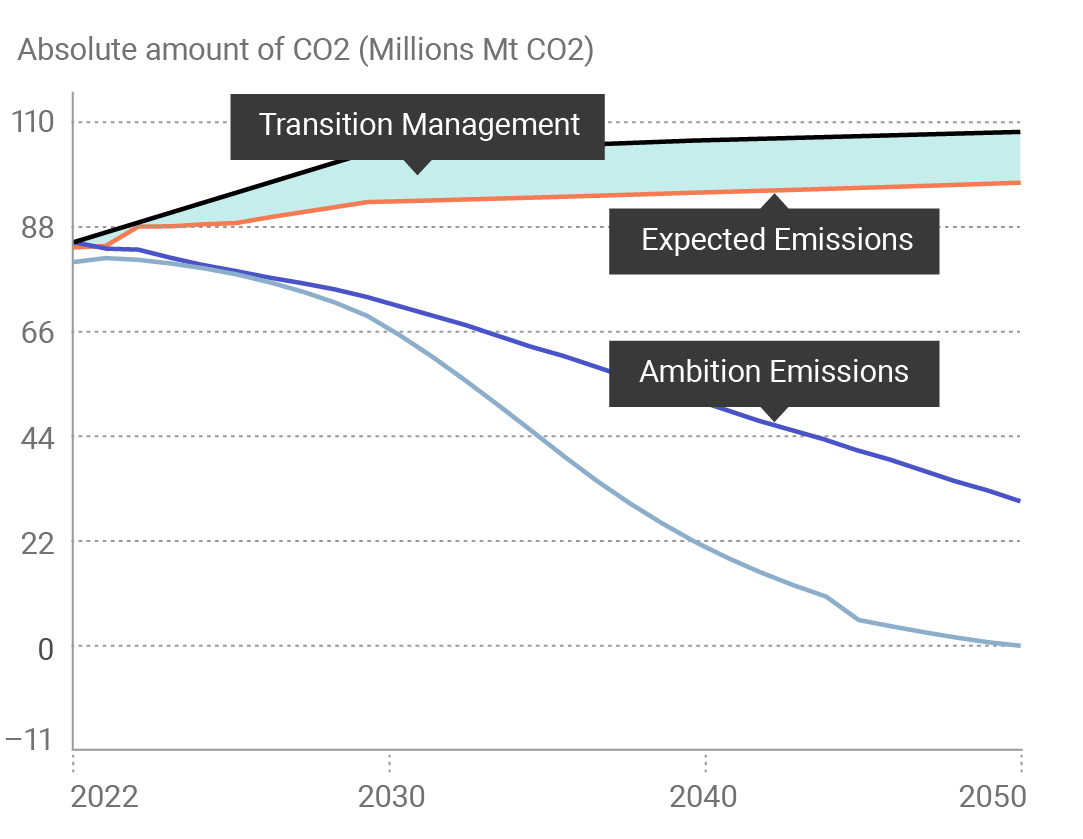
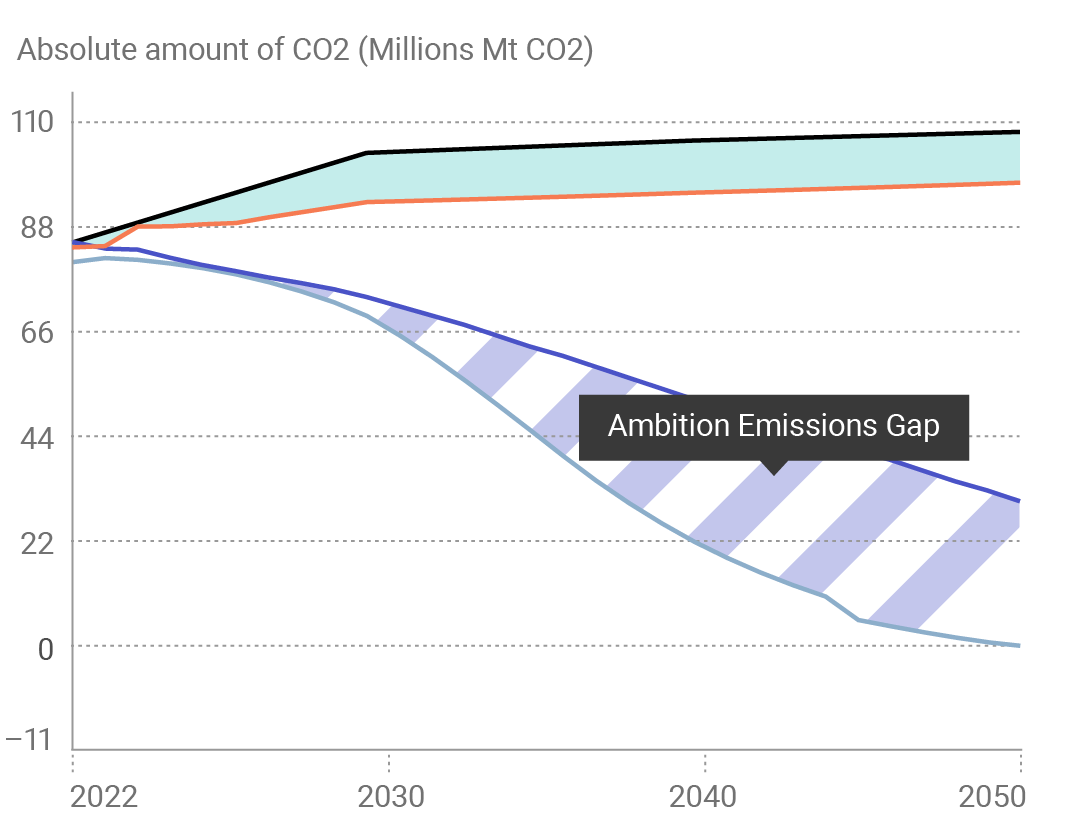
Next, we model the company's stated targets, turning metrics like an X% decrease in emissions by 2030 into an emissions pathway. This calculation is used for the Ambition Temperature Alignment.
Now we can see two different views of a company's projected emissions and how they differ from a low carbon pathway. The first one is the company's Expected Emissions Gap—its anticipated misalignment with what is needed to achieve low carbon performance for the specified pathway by 2050.
The second emissions gap presented is the company's gap between its Ambition Emissions and its low carbon pathway—how much its targets vary from what is needed to achieve the specified low carbon pathway by 2050.
Finally, we calculate the global temperature increase in 2050 if the global economy exceeds its low carbon budget by the margin of the company’s Expected Emissions Gap, resulting in the final Performance ITR.

We also calculate the global temperature increase in 2050 if the global economy exceeds its low carbon budget by the margin of the company's Ambition Emissions Gap, resulting in the final Ambition Temperature Alignment.

This enables you to assess how well a company's expected alignment to a low carbon pathway from current management actions matches their stated emissions reduction targets.
text

ACCESS
How to Access the LCTR
Computer with donut chart

Global Access Clients

Access our ratings using Morningstar Sustainalytics' screening and reporting tools.

Computer with network icon

Data Services Access 

Integrate LCTR into your preferred internal system through our FTP or API services.

Computer with Morningstar website

Monitoring Systems

Ratings are available via Morningstar Direct, MPS, and Data Feeds.

Computer with two browser windows

Third Party Systems

Ratings are currently in Snowflake and will soon expand to FactSet, Aladdin, and Bloomberg.