
|
|
|
Canada’s oil and gas sector presents one of the most complex transition challenges among G7 economies. The country combines a globally significant hydrocarbons industry with legally binding net zero commitments, creating a structural tension that investors must increasingly factor into long‑term risk assessments.
As part of our Material Risk Engagement service, we engage with high-risk companies in the oil and gas producers sector on material environmental, social and governence (ESG) issues linked to decarbonization, transition preparedness, and climate-related financial risk. Building on those dialogues, we draw on Morningstar Sustainalytics research to examine Canada's emissions trajectory, identify practical decarbonization pathways, and highlight the data and metrics institutional investors can use to distinguish credible transition progress from aspirational commitments.
Canada’s Emissions Trajectory and the Policy Gap
Canada has legislated an economy‑wide net zero target for 2050, alongside an interim objective of reducing emissions 40–45% below 2005 levels by 2030.1 Oil and gas remains Canada’s largest emitting sector, accounting for roughly 31% of national emissions, making its decarbonization essential to meeting these goals.2
Despite efficiency gains and improvements in methane management, sector‑level emissions have remained broadly flat since 2005,3 as production growth has offset operational improvements. Projections indicate that, under current policies, oil and gas emissions are not on a trajectory consistent with either Canada’s 2030 target or its long‑term decarbonization pathway.4
Looking beyond 2030, the gap between current policy trajectories and net zero‑aligned scenarios widens further. The scale and emissions intensity of Canada’s fossil fuel sector contribute materially to this divergence, reinforcing the financial relevance of transition risk for investors.
Canada’s Decarbonization Pathways: Where Emissions Sit Currently
Before assessing the sector’s decarbonization pathways, it is helpful to distinguish where emissions sit across the oil and gas value chain. The most material regulated emissions are concentrated in upstream Scope 1 operations, particularly in oil sands extraction and upgrading,5 while scope 2 emissions depend on regional electricity mixes. On a lifecycle basis, Scope 3 emissions from the use of sold products remain the dominant share of total emissions exposure, even though they largely sit outside Canada’s domestic inventory.
Given this profile, the most practical near-term decarbonization pathways are those focused on operational emissions, where companies retain the greatest direct control over outcomes. Within that operational focus, several levers stand out — some relatively low-cost and near-term, others more infrastructure-heavy and capital-intensive.
Carbon Capture, Utilization, and Storage
Among the sector’s main operational decarbonization levers, carbon capture, utilization and storage (CCUS) is widely viewed as one of the most important long-term options in Canada, particularly for emissions-intensive oil sands and gas-processing assets. The Oil Sands Alliance, formerly known as the Pathways Alliance, consists of six of Canada’s largest oil sands companies and targets net zero emissions by 2050 and a reduction of approximately 22 MtCO₂e by 2030,6 with CCUS expected to deliver nearly half of this reduction.7 Shared infrastructure, including proposed CO₂ trunklines, is intended to support scale and cost efficiency.8
Recent extensions to Canada’s CCUS investment tax credit have improved project economics and planning visibility. However, CCUS remains capital‑intensive, dependent on permitting and infrastructure coordination, and exposed to long lead times, making execution risk a continued concern for investors.
Abatement Levers Beyond CCUS
Beyond CCUS, broader scope 1 and 2 emissions abatement levers include:
- Decarbonizing steam for in situ production: Lowering steam-to-oil ratios and reducing reliance on gas-fired steam through efficiency upgrades, solvent-assist and lower-carbon heat or steam sources, which are among the most important operational levers in Alberta’s oil sands.
- Electrification: Replacing fossil-fired equipment and onsite power with lower-carbon electricity in extraction, processing and upgrading, where grid access and costs allow.
- Process efficiency: Including heat integration, improved drives, and other operational upgrades that reduce fuel use and emissions intensity.
- Methane abatement: Leak detection and repair (LDAR), vapor recovery, and flaring minimization.
From Ambition to Delivery: What the Data Shows
As transition expectations rise, the gap between stated ambition and operational delivery is becoming increasingly visible in company‑level data. Morningstar Sustainalytics’ ESG Risk Ratings provide a view into this through two complementary indicators:
- Greenhouse Gas (GHG) Reduction Program: An assessment of whether a company has a credible operational emissions-reduction plan, including the strength of its targets, actions, and implementation.
- Carbon Intensity Trend: An indicator of whether those efforts are translating into measurable changes in emissions intensity over time.
Across Canadian oil and gas producers, performance remains uneven. Most companies sit at an early or mid-stage of GHG reduction program maturity, with only a small group demonstrating clearly developed plans supported by dated actions and measurable results (see Exhibit 1). Among producers with disclosed three-year trends, most report declining intensity, although the scale and consistency of reductions vary. In some cases, expansion or operating changes have outpaced mitigation efforts, underscoring the importance of assessing intensity and production together.
Exhibit 1. Assessment of Emissions Reduction Programs at Canadian Oil and Gas Companies
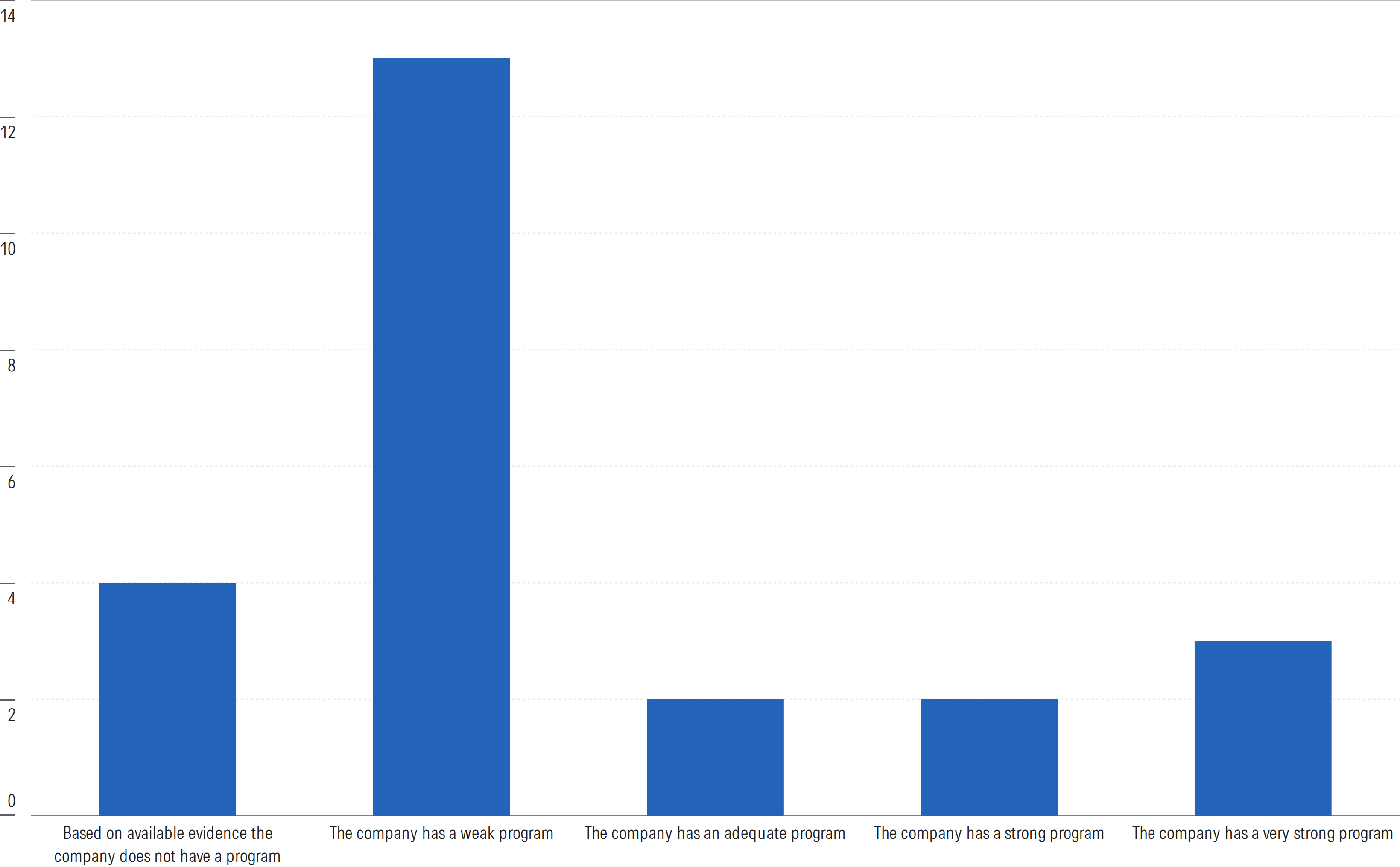
Source: ESG Risk Ratings dataset – Oil & Gas Producers (Canada), indicator E.1.7.0 “GHG Reduction Programme – Answer Category”; n = 24 companies; author’s analysis. Data as of October 2025.
Transition Alignment Through the Low Carbon Transition Ratings
Transition risk is increasingly priced into valuations as policy signals become clearer and financing becomes more selective. Morningstar Sustainalytics’ Low Carbon Transition Ratings (LCTR) provide a forward‑looking assessment through two complementary measures:
- Implied Temperature Rise (ITR): A directional assessment of whether current emissions pathways align with Paris‑type scenarios, expressing the temperature to which the world would warm, relative to pre-industrial levels, if all companies followed a similar emissions pathway.
- Transition Value‑at‑Risk (VaR): An estimate of how much enterprise value could be exposed to transition pressures through 2050.
Across Canadian oil and gas issuers, all companies fall into misalignment categories on ITR, with most classified as highly or severely misaligned (see Exhibit 2). Transition VaR results show that many issuers face potential value losses ranging from 50% to more than 100% of enterprise value under tightening policy and demand scenarios, while a smaller subset shows lower relative exposure.
Exhibit 2. Implied Temperature Rise Consistent with 1.5 Trajectory for Canadian Oil and Gas Companies
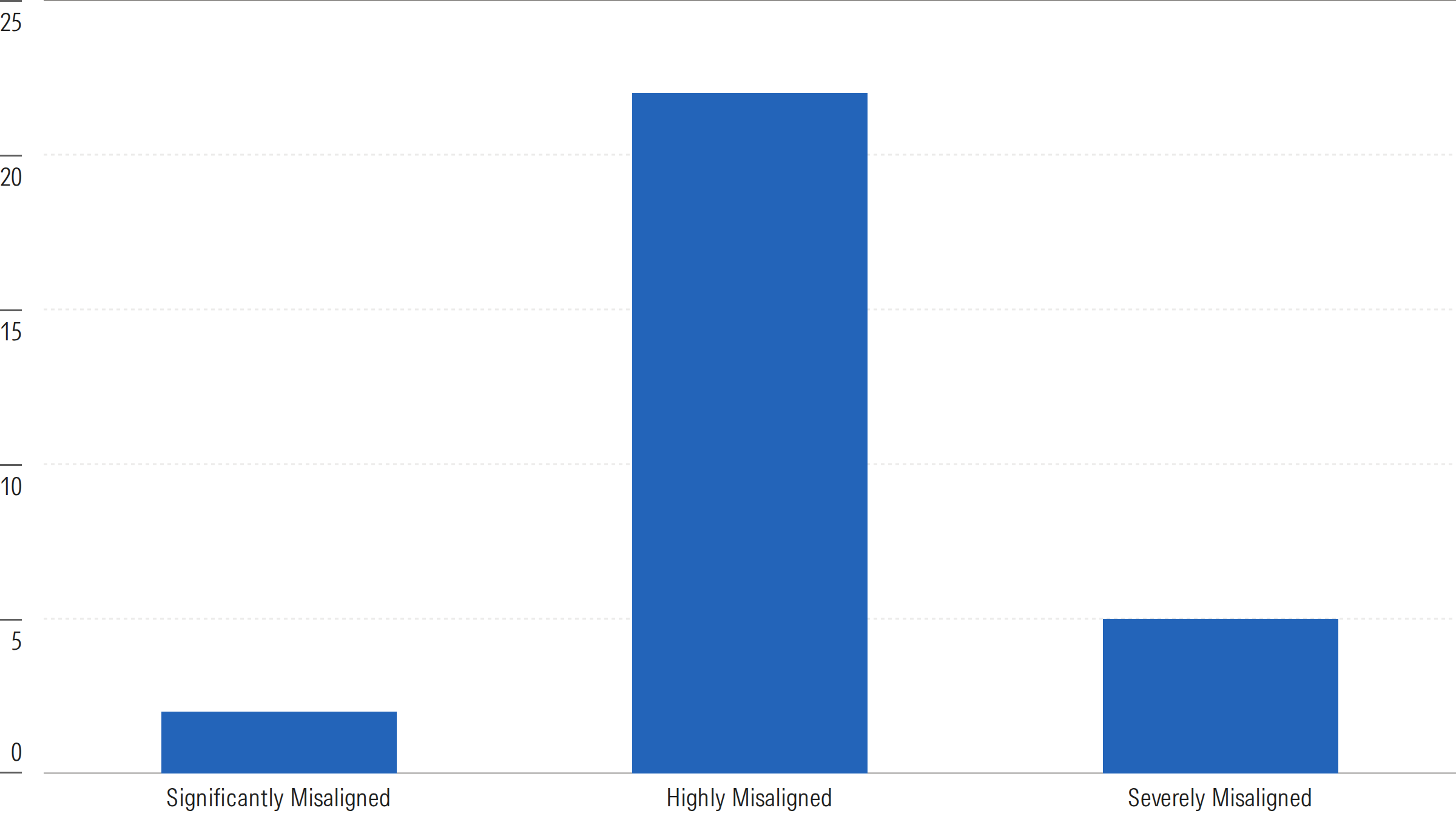
Source: Morningstar Sustainalytics Low Carbon Transition Ratings (LCTR) dataset – Canadian oil & gas issuers, Implied Temperature Rise (ITR) Category; n = 29 issuers; author’s analysis. Data as of October 2025.
What Should Investors Watch?
As scrutiny moves from targets to outcomes, several signals have become particularly relevant for investors assessing transition credibility. Companies with a clearly articulated, dated decarbonization roadmap — one that includes interim actions and checkpoints rather than vague long‑term goals — tend to demonstrate stronger execution discipline.
Capital allocation is another important indicator. Investment directed toward high‑impact measures such as methane reduction, steam efficiency, and targeted electrification generally signals greater near‑term delivery than reliance on long‑dated capture projects alone. Where CCUS is a core component of strategy, greater transparency around timelines, infrastructure dependencies, permitting, and policy assumptions becomes critical.
Operational performance ultimately provides the clearest proof point. Sustained declines in emissions intensity supported by field‑level data, rather than modelled estimates, offer strong evidence that mitigation efforts are keeping pace with production. Independent verification and clear explanations for deviations from stated plans further strengthen confidence in execution.
What’s Next for Canada’s Oil and Gas Transition?
Canada’s oil and gas sector faces a narrowing window to translate ambition into delivery. While the technical pathways to reduce operational emissions exist and policy support has strengthened, execution remains uneven across producers.
For institutional investors, transition credibility now lies less in long‑dated pledges and more in measurable near‑term evidence. Program maturity, sustained emissions-intensity improvement, and lower transition exposure already differentiate risk profiles across the sector — and are likely to become even more consequential as policy, market, and financing pressures continue to tighten.
A version of this research was originally published in Sustainalytics' Material Risk Engagement: 2025 Annual Report.
References
- "Canadian Net-Zero Emissions Accountability Act," Government of Canada, accessed December 8, 2025, https://www.canada.ca/en/services/environment/weather/climatechange/climate-plan/net-zero-emissions-2050/canadian-net-zero-emissions-accountability-act.html.
- "Where Canada’s greenhouse gas emissions come from: 2024 National Greenhouse Gas Inventory," Government of Canada, accessed December 8, 2025, https://www.canada.ca/en/environment-climate-change/news/2024/05/where-canadas-greenhouse-gas-emissions-come-from-2024-national-greenhouse-gas-inventory.html.
- "Greenhouse gas emissions projections," Government of Canada, accessed December 8, 2025, https://www.canada.ca/en/environment-climate-change/services/environmental-indicators/greenhouse-gas-emissions-projections.html.
- Ibid.
- "Technology Innovation and Emissions Reduction System," Government of Alberta, accessed December 8, 2025, https://www.alberta.ca/technology-innovation-and-emissions-reduction-system.
- "Pathways Alliance," Pathways Alliance, accessed December 8, 2025, https://pathwaysalliance.ca/.
- Chris Varcoe, “‘Fish or Cut Bait’ — Critical Year Ahead for Pathways Alliance’s $16.5B Carbon Capture Network,” Calgary Herald, published December 31, 2024, https://calgaryherald.com/opinion/columnists/varcoe-pathways-alliance-carbon-capture-network-critical-year.
- “Pathways Alliance CO₂ Transportation Network and Storage Hub Project,” Canadian Impact Assessment Registry, last updated December 20, 2024, https://iaac-aeic.gc.ca/050/evaluations/proj/89090.
.tmb-thumbnl_rc.png?Culture=en&sfvrsn=a680a273_1 "2026_SUS_Blog_Exploration_V5_SIP_Resource_Center_Sans_Type (1)")