
Artificial intelligence (AI) is fundamentally transforming the way we work, and workflows around environmental, social, and governance (ESG) data is no different. In this Q&A, we spoke with Jess Liu, Associate Director of Product Management, Platforms and Delivery, to understand more about what AI means for ESG data and workflows, what we are hearing from the market, and how Morningstar Sustainalytics is approaching building Model Context Protocols (MCPs).
Sustainalytics: Thanks for joining us today, Jess. As a start, could you tell us a bit more about your role?
Jess Liu: Thank you. I’m associate director of product management at Sustainalytics, sitting on the Platforms and Delivery team. I’m looking at the various ways our clients interact with and receive our data, and then trying to improve that experience and ease of integration. This involves looking at data feeds, client platforms, and now, an MCP server.
Specifically, I've spent most of the past six months building Sustainalytics' MCP server offering.
SUST: That's great, thank you. Could you briefly tell us more about what an MCP is?
JL: Model Context Protocols have become the industry standard for how service providers expose tools and resources to large language models (LLMs). LLMs are advanced AI systems trained on data, enabling them to understand, generate, and respond to human language. An MCP server provides tools for LLMs, allowing them to write to databases, call external APIs, modify files, or trigger other logic.
To put it simply, an MCP server could be thought of as a "USB-C for AI," a common connector for any LLM to reach a company's databases and toolkits. Consider it as another delivery channel, one that is designed for AI workflows.
SUST: Great, thank you. Can you explain why an MCP server matters for investors and ESG data in general?
JL: I think an MCP server presents a very exciting opportunity for ESG data providers. We know where one of the most common friction points relating to using ESG data comes from: an end user is often looking at data points that are not ubiquitous or commonly defined across the investment industry, and there can often be different nuances between providers. In Sustainalytics' recent 2026 State of ESG Data Survey,1 when asked about the biggest strategy and implementation pain points, "inconsistent sustainability data and ratings across vendors" was cited most frequently.
At its core, contextual knowledge is often required to understand an ESG data point. AI can help fill in those gaps, allowing users of ESG data to more seamlessly understand the methodology around data points, explore which data points are available for certain areas of interest, and recognize how ratings and data change over time. Therefore, we will be able to see increased transparency and accessibility of ESG data and insights, with previous friction points becoming much easier to navigate with AI. This aligns with Sustainalytics' values, as transparency has always been at the core of our offerings.
However, analysis is only as good as the underlying data. A data provider's role in providing quality, consistent data across a broad universe is imperative to enabling useful insights. This is even more pertinent in the age of AI.
SUST: An MCP server sounds very useful. However, am I right in thinking that it might not be best used as a catch-all solution?
JL: AI is very powerful and has numerous potential applications, but as everyone is trying to find the line on where AI fits and where it doesn’t, it’s becoming clearer through my conversations with clients that it’s not the answer to everything.
Instead, it comes down to use case and cost. AI can support non-deterministic workflows — those questions that require context, explanation, and exploration — but I believe that deterministic workflows will always have a place. If a reporting cycle or dashboard needs to be run consistently and frequently, this may be better suited for data feeds and traditional channels instead.
It's also important to keep cost in mind. Asking AI to run an industry-wide analysis on a certain data point will be costly. The more complex and frequent the ask, the higher the cost. With this in mind, if our clients ask a question regularly, this is something that Sustainalytics could provide as a pre-established data point, not by asking LLMs and MCPs to repeatedly compute that insight.
AI has the capacity to be a gamechanger, but it isn't a silver bullet to every client pain point.
SUST: How is Sustainalytics approaching building MCPs?
JL: Given our discussion above, for us, building an MCP server meant that we could really focus and be clear on the opportunities in which AI could add value to ESG workflows.
Our clients are already utilizing our data in various touch points such as Sustainalytics' portal, Global Access, third-party platforms, and through integration into their own internal dashboards.
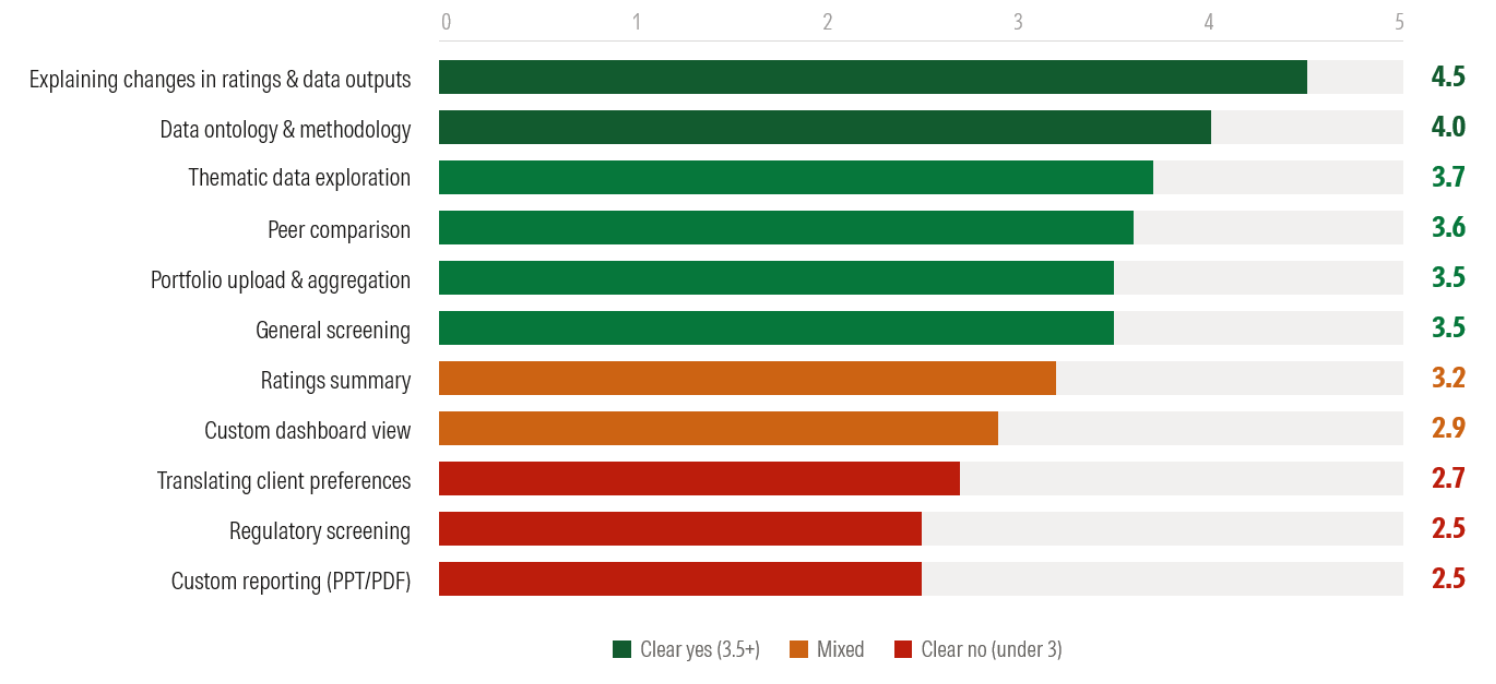
The question remains: where is AI going to make our clients' lives easier, especially where traditional channels are not meeting their expectations? To make sure we answered this question, we spent time systematically listening to our clients. From April to July, we conducted in-depth consultations with 25 of our clients who have shown interest in using AI in their ESG workflows.
The findings were resoundingly clear: no matter the size, team, or use case, clients want their data provider to be proficient at explaining their own data and research.
Figure 1. How Useful Would It Be to Have an AI Chat to Help With the Following (Scale of 1-5).
Source: Conversations conducted with 25 of Morningstar Sustainalytics' clients.
SUST: So, what does the rollout of Sustainalytics' MCP server look like?
JL: Sustainalytics' initial MCP server offering, which is slated to rollout in the beginning of Q4 of this year, starts by tackling the above use cases (see Figure 1), focusing on data fetching, discovery, and providing methodological context.
There will be five products available on launch: Controversy Ratings, Product Involvement, Global Standards Screening, Controversial Weapons Radar, and Carbon Emissions Data.
SUST: How can clients access Sustainalytics' MCP server?
JL: The MCP server is flexible and can be integrated into various LLM-enabled touchpoints. Sustainalytics is also aligned with the Morningstar Market Data MCP offerings, which means that our data will be accessible as a connector through major LLM providers, including Copilot, Claude, ChatGPT, Mistral, and Perplexity.
If a client is building an internal agentic experience, they can access our data through our MCP server endpoint. Sustainalytics data will be accessible via the same endpoint and connector instances as Morningstar market data.
That's the beauty of MCP servers: integration is easier than ever!
SUST: Finally, trust and reliability are very important. How is Sustainalytics building reliable, trustworthy AI-enabled experiences?
JL: You're right, it's essential that users can actually trust the data we're providing, especially as it serves investment use cases.
When we onboard a new product into our MCP server, we work with research and methodology (R&M) analysts to update each data point definition to ensure that an LLM has plenty of context.
Secondly, we onboard our methodology paper as "callable" context to support deeper methodological dives. Once the prep work is over, quality evaluation is very important.
As a product manager, I find managing AI experiences fascinatingly challenging. Every time we onboard a new dataset, we spend at least a week and a half evaluating and stress-testing the server with the R&M team, ensuring that the LLM can answer questions accurately.
When testing internally, we can trace each question and answer to make sure we're happy with the way in which our data and methodologies are presented. Of course, we can only see this when testing internally — we can't access our clients' information from an MCP server!
SUST: Thank you very much, Jess, this was very insightful. We're excited to see how the rollout takes place in Q4!
References
- The 2026 ESG Data Survey report is yet to be published.