
Ambitious climate transition targets can signal a company's strategic direction, although these targets often exceed transition investment; companies may announce ambitious goals and fail to allocate sufficient capital, potentially leading to implementation risk.
However, insight into a company’s transition investments can offer investors valuable context on how those goals are being supported through capital expenditures (capex).
Capex refers to the investments a company makes to acquire, improve, or maintain long-term assets, such as energy facilities and buildings. As more companies disclose forward-looking capex data, investors will increasingly be able to verify whether companies’ energy transition ambitions are backed by planned investment. Although data gaps and inconsistencies exist, capex data has the potential to help investors identify opportunities over hyped or unclear strategies.
In this article, we present an overview of an in-depth discussion hosted by Environmental Finance, featuring insights from sustainable investing and climate specialists from Allianz Global Investors UK, Legal and General Investment Managers (LGIM), and Morningstar Sustainalytics. The webinar, titled Follow the Money: Navigating Climate Transition Risk With Capital Allocation Data, explained why current pathways point to an approximate 2.6 degrees Celsius of warming by 2050 and the implications for portfolios; explored why capital allocation is the clearest forward-looking signal of transition credibility; and provided practical ways to separate credible transition strategies from those that don’t align with market realities.
Forward-Looking Capex May Deliver a Clearer Picture Than Reported Emissions
Investors focused on identifying opportunities within the energy transition face a key data challenge as standard climate assessments rely on disclosed or reported data across scope 1, 2, and 3 emissions, and net zero targets. Capex data, on the other hand, provides insights on a company’s investment in long-term assets, with a view on the future make-up of those assets and the technologies companies are choosing. This data can potentially give a clear signal of transition credibility.
According to Alex Osborne-Saponja, Director, ESG Methodology at Sustainalytics, “capex determines real-world outcomes, making it a clear indicator of both future emissions, transition risk, and long-term value creation.”
While many companies communicate optimistic narratives around low-carbon initiatives and their energy transition goals, capex disclosures can help to support claims about where management teams are committing capital for long-term change.
Sustainalytics’ Low Carbon Transition Ratings anchor transition assessment in capital allocation, translating forward-looking capex into projected future emissions. They also map investments to technology types and activities along with specific emissions intensities to project a company's asset mix.
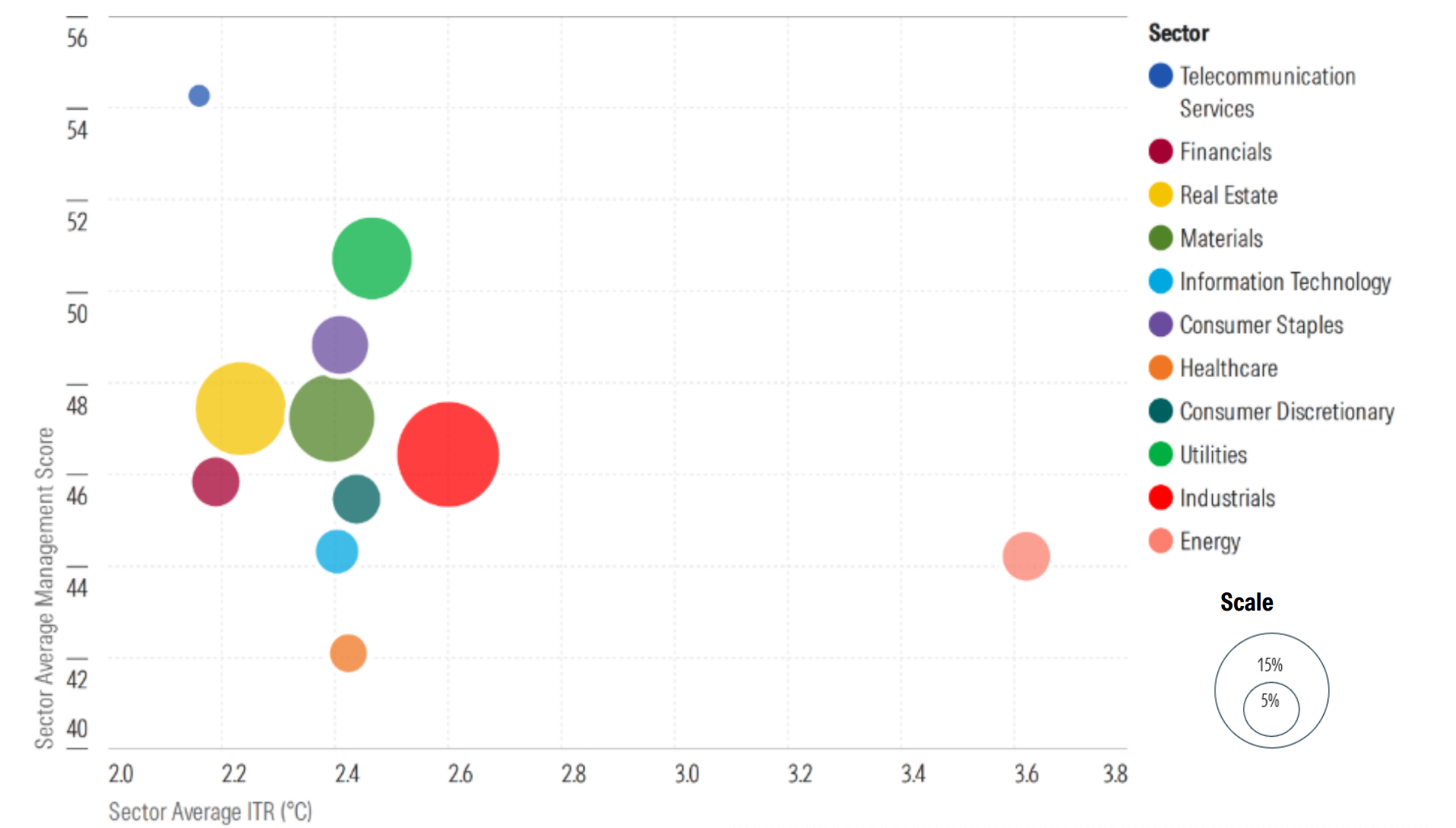
As Figure 1 indicates, sectors with stronger transition management generally achieve lower Implied Temperature Rise (ITR) scores, indicating better alignment with a low-carbon pathway. The telecommunications and utilities sectors lead on management quality, while energy shows the weakest alignment.
Exhibit 1. Sector Landscape on Low-Carbon Investment Disclosure vs ITR and Management Performance
Source: Morningstar Sustainalytics LCTR data, as of April 1, 2026.
Note: Size of bubble represents percentage of the 7,848 companies, by sector, which disclose low-carbon transition investment planning program. For example, the industrials sector represents 23% of all companies that disclose low-carbon investment planning (size of bubble), the overall sector average management score is 46.3, while the sector average ITR is 2.5 degrees Celsius (Significantly Misaligned).
Key Risks and Challenges of Capex Disclosures
As progress has been made in recent years in terms of capex data disclosures, gaps in the data and reporting shortfalls need to be addressed. Companies in different sectors and markets disclose capex differently, resulting in a lack of standardization, making comparisons difficult and benchmarking inconsistent.
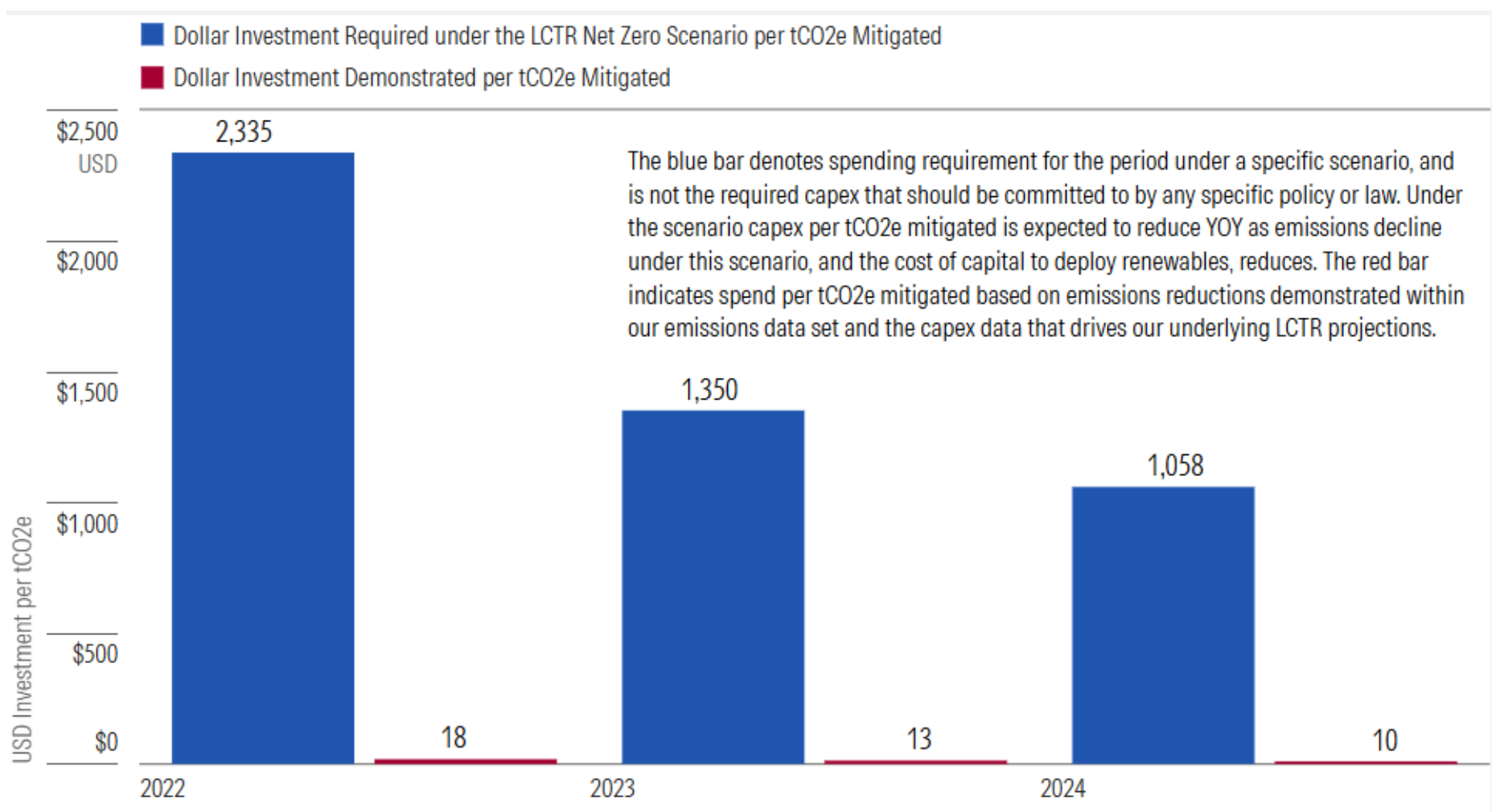
Exhibit 2. Required Capital Versus Utilities Deployment per tCO2
Source: Morningstar Sustainalytics. Based on Inevitable Policy Response and Sustainalytics data.
Note: The LCTR Net Zero Scenario is downscaled from the Inevitable Policy Response, Required Policy Response, a 1.5-degree aligned, net zero by 2050 scenario.
What the actual data represents and how granular it is are key factors in being able to understand a company’s transition. Disclosing total capex figures, for example, may not provide the full detail investors need. Detailed capex line items about technology-specific energy transition allocations — such as solar versus gas, electric vehicles versus internal combustion engine vehicles, and electrification versus fossil efficiency — would be useful data.
“The challenge investors face is understanding the dollar amount of capex is not a simple, homogenous data point that can be tracked,” said Nick Stansbury, Head of Climate Solutions at LGIM. “It isn't just about how much a company is spending in aggregate, but what it is spent on and how.”
While investors view capex as a useful indicator in terms of where company transition plans are being funded, capex data disclosure from companies remains inadequate.
Mark Wade, Head of Sustainability Research and Stewardship at Allianz Global Investors UK, pointed out: “Capex focuses on disclosure and direction of investment rather than necessarily testing sufficiency or alignment to an appropriate extent or level.” However, he suggested that it does serve as proof of implementation and directional alignment, as well as a financial credibility signal.
More data showing greater specificity of capex spend would evidence where it is being allocated and how hard the capital is working towards energy transition. The spectrum of capex spend outcomes ranges from a low impact to society and a low return to a company, to capex that works much harder to deliver a high impact and high return.
What Capex Signals Can Investors Prioritize?
Understanding what share of total capex goes to low-carbon technologies, electrification, and renewable infrastructure is vital, but understanding the intent behind the capital spend is just as important. Companies will need to provide more technology-level disclosures with project-level detail, technology-specific capex, and expected outputs and expected emissions impact.
If capex spend is additive and is not displacing fossil fuel capex or fossil fuel-related emissions, greenhouse gas emissions reductions are not likely to stabilize or decline fast enough to meet a sub-two-degrees Celsius scenario. In some sectors, however, large amounts of capex still flow to fossil energy infrastructure with projected long-life asset use, and carbon and capital lock-ins.
Considering capex versus transition targets, investors need to understand if and how investment plans support net zero commitments, Paris Alignment goals, and stated decarbonization pathways.
As investors are shifting focus from reducing emissions to allocating capital toward companies that are well positioned for the low-carbon transition, accessing resources such as the Climate Transition Toolkit could support portfolio preparedness for the complexities of the evolving market.
Looking forward, future climate resilience may become as important as mitigation, increasing the importance of tracking investment in water systems, resilience infrastructure, flood protection, and climate adaptation.
Bridging Climate Ambition and Financial Reality
Capex is becoming one of the most important bridges between climate ambition and financial reality. Although data gaps and inconsistencies exist, capex data can help investors distinguish genuine transition leaders from greenwashing. It can also help them identify future winners and stranded asset risks, assess whether transition plans are funded, evaluate exposure to peak fossil fuel demand, and anticipate the pace of energy system transformation.
For more information on how capex data can help investors navigate climate transition risk, watch the webinar, Follow the Money: Navigating Climate Transition Risk With Capital Allocation Data. Alternatively, read Sustainalytics’ recent report, Transition or Illusion? What Capital Flows Reveal About Net Zero Credibility.
.tmb-thumbnl_rc.png?Culture=en&sfvrsn=a680a273_1 "2026_SUS_Blog_Exploration_V5_SIP_Resource_Center_Sans_Type (1)")