Net‑zero commitments have become a familiar feature of corporate climate disclosures. Across markets and sectors, companies increasingly articulate long‑term decarbonization goals, often framed around 2050 targets and interim milestones. For institutional investors, this shift reflects progress: climate considerations are now firmly part of mainstream financial analysis.
Yet as climate ambition becomes more widespread, another question has moved to the foreground: how credible are these transition plans in practice? Targets alone do not determine financial outcomes. The difference between stated ambition and actual preparedness for a low‑carbon transition is becoming a key source of investment risk and opportunity.
Climate Ambition Has Matured, but Implementation Lags
The rapid adoption of climate targets has helped normalize the idea that companies must plan for a lower‑carbon future. However, research and market experience suggest that ambition often outpaces execution. Many companies disclose long‑term goals without clearly demonstrating how those goals will be achieved, financed or governed.
This gap between climate ambitions and decarbonization performance matters for investors. Transition risk is not only about exposure to regulation or carbon pricing; it is also about whether companies can adapt their operations, supply chains and capital allocation in time. In this context, the quality of a transition plan becomes as important as the headline target itself.
In an analysis of companies’ climate-risk disclosure against the Taskforce for Climate-Related Disclosures (TCFD) guidelines, those in regions with the highest regulatory requirements (Europe and the United Kingdom), also had the highest rates of TCFD-aligned disclosures.1 However, their performance on the indicators of decarbonization alignment was only marginally better than the global average.2
Institutional investors are therefore increasingly shifting focus from what companies say to how they plan to deliver.
Why Forward-looking Transition Metrics Matter
Traditional emissions metrics provide important information, but they largely reflect past performance. To understand future risk, investors increasingly rely on forward‑looking indicators that attempt to capture how companies are positioned under different decarbonization pathways.
One such signal is implied temperature rise (ITR), which signifies the temperature alignment of a company’s forward-looking emissions trajectory. It answers the question of how much global temperatures would rise if all companies’ expected emissions differed from their net-zero budgeted emissions to the same degree as the company. Used carefully, ITR can help investors compare companies and sectors, highlighting where misalignment with global climate goals may persist.
Recent analysis of forward-looking corporate emissions projections, based on current assumptions and available data, suggests that most companies globally appear misaligned with pathways consistent with limiting warming to 1.5 degrees Celsius. Examining companies in Morningstar Sustainalytics Low Carbon Transition Ratings universe found that global average ITR is 2.5 degrees by 2050.3 While stated climate ambitions have increased markedly in recent years, expected emissions outcomes — based on current policies, governance and investment patterns — often tell a different story.
Figure 1. Average Implied Temperature Rise by Region
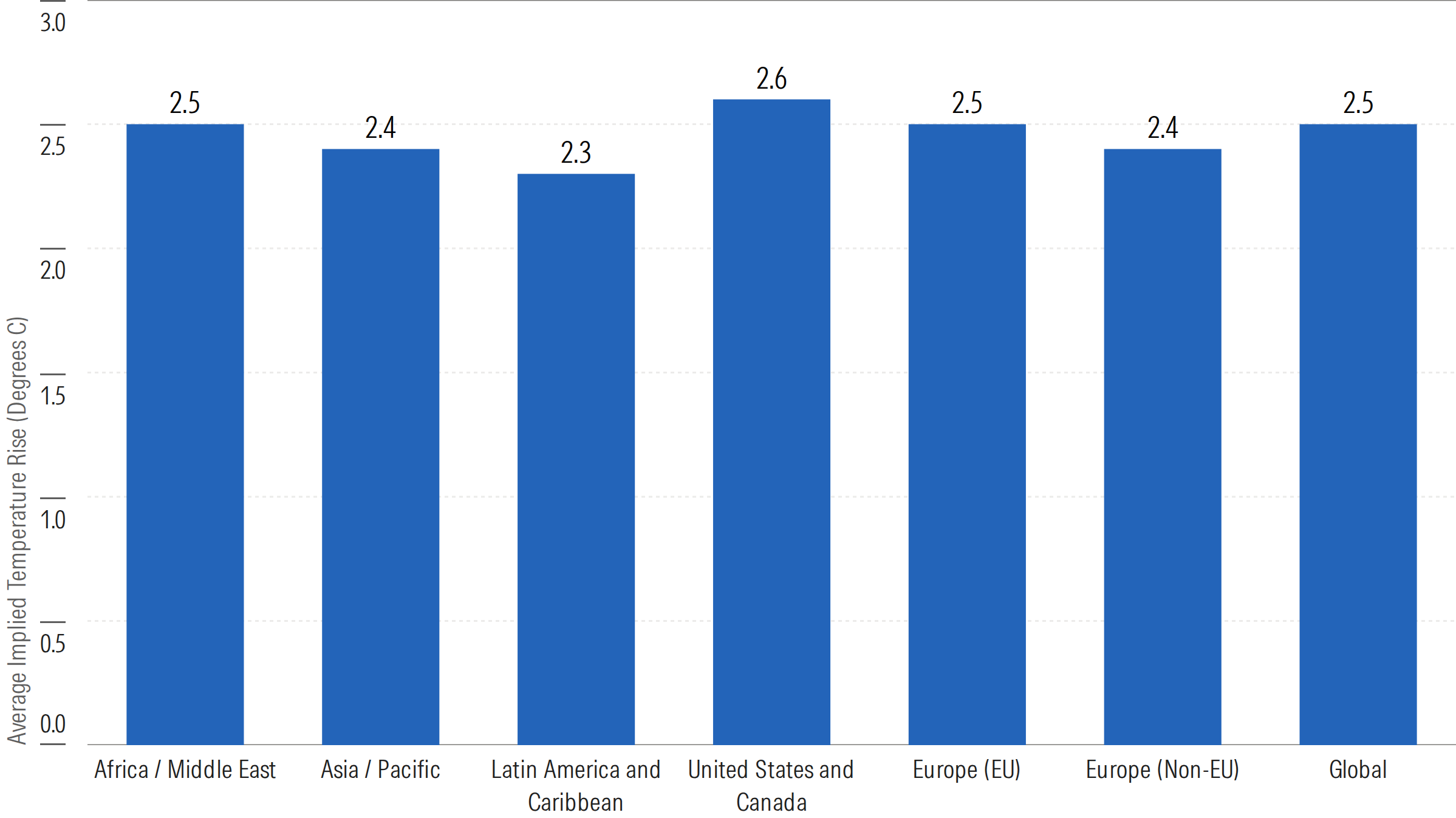
Source: Morningstar Sustainalytics.
Note: Data as of May 2, 2025. Based on the Low Carbon Transitions Ratings universe of 10,446 companies.
This divergence points to a persistent gap between long‑term commitments and near‑term execution, highlighting why forward‑looking transition management indicators are increasingly relevant for investors assessing climate‑related financial risk.
What has also become clear through this analysis is that misalignment remains widespread. Many companies, and even entire sectors, are still on trajectories that exceed global carbon budgets aligned with 1.5 C pathways. This does not imply uniform outcomes, but it does suggest that transition risk is structural rather than marginal.
Ambition Versus Performance: Two Sides of the Same Story
Forward‑looking climate analysis often distinguishes between two complementary perspectives. One focuses on performance, asking what temperature outcome would result if all companies behaved like a given firm, based on current policies, governance and investments. The other focuses on ambition, asking what outcome would occur if companies fully achieved their stated targets.
Morningstar Sustainalytics Climate Transition Toolkit provides top-line signals, including Implied Temperature Rise and Ambition scores, that can help to inform investment strategy. Comparing both signals can offer a more holistic view of a company’s progress toward decarbonization and can reveal informative gaps. For instance, a large difference between ambition-based outcomes and performance-based outcomes could suggest that a company’s current practices haven’t yet caught up to its goals. Perhaps the company has set ambitious targets without yet embedding them into capital allocation, governance or operational planning.
Conversely, closer alignment between these indicators could be an encouraging sign of credible progress on decarbonization and suggest that ambition is being supported by tangible execution.
This disparity between climate ambition and performance makes it important for investors to look beyond headline commitments and assess the credibility and feasibility of corporate transition plans; interim targets and near-term actions; as well as investment decisions that support (or undermine) stated goals.
Translating Climate Signals Into Financial Context
Another challenge for investors is linking climate transition analysis to financial implications. Transition risk ultimately matters because of its potential impact on revenues, costs, asset values and long‑term competitiveness.
The Climate Transition Toolkit also includes Value at Risk (VaR) and scenario analysis. VaR aims to translate transition dynamics into potential financial outcomes, projecting how potential policy shifts, market changes or technology adoption could affect company value. While such estimates rely on assumptions, and projections differ under different climate scenarios, they can help frame climate transition as an economic issue rather than a purely environmental one. For example, our analysis also found that average VaR ranged from USD 1.7 billion–USD 2.5 billion for companies based in the European Union, and between USD 1.8 billion–USD 2.2 billion for companies outside of the EU, depending on the climate scenario (see Figure 2).4
Figure 2. Average Value at Risk in Billions of USD by Region and Climate Scenario
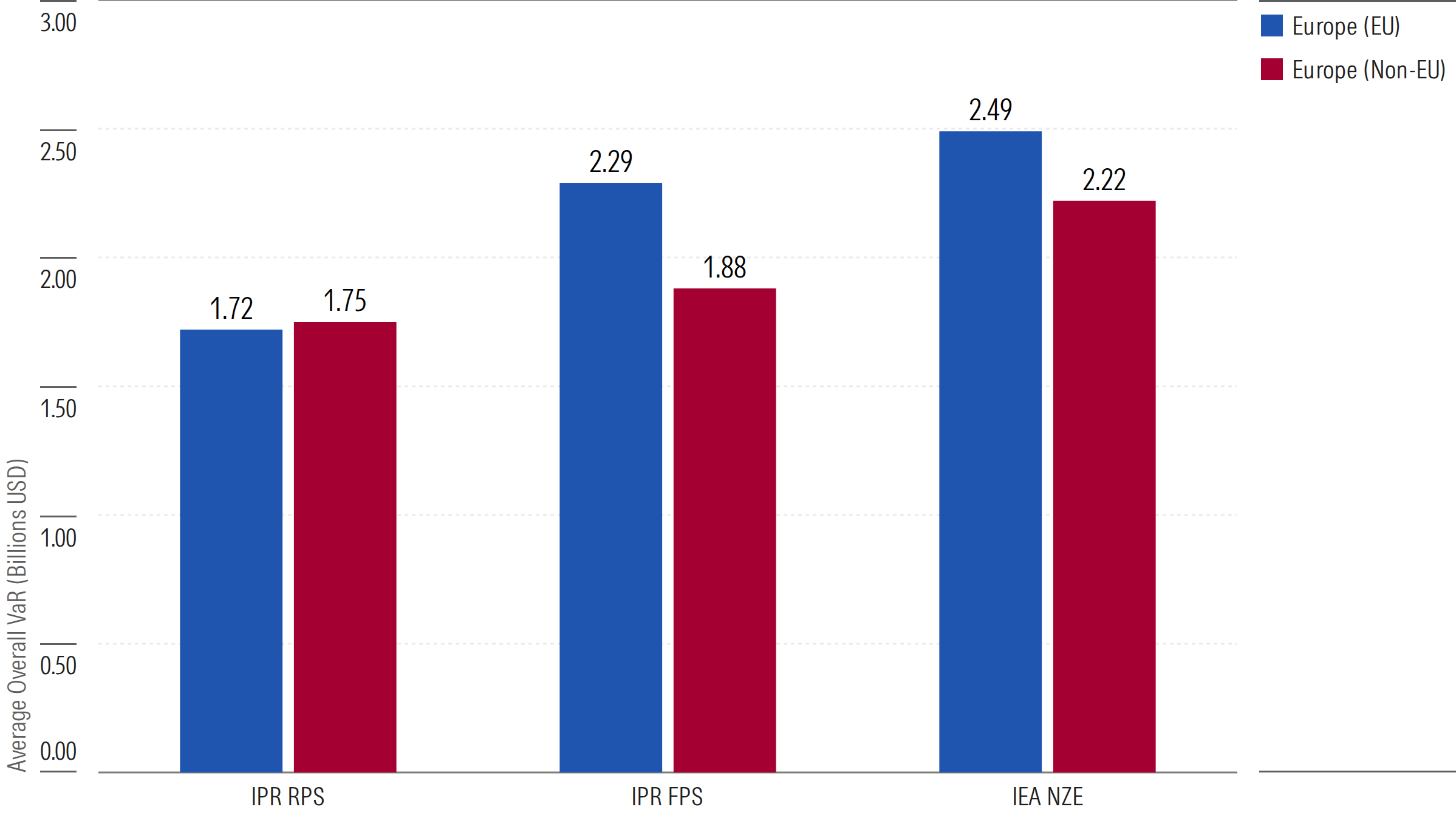 Source: Morningstar Sustainalytics. Data as of May 2, 2025.
Note: Based on an analysis of the Low Carbon Transition Ratings universe of 10,446 companies. Graphs includes only companies with values for all three climate scenarios - the Inevitable Policy Response's Required Policy Scenario, Forecast Policy Response Scenario and IEA's Net Zero Emissions Sceanario.
Scenario analysis further supports this perspective by exploring how companies might perform under different climate pathways and time horizons. For long‑term asset owners, this multi‑scenario view is increasingly relevant as investment horizons extend well beyond typical business cycles.
Sector Context Remains Critical
Climate transition risk can differ widely across industries. Some industries face technological or economic constraints that make rapid decarbonization more difficult. For instance, high emitting sectors such as oil and gas continue to exhibit the highest performance ITR, reflecting ongoing investment in fossil assets and long asset lifetimes. At the other end of the spectrum, sectors with relatively lower levels of warming, such as textiles and apparel, also fall short of decarbonization alignment thresholds. This could be due to limited visibility on forward-looking investment and capital expenditure plans.
These examples underscore why sector-specific context matters — misalignment can have different causes across different sectors. Climate transition risk does not look the same across energy, materials, financials, or consumer sectors, and applying a single lens to all of them may be misleading. Understanding sector context helps avoid over‑simplified conclusions and supports more informed portfolio‑level analysis. It also reinforces the importance of comparing like with like rather than relying on absolute thresholds.
Climate Data as Decision Support, Not Prescription
As climate datasets become more sophisticated, it is important to emphasize their role. Climate transition metrics are decision‑support tools, not forecasts or investment recommendations. They are designed to inform analysis, not replace investor judgement.
Used appropriately, these tools can help investors identify where deeper analysis or engagement may be warranted, where transition risks may accumulate, and where alignment appears more robust. They are most effective when combined with financial analysis, sector expertise, and active stewardship.
It is also important to recognize the inherent limitations of forward-looking transition metrics. Assessments of alignment and transition risk rely on assumptions about future policy, technology and market behavior, all of which may evolve. For this reason, climate transition indicators are better seen as tools for framing risk and opportunity, rather than as predictions or definitive results.
Used alongside financial analysis, sector expertise and stewardship insight, these metrics can support more informed decisions.
Looking Ahead: From Ambition to Preparedness
The widespread adoption of decarbonization targets represents meaningful progress, but ambition is only the starting point. For institutional investors, the next phase of climate integration is about understanding preparedness, credibility and execution risk.
Transition analysis that blends qualitative insight with quantitative indicators can support this shift, helping investors move beyond surface‑level commitments towards a more nuanced understanding of how climate transition may influence long‑term outcomes.
Learn More
Morningstar Sustainalytics provides a range of climate solutions, including its Climate Transition Toolkit, designed to support investors in assessing transition alignment, analyzing sector pathways, and informing stewardship discussions. Investors interested in exploring how these tools may complement their existing analysis can learn more by visiting www.sustainalytics.com/investor-solutions/climate-solutions/climate-transition-toolkit.
This article was originally published in IPE's June issue in print and online.
References
- White, A. and Feldman, J. 2025. “EU Corporate Climate Disclosures: An Evaluation of Completeness and Quality.” March 26, 2025. https://www.sustainalytics.com/esg-research/resource/investors-esg-blog/eu-corporate-climate-disclosures--an-evaluation-of-completeness-and-quality.
- White, A. 2025. “It’s Not Just Emissions: Other Metrics Evaluating EU Companies and Their Decarbonization Pathway.” May 13, 2025. https://www.sustainalytics.com/esg-research/resource/investors-esg-blog/beyond-emissions-other-metrics-evaluating-eu-companies-decarbonization-pathway.
- Ibid.
- Ibid.