
Key Insights:
|
|
|
Water scarcity is emerging as a financially material risk across multiple sectors, with the software and services industry facing increasing exposure due to its reliance on water-intensive data center (DC) infrastructure. Rapid growth in artificial intelligence (AI) workloads has accelerated demand for data centers, significantly increasing corporate water use, particularly in water-stressed regions.
Morningstar Sustainalytics’ latest research takes a deeper look at data center-driven water risk, and provides a case study examining how Amazon, Google, Meta, and Microsoft — four of the largest global data center operators — manage water-related risks as they rapidly expand AI-driven infrastructure, much of it in water‑stressed regions. The full report provides data-driven insights, comparative analysis, and best-practice considerations.
Water Risks Associated with AI Data Centers
Data centers’ environmental footprint is firmly grounded, with many hyperscale facilities relying on water-intensive cooling systems that can withdraw millions of gallons per day. As AI workloads grow more complex and compute-heavy, cooling demands scale alongside them.
This matters because data center expansion is not happening in a vacuum. Nearly half of the world’s population is expected to live under conditions of water stress by 2040,1 while climate change continues to make water availability more volatile and geographically uneven. Against this backdrop, AI’s rising water footprint exposes companies — and their investors — to heightened operational, regulatory, and reputational risk.
For investors, the key issue is not simply how much water is used, but where, and how well that risk is managed.
Why is Data Center Water Usage an Issue for Investors?
Across the US and elsewhere, local opposition to data center development is intensifying,2 driven in many cases by water concerns. Communities are questioning whether large-scale digital infrastructure should be prioritized over residential, agricultural, or ecological water needs — particularly in already water-stressed regions.
The result has been real financial impact. In recent years, community pushback has delayed or blocked tens of billions of dollars’ worth of planned data center projects.3 These disruptions translate directly into schedule delays, stranded capital, and uncertainty around future growth.
Opposition tends to emerge late in the project lifecycle, when capital commitments are already substantial. That makes water risk not just an environmental concern, but a timing and execution risk with immediate financial implications.
Big Tech’s Exposure to Water Risks
The world’s largest technology companies have some advantages when it comes to managing water risk. Scale, capital availability, and public scrutiny have likely influenced several big tech players to invest in water management, water stewardship initiatives, and expanded reporting.
But scale cuts both ways. Large technology firms also face outsized exposure because of their expansive data center footprints and ambitious AI-driven growth plans. In many cases, a significant share of planned capacity is in regions already experiencing high or extreme water stress.
From an investment perspective, this creates a nuanced picture:
- Strong policies and commitments may indicate resilience.
- Continued expansion into water-scarce regions may signal growing exposure.
- Rising total water use can undermine even best-in-class efficiency improvements.
In our report, we examined water risk management at the big four tech companies, Amazon, Google, Meta, and Microsoft. While each companies’ strong market position and financial capacity can support better risk management, their continued expansion in water-scarce regions exposes them all to rising operational, regulatory, and reputational risks if management practices do not keep pace with growing water demand.
Figure 1. Google, Meta, Microsoft: 5-Year Trend in Annual Water Withdrawal and Consumption (in Megaliters)
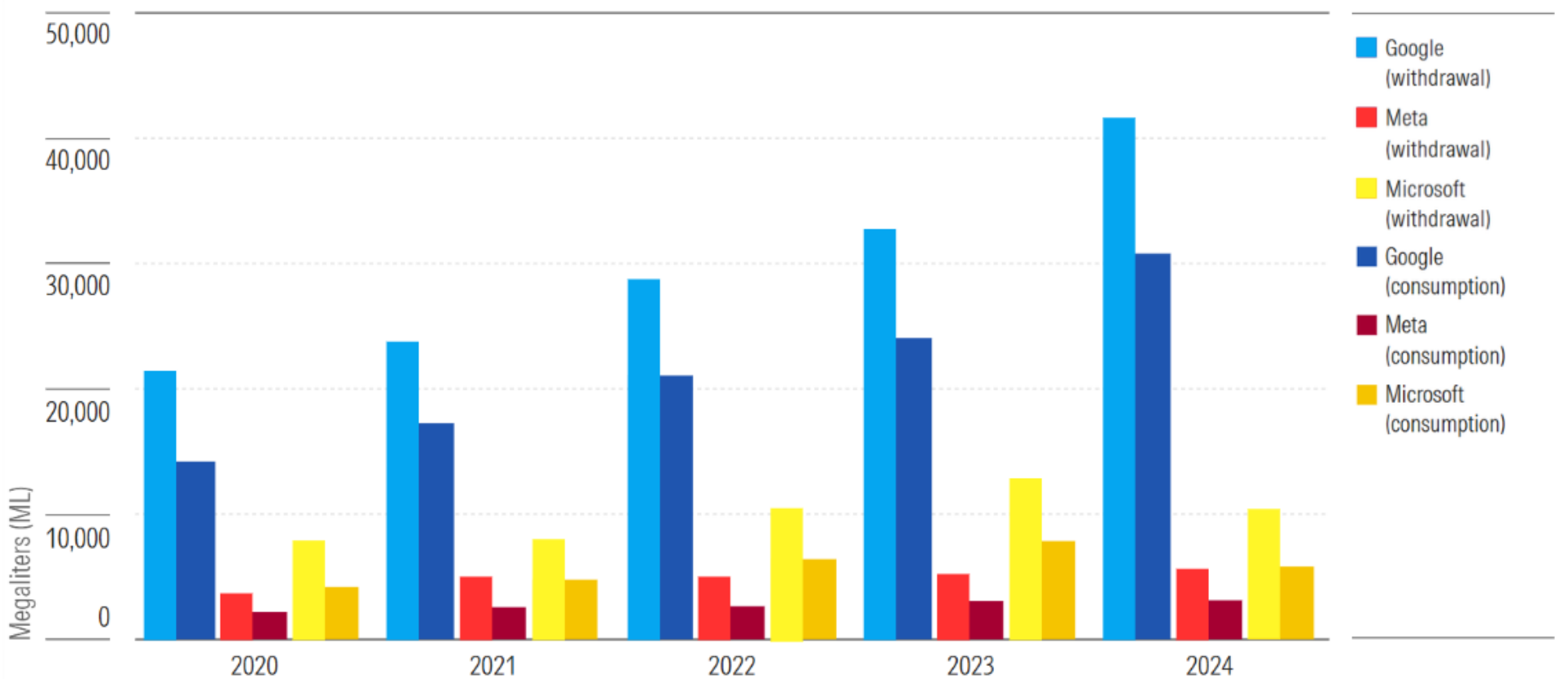
Source: Google 2025 Environmental Report; Meta 2025 Environmental Index; Microsoft 2025 Environmental Data Fact Sheet.
Note: Microsoft reports that it updated its estimation approach for withdrawals and consumption starting in FY2024. Under this new approach, it uses water use efficiency metrics to estimate how much water it withdraws and consumes. We have excluded Amazon as it does not disclose its data.
What Leading Water Risk Management Looks Like
Water risk management for AI-driven infrastructure is still evolving, but certain practices are emerging as markers of stronger performance:
- Strategic integration: Companies that embed water risk into enterprise risk management and project planning may be better positioned to anticipate constraints before capital is deployed.
- Location-specific targets: Water scarcity is local. Targets and initiatives that focus on high-risk regions are more meaningful than global averages.
- Transparent reporting: Clear, standardized disclosure allows investors to assess progress, compare peers, and engage effectively.
By leveraging insights from Sustainalytics’ ESG Risk Ratings — across exposure, management quality, disclosure, and peer performance — investors can better identify vulnerabilities, compare companies, and integrate water risk considerations into investment analysis, portfolio construction, and engagement strategies.
References
- Global Water Forum. The Future Water Crisis: Are We Prepared for the Worst or Best Case? Published February 13, 2025. https://www.globalwaterforum.org/2025/02/13/the-future-water-crisis-are-we-prepared-for-the-worst-or-best-case/.
- Data Center Watch. Q2 2025 Update: 125% Surge in Data Center Opposition. Research timeline: Late March 2025-June 2025. https://www.datacenterwatch.org/q22025.
- Project Censored. Communities Push Back Against AI Data Center Expansion. Published January 8, 2025. https://www.projectcensored.org/communities-against-ai-data-center/.
.tmb-thumbnl_rc.png?Culture=en&sfvrsn=a680a273_1 "2026_SUS_Blog_Exploration_V5_SIP_Resource_Center_Sans_Type (1)")