
|
|
After years of protests and bargaining, five Starbucks stores in Ontario, Canada ratified collective bargaining agreements in May 2025.2 While efforts to reach such agreements continue in the US, this was a major win for the 11,000 workers represented.
Some restaurant chains and shareholders, however, see unions as a cost burden, citing higher wages, reduced flexibility, and operational disruption. The US National Restaurant Association has even advised businesses on limiting union influence3 and some research indicates that lawsuits initiated by unions can lead to business downsizing, and store and restaurant closures.4
This article explores how management of labor disputes can impact environmental, social, and governance (ESG) risk for companies within the restaurants subindustry amid growing scrutiny. When applying Morningstar Sustainalytics’ Controversies Research to Starbucks Corporation, we found that an escalation of labor disputes at the coffee shop chain could trigger a change in our assessment (based on the labor relations event indicator.)5
Right to Freedom of Association is Systematically Undermined
Freedom of association and collective bargaining are fundamental human rights under international law. Article 20 of the United Nation’s Universal Declaration of Human Rights, and the International Labour Organization’s Conventions 87 and 98, affirm workers’ rights to organize, negotiate workplace conditions, and take collective action, including the right to strike.6,7 These rights foster democratic governance, workplace safety, and economic stability. Collective bargaining agreements addressing wages, safety, and dispute resolution can reduce government intervention and promote mutual trust between employers and employees.8
Respecting these rights can enhance economic performance, yet violations remain widespread.9,10 The 2025 Workers’ Rights Index shows that policy restrictions on collective bargaining have increased and now impact 80% of countries globally (see Figure 1).11 The International Trade Union Confederation found that 88% of countries violate the right to strike, and nearly half detain union members arbitrarily.12 While corporate interference can silence workers’ voices through anti-union discrimination, excessive membership barriers, and retaliation, a US Department of Labor report found that empowering workers and unions is the most effective means of ensuring labor rights.13 Arguably, labor policies alone are insufficient and need to be combined with effective programs to ensure the protection of employees’ labor rights.
Figure 1. Number of Countries Opposed to Trade Unions & Collective Bargaining: 10-Year Trend
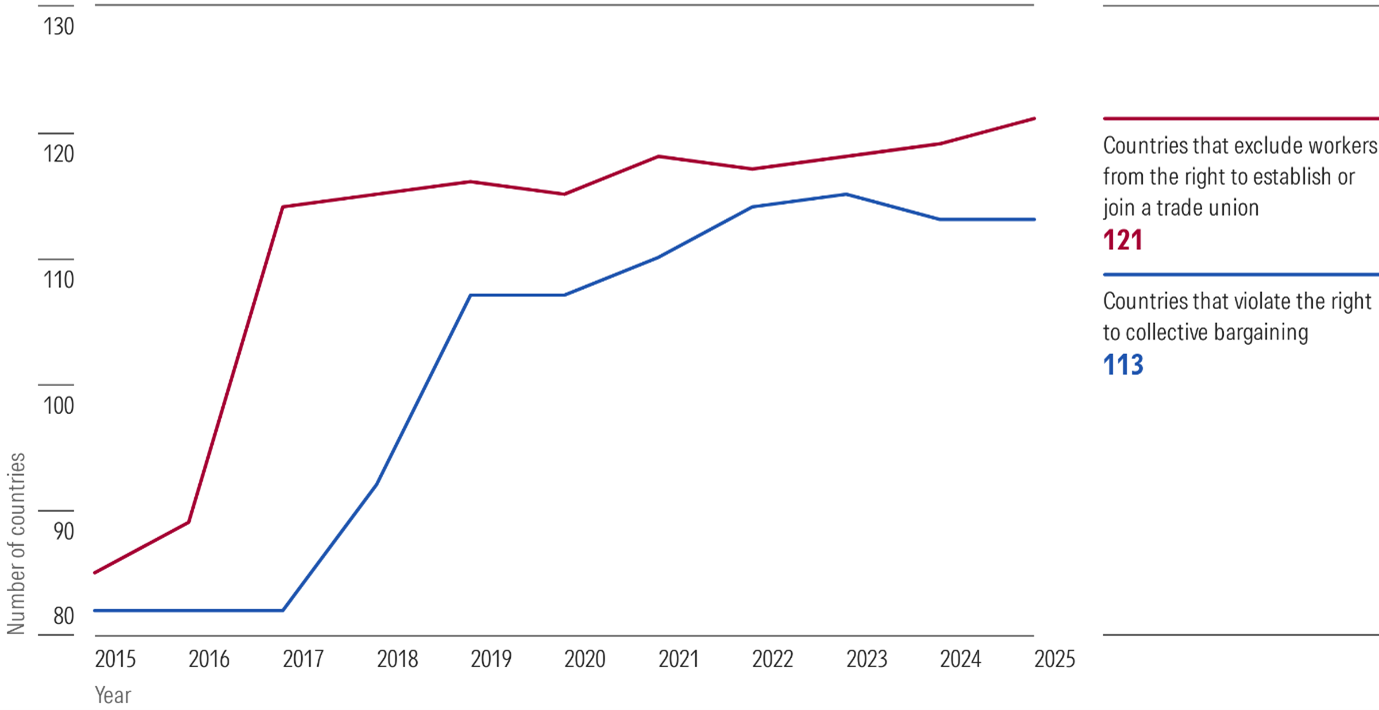
Source: 2025 ITUC Global Rights Index: The World’s Worst Countries for Workers, p.17 https://www.ituc-csi.org/global-rights-index-reports. For informational purposes only.
How ESG Risk Ratings Capture Labor Disputes
For investors, labor rights violations are no longer just an ethical concern. They pose real financial risks, as the associated reputational damage, operational disruption, and legal liabilities can have a direct impact on a company’s bottom line. Reputational risk is difficult to quantify, but its impact is undeniable.14 Failure to address labor rights concerns can threaten long-term brand value, consumer trust, and investor confidence. Sustainalytics monitors such developments and provides investors with insights via our Controversies Research. This research is incorporated into our ESG Risk Ratings by increasing a company’s exposure score for a specific labor-related issue and diluting its management score. ESG Risk Ratings assess the management of corporate labor relations through two key management indicators:
- Freedom of Association Policy: This indicator evaluates whether companies explicitly commit to fundamental ILO conventions.
- Collective Bargaining Agreements: This indicator measures the percentage of employees covered under these agreements.
As shown in Figure 2, our data reveals that among consumer services companies, labor-related controversies are disproportionately concentrated in the restaurants subindustry.15 Moreover, our ESG Risk Ratings data shows a clear trend: companies with higher unionization rates tend to have lower employee turnover, highlighting the potential financial advantage of strong labor relations. Meanwhile, employee disputes over wages and working conditions carry reputational risks, which can lead to challenges in areas such as recruitment and retention.
Figure 2. Percentage of Companies With Labor Relations Events
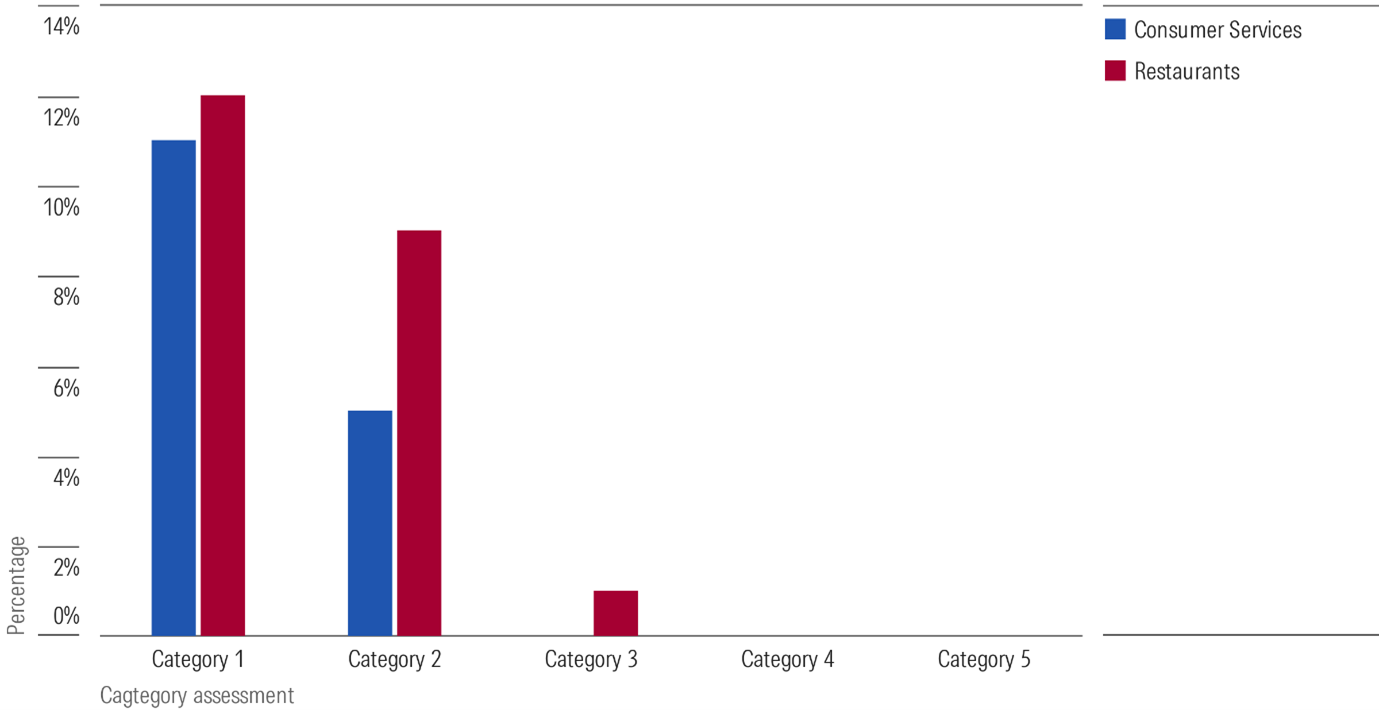
Source: Morningstar Sustainalytics. Data as of June 6, 2025. For informational purposes only.
Note: Category 3 ratings imply significant risk for companies and significant impact on stakeholders.
Across the board, the restaurant companies within Sustainalytics’ research universe have a low percentage of their workforce covered by collective bargaining agreements. This indicates that many restaurant employees lack the protection and benefits typically associated with union representation, which can contribute to labor disputes, higher turnover, and reputational risks for companies. The absence of strong collective bargaining in this subindustry highlights a potential area of vulnerability for restaurants in managing labor relations and mitigating long-term risks.
Figure 3 shows a breakdown of how some of the largest companies in the restaurants subindustry (i.e., companies with a market cap of more than USD 10 billion) are assessed on freedom of association and collective bargaining. Most companies scored 100% for freedom of association policies; however, the percentage of employees covered by collective bargaining agreements is low throughout the sample. Despite having strong policies in place, McDonald's and Starbucks are involved in category 3-rated controversies, showing that a good policy does not always translate into effective labor relations, and that mismanaging this issue can increase reputational risk. This underscores the critical need for companies in the subindustry to proactively address labor rights concerns. To emphasize the relevance of labor issues for investors, we highlight the case of Starbucks below.
Figure 3. Restaurants' Indicator Scores
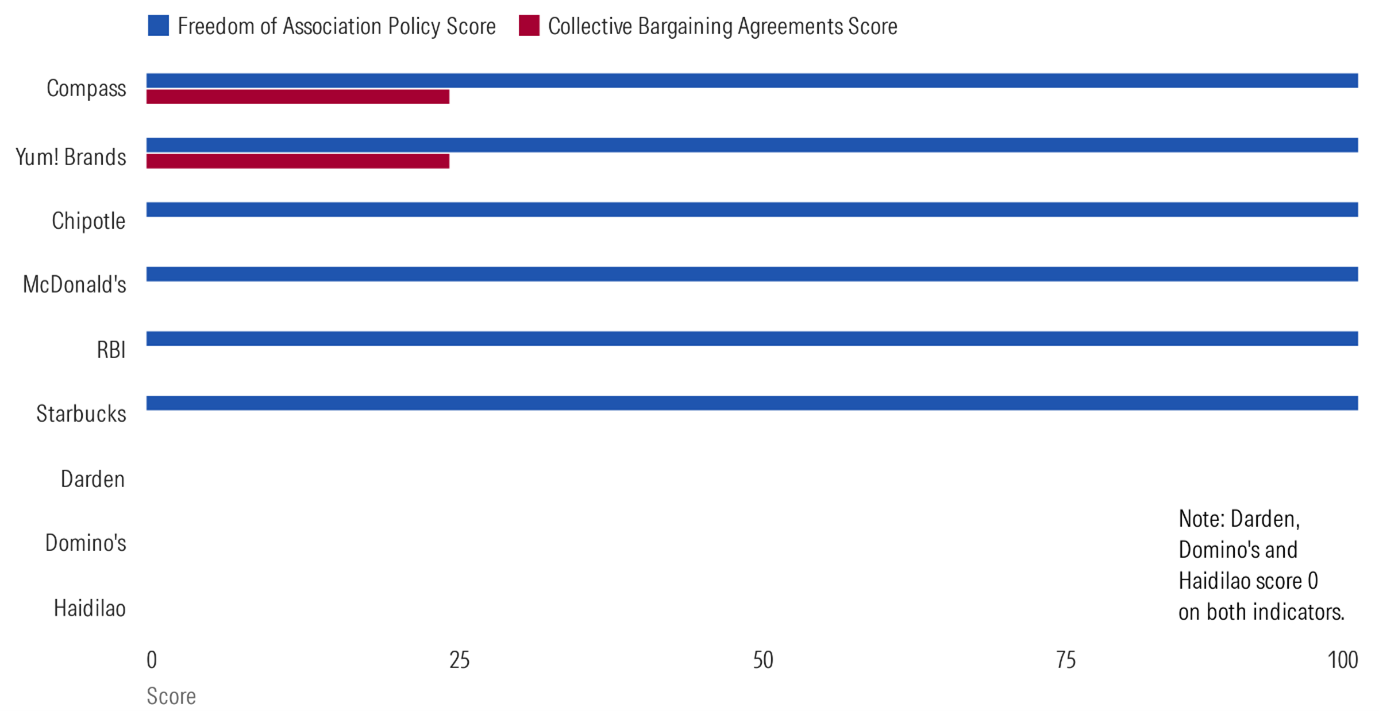
Source: Morningstar Sustainalytics. Data as of June 6, 2025. For informational purposes only.
Implications of Starbucks' Labor Dispute
Starbucks’ management of labor relations issues affects the company’s current and future rating outcomes. We downgraded our rating for the labor relations event indicator for Starbucks to category 3 in March 2022, after more than 20 complaints were filed against Starbucks with the National Labor Relations Board, accusing the company of retaliating against employees seeking to unionize (see Figure 4).16,17 Despite Starbucks’ strong policy on freedom of association, it has faced sustained scrutiny over union-busting allegations and the challenge of aligning its stated commitments with its labor practices.
Reputational risk, which refers to potential damage to a company’s public image and brand value, is a key concern for investors, particularly in the restaurants subindustry, where customer loyalty and trust are paramount. Extending beyond the initial dispute, the controversy has played a role in shaping Starbucks’ public image.18,19 Since 2021, numerous Starbucks stores in the US have voted to unionize, leading to a series of labor disputes and allegations of retaliatory actions against employees involved in union activities.20 Beyond media coverage and political debates surrounding its treatment of workers, Starbucks has also faced tangible stakeholder backlash, including universities cutting ties with the brand and investor-led initiatives urging corporate accountability.
Figure 4. Starbucks' Score Development
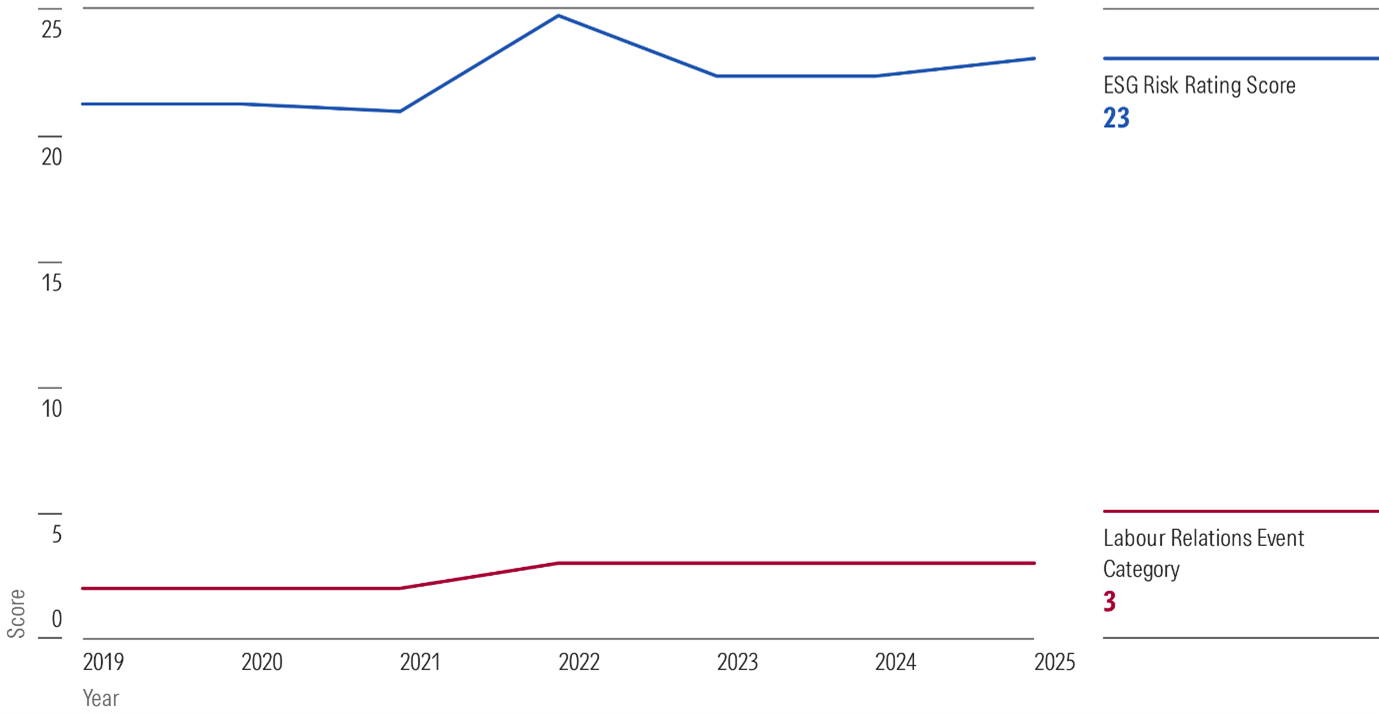
Source: Morningstar Sustainalytics. Data as of June 12, 2025. For informational purposes only.
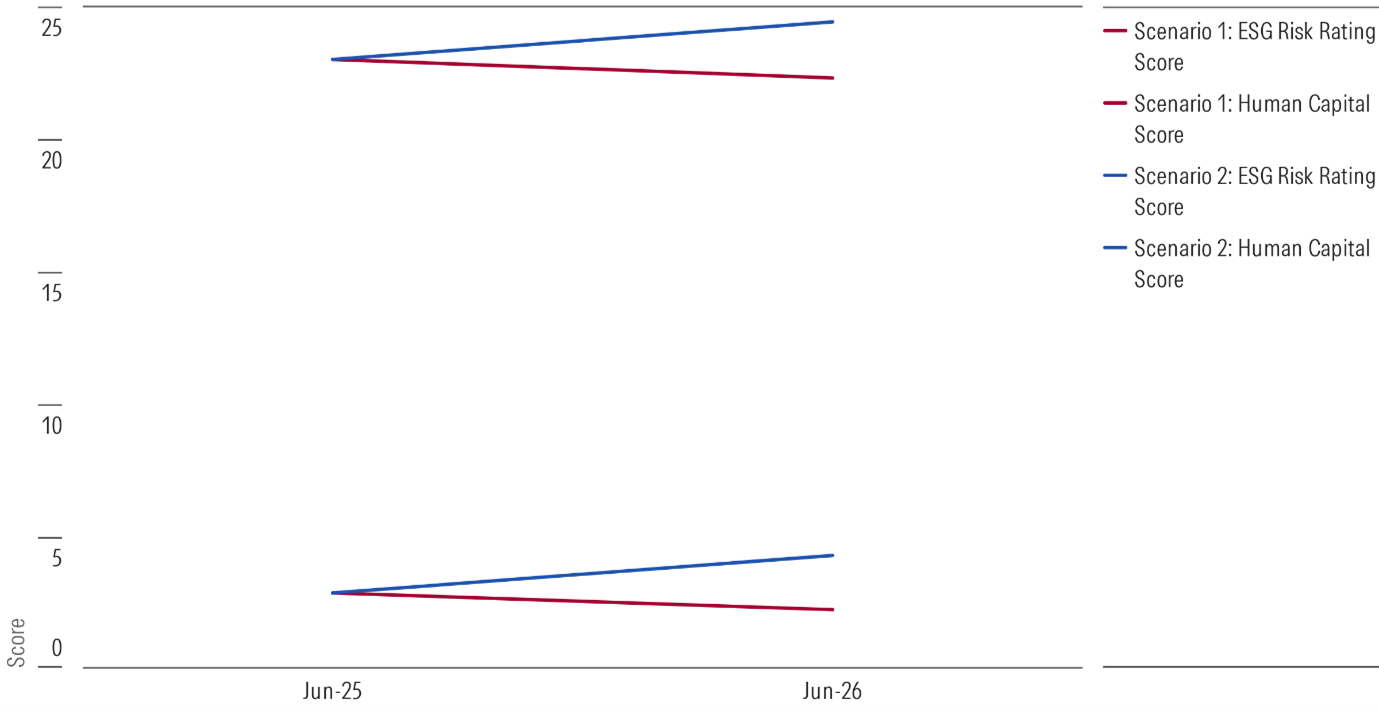
Figure 5. Scenario Analysis of Starbucks' Scores
Source: Morningstar Sustainalytics. Data as of June 30, 2025. For informational purposes only.
Note: The event indicator Labor Relations falls under Human Capital Material ESG Issue (MEI) within the ESG Risk Rating.
Looking ahead, Starbucks’ management of labor issues may significantly impact its ESG risk scores. In one scenario, if Starbucks were to remediate ongoing labor disputes and bargain in perceived good faith, this could lead to a settlement of lawsuits, a reduction in the frequency of strikes and, potentially, the creation of collective bargaining agreements. This would also lead to a reassessment and upgrade of the company’s controversy rating, resulting in a reduction of its ESG Risk Rating score by approximately 0.7 points (see Figure 5).
Conversely, if Starbucks does not bargain in what is generally perceived to be good faith, this could lead to an escalation of its labor disputes, and an increase in the frequency of strikes, lawsuits, and investor and media scrutiny. Sustainalytics would then consider a downgrade of the company’s rating for labor relations if Starbucks were found to be interfering with its workers’ right to organize a union in other US states, and if regulatory action were taken that is deemed financially material to the company. This would impact Starbucks’ ESG risk score through an increase in exposure and a dilution of its management score, leading to an increase of approximately 1.42 points in the company’s ESG Risk Rating score.
This case illustrates how a misalignment between policy and practice can lead to significant reputational risk. Companies in the restaurants subindustry can manage risk and drive long-term sustainable value for investors by maintaining sound labor relations. Investors can monitor Sustainalytics’ controversies data and track the progress of Starbucks and its industry peers in resolving any ongoing disputes.
References
- The restaurant sector is classified as a subindustry under the consumer services industry, according to Morningstar Sustainalytics. Classifications are proprietary to Sustainalytics and do not follow ISO, NAIC or other naming conventions.
- Talent Canada. 2025. “Five Starbucks Shops in Ontario Ratify First Collective Agreements.” May 13, 2025. https://www.talentcanada.ca/five-starbucks-shops-in-ontario-ratify-first-collective-agreements/.
- Rock, J. “Restaurant Industry Execs Are Very Worried About Food Service Workers Unionizing.” Jacobin. January 31, 2023. https://jacobin.com/2023/01/national-restaurant-association-legal-summit-union-busting-strategies.
- Unsal, O. “Employee Lawsuits and Business Downsizing: Evidence from Labor Unions.” Journal of Financial Stability. Volume 74, October 2024. Science Direct. https://www.sciencedirect.com/science/article/abs/pii/S1572308924001037.
- The labor relations event indicator is listed in UK English as labour relations within Morningstar Sustainalytics Global Access. The indicator assesses incidents related to poor compensation or unfair working conditions that are raised by a company's own employees or their representatives, such as labor unions. It also includes incidents related to discrimination and harassment in the workplace.
- United Nations. 2025. Universal Declaration of Human Rights. https://www.un.org/en/about-us/universal-declaration-of-human-rights.
- International Labour Conference 97th Session. 2008. Freedom of Association in Practice: Lessons Learned. https://www.ilo.org/wcmsp5/groups/public/---dgreports/---dcomm/documents/publication/wcms_096122.pdf.
- International Labour Office. 2015. Collective Bargaining: A Policy Guide. https://www.ilo.org/sites/default/files/wcmsp5/groups/public/%40ed_protect/%40protrav/%40travail/documents/instructionalmaterial/wcms_425004.pdf.
- International Labour Organization. “ILO report sees encouraging trends in fundamental rights at work although serious violations persist.” May 28, 2004. https://www.ilo.org/resource/news/ilo-report-sees-encouraging-trends-fundamental-rights-work-although-serious.
- Burtless, G. “Workers’ Rights: Labor Standards and Global Trade.” September 1, 2001. https://www.brookings.edu/articles/workers-rights-labor-standards-and-global-trade/.
- International Trade Union Confederation. 2025. ITUC Global Rights Index: The World’s Worst Countries for Workers. https://www.ituc-csi.org/global-rights-index-reports.
- United States Department of Labor. 2023. “Worker Voice: What It Is, What It Is Not, And Why It Matters.” December 19, 2023. https://www.dol.gov/sites/dolgov/files/ILAB/Worker-Voice-Report-Final-3-6-24.pdf.
- United States Department of Labor. 2022. How Unions and Unionized Workplaces Advance the Mission of the Department of Labor. https://www.dol.gov/sites/dolgov/files/general/labortaskforce/docs/WORK-fs-DOL-Unions-v6.pdf.
- International Journal of Safety and Security Engineering. 2018. Mitic, P. “Reputation Risk: Measured.” January 2018. https://www.researchgate.net/publication/322994351_Reputation_risk_Measured.
- Consumer Services Industry Report, October 2024, https://globalaccess.sustainalytics.com/#/ga/research/riskIndustry.
- Gibson, K. “Starbucks Workers Vote for a Union at First Store in Seattle.” March 22, 2022. CBS News. https://www.cbsnews.com/news/starbucks-union-seattle/.
- National Labor Relations Board. 2022. NLRB Region 28-Phoenix Announces Results of Starbucks Ballot Count. February 25, 2022. https://www.nlrb.gov/news-outreach/region-28-phoenix/nlrb-region-28-phoenix-announces-results-of-starbucks-ballot-count.
- One.Starbucks. 2023. Reaffirming our commitment to the principles of freedom of association and the right to collective bargaining. December 13, 2023. https://one.starbucks.com/get-the-facts/freedom-of-association-and-collective-bargaining-assessment-findings/.
- Principles for Responsible Investment. 2023. Assessment of Worker Rights Commitments at Starbucks Corporation. AGM: March 23, 2023. https://collaborate.unpri.org/group/15666/stream.
- Kim, L. “Starbucks Workers File Complaint Alleging Company Illegally Responded to Union Drive.” Forbes. April 21, 2022. https://www.forbes.com/sites/lisakim/2021/11/04/starbucks-workers-file-complaint-allege-company-illegally-responded-to-union-drive/.
.tmb-thumbnl_rc.png?Culture=en&sfvrsn=a680a273_1 "2026_SUS_Blog_Exploration_V5_SIP_Resource_Center_Sans_Type (1)")