Key Insights:
|
|
|
|
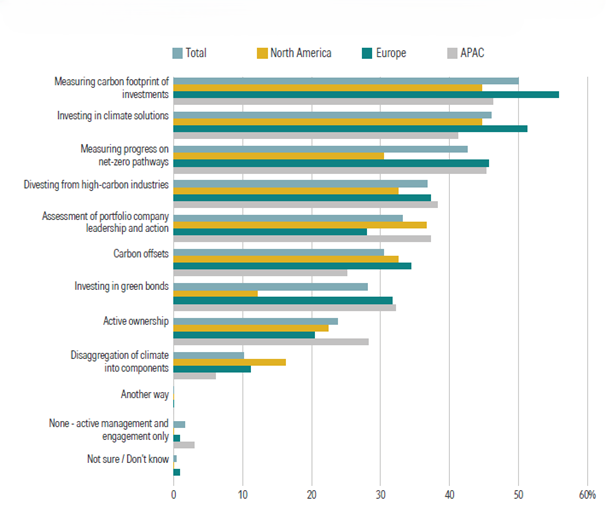
Investors are adopting increasingly sophisticated strategies to manage climate-related risks and achieve their climate goals. In Morningstar’s 2025 survey1 (see Figure 1), we found that among asset owners who view climate-transition readiness as material, 43% track progress on net zero pathways, making it the third most common approach after measuring carbon footprint (50%) and investing in climate solutions (46%). Divesting from high-carbon industries ranked fourth, cited by 37% of respondents.
These findings indicate that investors are increasingly moving away from what is often described as paper decarbonization — reducing financed emissions within their portfolio — towards supporting real-world emissions reductions.
Figure 1. Measures by Asset Owners to Promote Transition Readiness in Investments (%)
Source: Morningstar Sustainalytics and Morningstar Indexes. Data as of September 2025. For informational purposes only.
Note: Question was only applied to asset owners who indicated climate transition readiness is material.
To help operationalize investors’ climate commitments, a range of frameworks have emerged, including the Transition Plan Taskforce (TPT) Disclosure Framework2 and the Institutional Investors Group on Climate Change (IIGCC) Net Zero Investment Framework (NZIF) 2.0.3 The latter has become a widely used guide among institutional investors who rely on it to assess companies’ progress along their net zero journey.
What is NZIF 2.0?
NZIF 2.0 outlines the key components of a net zero strategy and transition plan that an investor can consider for real economy decarbonization. The framework provides guidance on categorizing the alignment of investments across multiple asset classes, including listed equity and corporate fixed income.
NZIF 2.0 provides five categories of alignment, representing “progressive steps towards alignment with a net zero pathway.”4 Using the framework, investors can categorize assets from “not aligning,” which indicates the lowest degree of alignment with global climate goals to “achieving net zero,” representing full alignment.
The framework can help investors set targets, monitor progress, engage companies, and report to stakeholders. Specifically, it can support investors in monitoring their progress towards net zero goals, and identifying and allocating capital to companies that have set decarbonization targets.
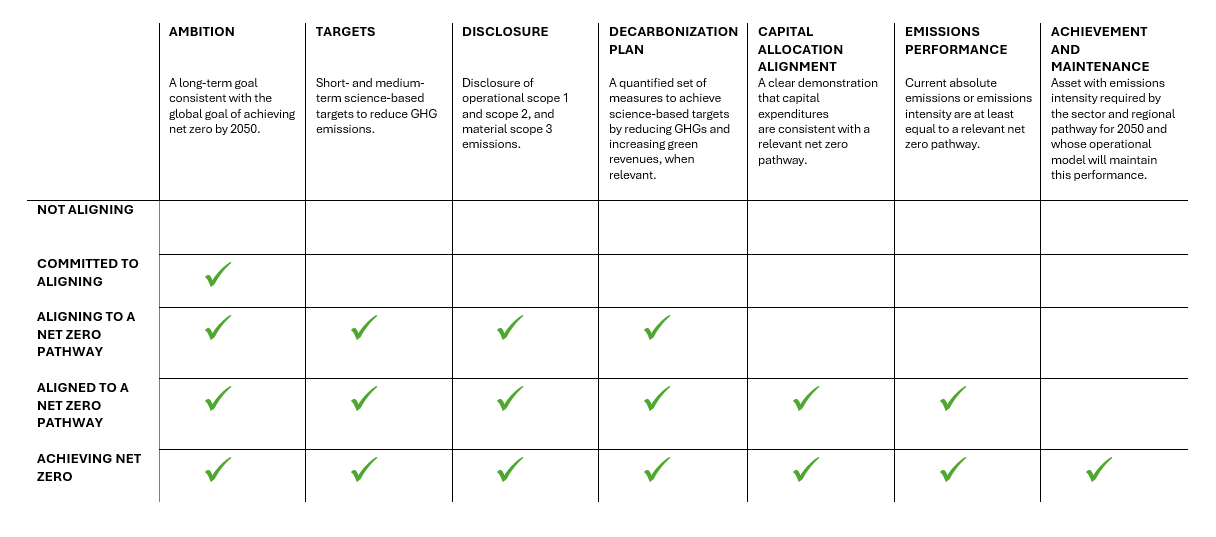
For the listed equity and corporate fixed Income asset class, each of the five alignment outcome categories outlined in Table 1 has seven criteria.
Table 1. NZIF 2.0 Criteria Underpinning the Alignment Categories
Source: Net Zero Investment Framework 2.0. Page 24. Data as of June 2024.
Note: Companies in high impact material sectors such as airlines, automobiles, industrials, oil and gas, agriculture, forestry and fishing among others, must satisfy more criteria to be classified, under NZIF 2.0, as “aligned to a net zero pathway.” The rationale is that exposure to transition risk is especially prevalent in these sectors, which are critical to overall global decarbonization.5
Consider the example of a company that has a long-term objective consistent with the global goal of achieving net zero by 2050 but has not set short- and medium-term science-based targets yet is committed to aligning. To be classified as aligning to a net zero pathway, this company must set short- and medium-term targets, disclose operational scopes 1 and 2, and material scope 3 emissions, and if the company is in a high impact material sector (see the note alongside Figure 2), have a decarbonization plan.
Companies or assets that are aligned to a net zero pathway are those that have science-based targets, a decarbonization plan, and current absolute emissions or emissions intensity at least equal to a relevant net zero pathway. This category broadly signifies that the company is managing transition risk.
Companies that are already achieving net zero targets are those that meet all the criteria mentioned above and are expected to maintain their decarbonization trajectory.
How Can Investors Use NZIF 2.0 to Support Their Strategies?
The flexibility of NZIF 2.0 means that market participants can use the framework in multiple ways, from portfolio construction and portfolio alignment assessments to engagement and stewardship, reporting, and disclosure. Clearly, the use case will drive the focus.
Asset managers looking to identify leading companies can focus on comparing how companies within a given sector and/or region fare on specific criteria, such as Ambition or Disclosure, for a contextualized view.
Alternatively, a portfolio manager looking to construct a climate transition portfolio could use the outcome categories to identify companies that are, at a minimum, committed to aligning with a net zero pathway.
For engagement and stewardship purposes, a portfolio manager or an asset owner could use the framework’s maturity scale to identify topics of engagement. For example, a company within the “committed to aligning” category could be encouraged to set interim targets, while one that already has targets and a decarbonization plan (within the “aligning” category) could be approached to discuss plans to allocate capital to enact its transition plan.
For reporting, the focus would be more on the proportion of portfolio companies that sit in each category, and on setting allocation targets at the portfolio level.
Identifying the use case when applying NZIF 2.0 will determine which data inputs and methodology supports a user’s objective.
Selecting Data for NZIF Categorization
NZIF 2.0 is not prescriptive about which indicators and metrics investors can use to determine the alignment category a company falls into. Investors can decide the number and type of datapoints to use based on their strategies, use cases, and available data.
At Morningstar Sustainalytics, we have identified 10 core metrics and 40 supplementary metrics from our Climate Transition Toolkit that can be utilized to determine alignment to NZIF 2.0. To determine if companies are aligning to a net zero pathway, for example, investors can use metrics such as GHG Reduction Target - Interim Targets, Scope of GHG Reporting, Initiatives in Place to Reduce Emissions, and Low Carbon Transition Investment.
Using different metrics may result in different category outcomes. Some investors may want to focus on scope 1 and 2 emissions and ignore scope 3, or only use verified science-based targets, while others will also consider internal transition plans.
Similarly, for the Decarbonization Plan criteria, different metrics may be used. One user may, as we have established in our NZIF mapping methodology, consider that a company meets the Decarbonization Plan criteria if it has disclosed carbon reduction initiatives for at least 50% of its operations. Others may choose a different threshold or add criteria.
Transparent and accurate data is essential, as poor-quality data and insufficiently rigorous methodologies may lead to overly generous classifications, potentially allowing companies with weak or unverified transition plans to appear credible.
Global NZIF Alignment Results Using Sustainalytics’ Dataset and Methodology
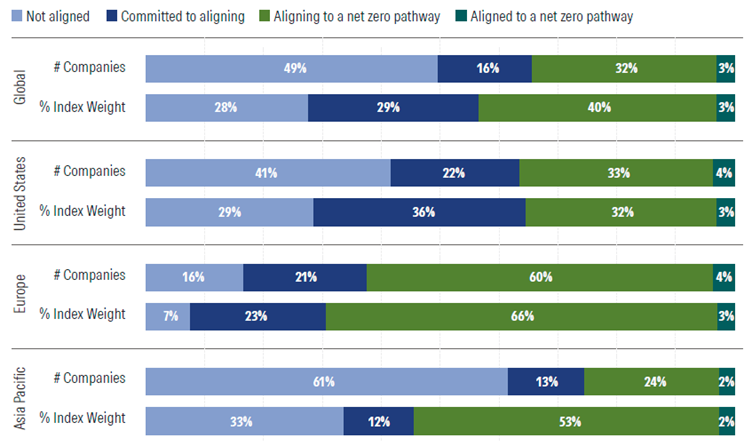
Using Sustainalytics’ dataset and research, we note that less than 3% of the Morningstar TME Global Index is currently aligned to a net zero pathway, and almost half (49%) is not aligned, meaning those companies currently have no publicly stated ambition to decarbonize on a pathway to achieving net zero. In the US, 41% of companies making up the domestic index are not aligned, while 55% are either aligning or committed to aligning to a net zero pathway (see Figure 2).
Figure 2. Geographic Comparison of NZIF Alignment
Source: Morningstar Sustainalytics. Data as of November 2025. For informational purposes only.
Note: We have used Low Carbon Transition Rating data applied to the Morningstar Global TME Index, Morningstar US TME Index, Morningstar Europe TME Index, and Morningstar APAC TME Index.
Europe shows much stronger results, with only 16% of companies within the Europe TME Index not aligned, and 81% either already aligning or committed to aligning to a net zero pathway. European companies exhibit higher alignment compared with other regions, likely due to a combination of better disclosure levels, and regulatory and investor pressure.6 In Asia Pacific, a higher proportion of the index is not committed to aligning (33%), but 53% of the index is already aligning to a net zero pathway compared to 12% that is only committed to aligning.
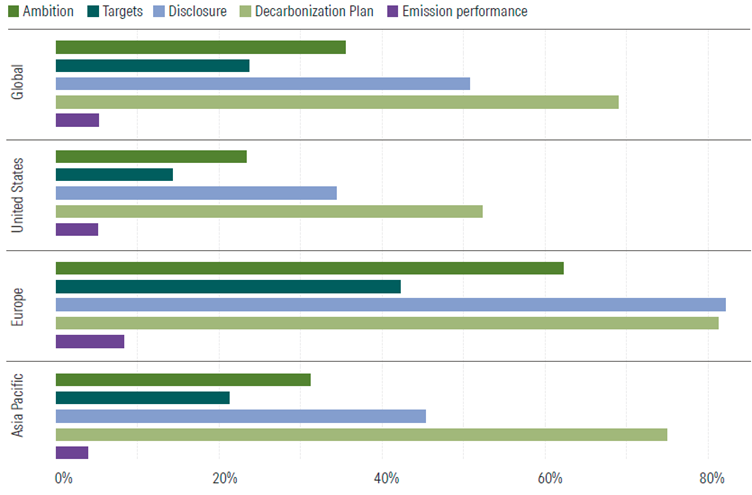
Figure 3. Proportion of Companies Meeting NZIF Criteria by Morningstar Regional Index
Source: Morningstar Sustainalytics. Data as of November 2025. For informational purposes only.
Note: We have used Low Carbon Transition Rating data applied to the Morningstar Global TME Index, Morningstar US TME Index, Morningstar Europe TME Index, and Morningstar APAC TME Index. The “Capital Allocation Alignment” and “Achieving Net Zero” criteria are not represented here because none of the companies in the relevant Morningstar TME Indexes currently meet them.
Looking more closely at the seven criteria set by NZIF 2.0 for the outcome categories, we found that across all regional variations of the Morningstar TME Index, the proportion of companies currently meeting the standard for Disclosure and Decarbonization Plan is higher than the proportion of companies meeting the standard for Ambition or Targets. This means that in every region, more companies have disclosed emissions and decarbonization plans than have set interim or long-term science-based emissions reduction targets.
European companies lead across five of the alignment criteria. Again, this likely reflects the presence of disclosure regulations in Europe compared to other regions. Companies in the US lag other regions on four of the criteria, namely Ambition, Targets, Disclosure, and Decarbonization Plan.
Meanwhile, no companies in the Morningstar TME Index currently meet the Capital Allocation Alignment and Achieving Net Zero criteria, while very few companies meet the criteria for Emissions Performance (tracking against targets). This suggests that the lower-hanging fruit of emissions disclosure and decarbonization plans have not yet led to real-world emissions reductions, which is borne out by continued increasing global greenhouse gas emissions.7
Understanding Company Context is Essential When Assessing Net Zero Alignment
In addition to the data selection, understanding how market factors can affect category outcomes is also essential when operationalizing NZIF 2.0. Companies face varying external pressures — positive and negative — around disclosing emissions, decarbonization plans, and targets.
For example, in jurisdictions where emissions disclosure is a regulatory requirement, investors can expect a higher proportion of companies to meet the Disclosure criteria (as seen previously in the case of Europe). In these jurisdictions, there may also be more companies with decarbonization plans, compared with other places. But many of these companies may still be reluctant to set short term or interim targets. In this instance, companies in fast growing sectors such as technology may consider their growth prospects too uncertain to commit to robust decarbonization targets. Meanwhile, other companies may have issues with their supply chain and may not be willing to set targets before they have identified the right suppliers.
Certain companies may perceive that there is limited stakeholder demand, including from customers and investors, for ambitious decarbonization, thus reducing their incentive to set targets. Such companies may be willing to decarbonize but prefer to wait for clearer market signals (such as a first mover advantage or other factors that would increase the financial risk of no ambitious action) before acting. Investors with portfolio companies in developing markets may also face challenges in evaluating them against the same criteria used for companies in developed markets. Differences in regional pathways due to varying national energy plans should be considered based on the investor’s objectives.
NZIF Offers a Practical Framework for Investors
As assessing alignment to net zero pathways gains traction among asset owners, NZIF 2.0 offers a practical framework to translate climate ambition into action. Yet the categories assigned to companies under the framework can be significantly influenced by investors’ data choices. To use NZIF effectively, investors should identify their core objectives, as these will guide the selection of data inputs and methodologies, the interpretation of results, and ultimately the actions they choose to take.
This article includes contributions from Hortense Bioy, CFA.
References
- Morningstar Indexes and Morningstar Sustainalytics. 2025. Voice of the Asset Owner Survey; Quantitative Analysis. https://assets.contentstack.io/v3/assets/bltabf2a7413d5a8f05/blt6e05672ec624bc67/68cae3a47b2e154a1f809a04/Voice-of-the-Asset-Owner-Survey-2025-Quantitative-Analysis.pdf.
- IFRS. Transition Plan Taskforce resources. https://www.ifrs.org/sustainability/knowledge-hub/transition-plan-taskforce-resources/.
- IIGCC. 2024. Updated Net Zero Investment Framework, the most widely used net zero guidance by investors, published as 'NZIF 2.0'. https://www.iigcc.org/media-centre/updated-nzif-2.0.
- IIGCC. 2024. Net Zero Investment Framework 2.0. June 2024. Page 22. https://www.iigcc.org/hubfs/NZIF%202.0%20Report%20PDF.pdf.
- Net Zero Investment Framework 2.0. PDF Report. June 2024. Page 23. https://www.iigcc.org/hubfs/NZIF%202.0%20Report%20PDF.pdf.
- Beasley, Pagach, et al. Managing the Risks of Climate Change – Insights into Business Practices. 2025. https://erm.ncsu.edu/wp-content/uploads/sites/41/2025/03/Managing-the-Risks-of-Climate-Change-Insights-into-Business-Practices-REPORT-1.pdf.
- European Commission’s Emissions Database for Global Atmospheric Research. 2025. GHG emissions of all world countries. https://edgar.jrc.ec.europa.eu/report_2025.